
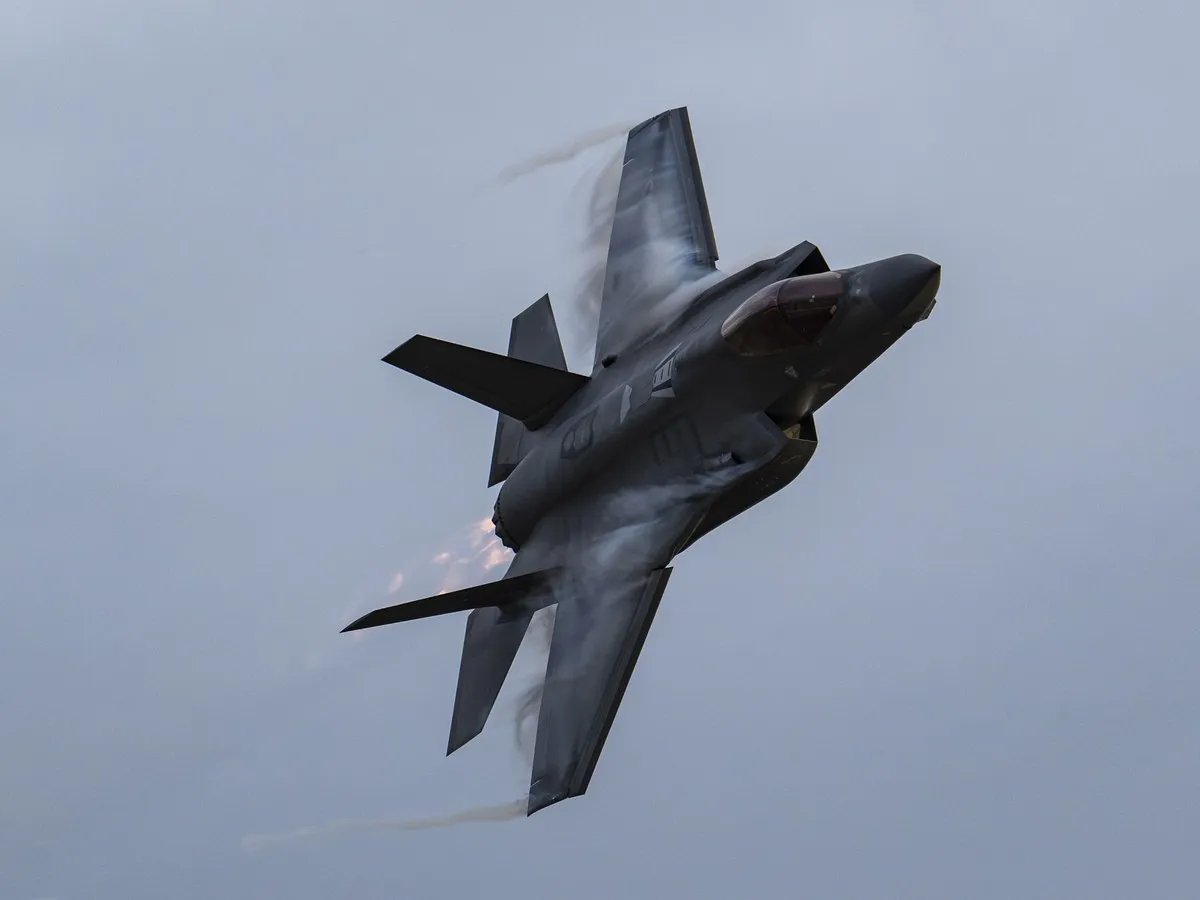
WASHINGTON, D.C. — Washington is signalling growing impatience with Ottawa’s delays on its F-35 purchase and broader defence reset.
U.S. defence officials applauded Canada’s 2022 selection of Lockheed Martin’s stealth fighter, and the plan to buy 88 of the U.S.-made jets, but political debate and shifting priorities have left only 30 under contract so far.
For years, Washington has been pushing Canada to ramp up defence spending, and there has been progress: Prime Minister Mark Carney has touted Ottawa’s plan to meet the 2 per cent of GDP target this past year. Now, the U.S. is signalling it wants Canada to stay closely aligned on defence.
That impatience is not just about the F-35. It’s about what comes next.
But how Canada’s enhanced defence budget will be spent remains an open question amid Carney’s push to make Canada less dependent upon the U.S.
“The F-35 is not an American plane,” Ambassador Pete Hoekstra said at a recent summit in Toronto. “The F-35 is what? It is an international consortium building the most advanced fighter jet in the world.”
Adding pressure for defence cooperation, he hinted that the U.S. could work well with Canada on the sixth-generation fighters.
“You may get an invitation to join the U.S. as part of a consortium to do the sixth gen on fighter planes,” he said.
“Your choice. You wanna partner with the U.S. or not? Not our decision.”
Carney’s jet review, looking at the F-35 vs. Saab’s Gripen , was meant to be completed last summer, but it continues, according to Defence Minister David McGuinty.
“We are taking the necessary time to study very, very closely the question of the fighter fleet,” he said recently.
McGuinty also said Canada is looking into whether Canada should take part in developing a sixth-generation fighter.
If they had a vote, defence analysts and military leaders would largely pick the F-35. It has consistently outperformed competitors and offers the interoperability Canada needs for NORAD and NATO.
“It really is the sort of easy button… for moving the Air Force forward,” said Richard Shimooka, senior fellow at the Macdonald-Laurier Institute, noting previous reviews have identified it as the best option.
He added that Canada’s industrial benefits from the F-35 program are tied to the number of aircraft purchased, meaning a smaller order would likely reduce long-term work and sustainment opportunities.
Shimooka expects Carney to stick with the F-35 and to procure 88 or more of them, but he doesn’t rule out the possibility of a mixed fleet.
Christopher Coates, director of foreign policy, national defence, and national security at Macdonald-Laurier Institute, also said he favours the F-35 and hopes Canada buys a lot more of them.
“I think the right answer is a greater number than [88],” said Coates, suggesting that 125-135 of the planes would be the “right sort of decision space to be in.”
But the debate is becoming politically messy.
Canadians are so fed up with the U.S., Coates said, that they’re avoiding American strawberries and instead choosing fruit from Mexico, South America, or domestic greenhouse varieties. He fears the same thing is happening to fighter jets, where the resistance has nothing to do with performance but is more about the political mood toward “Trump and all things American.”
“Canadians are applying the same sort of thinking behind strawberries as they are to fighter aircraft,” he said.
“It’s politically useful for them to … just kick the can on the F-35 decision ,” Coates said. But that can’t last forever, and he thinks Carney may be trying to ease tensions slowly.
While the elbows-up approach generated anti-American sentiment that helped the Liberals, Carney’s recent speech in New York — where he said a strong Canada can help make America great again — could be “the start of a bit of détente,” Coates said.
He noted that a mixed-fleet approach would be fine so long as it’s well-funded and involved a substantial F-35 component.
But the debate over the F-35 is not just about air combat; Canada is also deciding whether it wants a role in what comes next.
Carney’s team is reportedly mulling whether to seek observer status in the UK-Japan-Italy Global Combat Air Programme (GCAP), a sixth-gen fighter program plagued by money and timing issues that some fear could affect Japan’s commitment. British Defence Secretary John Healey recently resigned over a lack of British defence spending he feared threatened GCAP.
Hoekstra poked holes in the notion of a European partnership for Canada.
“Europe was working on sixth gen, and they’ve been working on it for more than five, maybe 10 years. The partnership between Spain, Germany, and France, poof, gone. F6 is gone. Gen 6 is gone in Europe,” he said.
“I know you’ve been looking at doing business in Europe on defence. You’re not gonna be doing it on Gen 6.”
So should Canada be looking to join a sixth-gen program and, if so, does it matter whether it opts for the GCAP or an American-led system?
For Jennifer Kavanagh, senior fellow and director of military analysis at Defense Priorities in Washington, the answers are no and no.
“Canada’s defence spending is not high,” she said, “so it cannot afford to waste money on expensive platforms that it does not need.”
She explained that sixth-gen fighters may be needed for a major power war, but she questions whether Canada’s comparative advantage is in contributing to air supremacy.
Coates disagrees.
“I think it’s a reasonable activity for government to future-proof its defence and security portfolio,” he said. “Part of that is being, for a nation with Canada’s resources and ambitions, maybe not at the leading edge, but in the next tier. So maybe not leading the development of a sixth-gen fighter, but participating in such a program would make sense for Canada.”
National Post
Our website is the place for the latest breaking news, exclusive scoops, longreads and provocative commentary. Please bookmark nationalpost.com and sign up for our newsletters here.
