
First there was a large evangelical service on the National Mall in Washington. Then came the violent spectacle of a mixed martial arts fight at the White House that exhausted all metaphors and adjectives. Next Wednesday, the celebration of the 250th anniversary of the signing of the United States Declaration of Independence will continue with a rally by Donald Trump — a familiar spectacle, but strikingly out of place in the context of commemorating the birth of a nation that is also, or once was, a powerful idea, and whose president intends to turn it into a grand celebration of himself.
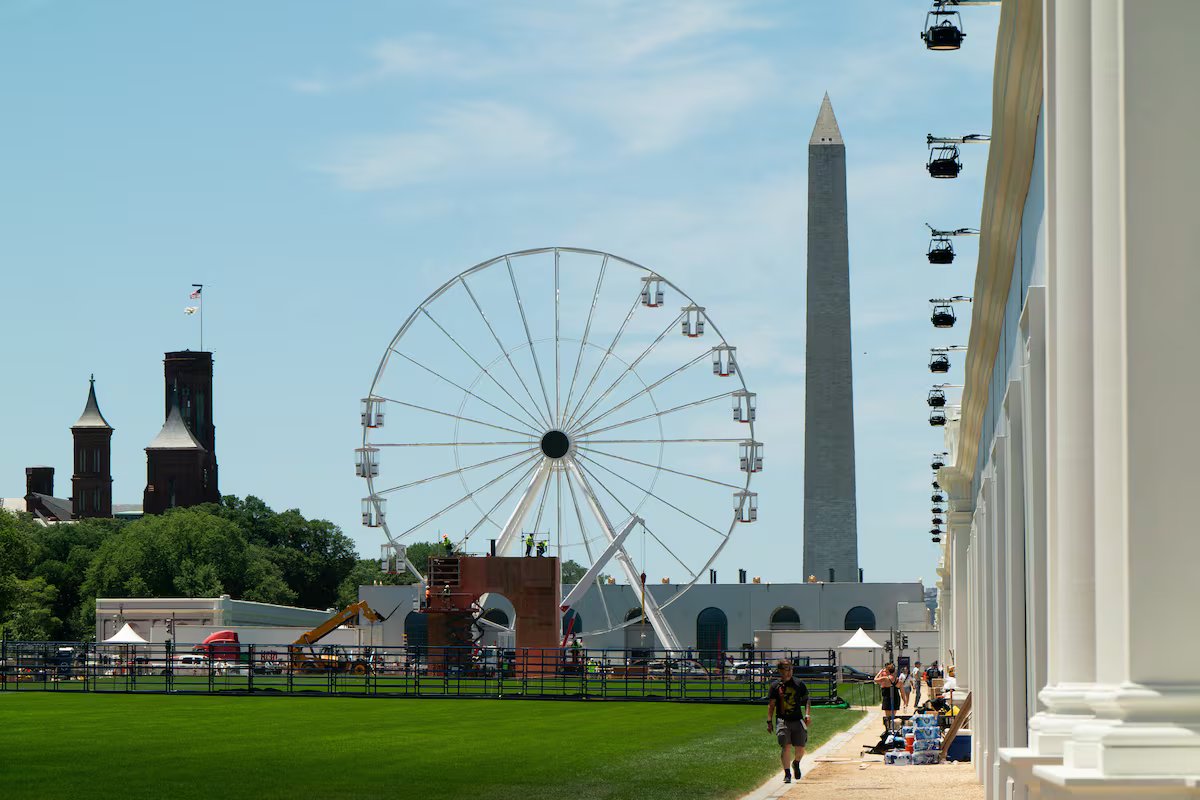
It was not meant to be this way. The organizers of the semiquincentennial had scheduled for the evening of June 24 the first in a series of concerts as a preview to the opening the next day of the Great American State Fair, also on the Mall. The fair is a free event spanning 16 days that invites presentations from the 50 states and the six associated territories.
When the list of scheduled performers — all second-tier names — began to shrink as acts withdrew, and it became clear that only two rappers, Flo Rida and Vanilla Ice, remained on the bill, Trump moved to resolve the crisis by announcing that the evening would become a partisan political event starring himself. It would be the best rally of all time, he promised.
Those musicians’ withdrawals were a protest against the hijacking of the anniversary by the current administration, whose preparations began a decade ago with the creation of a nonpartisan organization called America 250. The scandals that dogged it at the outset, Trump’s first presidency, the pandemic and the turbulent years of Joe Biden did not help its progress.
And then another group came along. Freedom 250 was created last year by executive order when Trump created a “Salute to America 250 Task Force” with the stated aim to “inspire a renewed love for American history, encourage citizens to experience the beauty of our country, ignite a spirit of adventure and innovation to help our nation succeed for the next 250 years, and invite Americans to pray for our country and our people and rededicate ourselves as One Nation Under God.”
Trump put the tech entrepreneur Keith Krach — who served as deputy secretary of state in his first administration — in charge of Freedom 250. Last Wednesday, Krach told EL PAÍS, on the site that’s been allocated on the Mall to view World Cup matches, that the seemingly neutral America 250, which has planned a large “street party” across the country and a concert in Los Angeles to celebrate July 4, “is at the disposal of” the Trump-aligned Freedom 250. He also said that if everything is taking on the tone of a large MAGA party, that was not the intention.
“Our mission is to unite Americans and people around the world to celebrate the anniversary. Americans have far more in common than differences. If there is one thing I have learned, whether in the Detroit factories, in Silicon Valley or at the State Department, it is that freedom matters. The greatest export of this great country is not a product but freedom,” Krach added.
His organization expects “between 100,000 and 150,000 daily visitors” to the Washington state fair, which increasingly looks like a MAGA celebration, including two days dedicated to the Make America Healthy Again ideals promoted by Health Secretary Robert F. Kennedy Jr.
A car race and a rodeo
There are also six 18-wheel “freedom” trucks touring the United States, and aerospace company Boeing has lent a plane (also dubbed a “freedom” plane) to carry across the country the “most precious and sacred founding documents,” which, for the first time, will leave the National Archives in Washington. In the capital, a rodeo, an IndyCar championship race and “patriotic games” for student athletes are planned, with two $250,000 college scholarships awarded in the male and female categories. The city is also slated, unless judges block it, to receive a triumphal arch and a sculpture park called the National Garden of American Heroes. Both are Trump proposals.
“Presidents have always used these commemorations to present themselves to the public as the embodiment of the values on which this republic was founded; Trump is clearly intent on turning it into a validation of the ideals of his movement,” explains historian M.J. Rymsza-Pawlowska in her office at American University in Washington.
She is the author of an essay on how the United States marked the bicentennial in 1976. That celebration is remembered as a moment of unity between the two Americas (or, at least, an agreement to set aside their differences) after the turbulent years of the Vietnam War, the rise of social movements of groups — women, Native Americans and Black people — excluded from the promises of the Declaration of Independence, and President Richard Nixon’s resignation over the Watergate scandal.
Nixon also tried to stage “a very patriotic party aimed at his supporters and his own political interests,” Rymsza-Pawlowska warns. But public resistance to those attempts succeeded in stopping him. Two commissions were also involved then, and in the end, with the commemoration in the hands of his successor, a Gerald Ford overwhelmed by circumstances, it resulted in “an extraordinary injection of federal money into a lot of nonfederal institutions,” the historian says. “Many of the most successful [bicentennial] projects were very local and allowed citizens to be involved in building their own history.”
So Rymsza-Pawlowska says that before writing off the anniversary, which the country is approaching in a decidedly somber mood and amid protests against the authoritarian tendencies of its president, attention should be paid to the programs by lower-tier institutions planning to celebrate it across the country, this time without any federal government funding.
In Washington, for example, there is an excellent exhibition at the Martin Luther King Library on the contributions to 250 years of history of its local residents (from historian Carter G. Woodson to musicians such as Duke Ellington). And the Smithsonian museums have much to offer these days, although it is difficult to give them the attention they deserve over the din coming from the White House.
And the noise is not going to stop any time soon. Trump plans to hold another rally on July 4 (once again promising it will be “the best ever”). There will also be a parade, military demonstrations and a fireworks show that aims to set records for duration. But it seems unlikely that gunpowder will produce a united country ready to set aside its differences to celebrate its 250th birthday.
Sign up for our weekly newsletter to get more English-language news coverage from EL PAÍS USA Edition
