
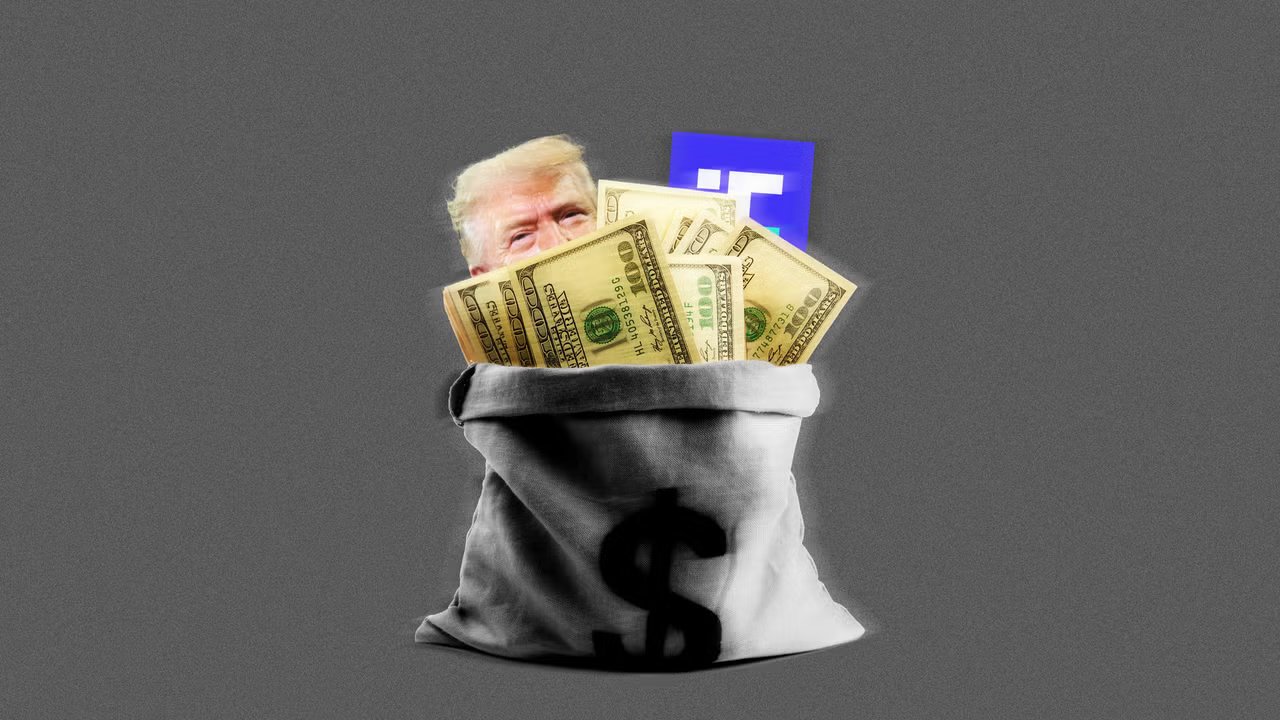
The Trump Media & Technology Group announced last week that it would soon offer a new product for financial services companies: a real-time feed of posts from the “highest-ranking” accounts on Truth Social, the right-wing social media platform that will have your laptop fan roaring like a jet engine within two minutes of opening it in a browser tab. And as compelling as the content produced by, for example, the conservative podcaster Dan Bongino might be, what’s really for sale here is premium access to insights from the only Truth Social user anyone cares about: President Donald Trump, who often uses the platform to announce his administration’s official policies in meandering, typo-ridden posts.
The service, branded as Truth API and marketed to “high-frequency and algorithmic trading firms,” advertises seamless delivery of Truth Social data within “milliseconds.” It also promises “continuous 24/7 coverage,” which means that next time Trump pulls out his phone in the middle of the night to impose a 400% tariff on whichever country he’s most recently decided he doesn’t like, subscribers can turn a profit without even waking up.
For sophisticated trading outfits, any and every edge over the general public can be extremely valuable: As documented by The Wall Street Journal, posts from Trump have prompted spikes in the share prices of U.S. Steel (after he touted a substantial foreign investment in the company), Intel (after he announced its new partnership with Apple), and American Eagle (after he expressed his vaguely horny appreciation for its Sydney Sweeney ad). In the months since Dell founder Michael Dell and his wife, Susan, donated more than $6 billion to a Trump-branded government savings program for children, Trump has repeatedly plugged the company and urged people to buy its products. In a possibly related story, Trump acquired more than $1 million in Dell stock during this period, and shares have more than tripled in value.
Trump Media & Technology Group’s interim CEO, Kevin McGurn, issued a statement expressing optimism that Truth API would “become a meaningful, ongoing source of revenue for the company” and create “lasting value for shareholders.” Notably absent from McGurn’s statement are the facts that TMTG’s stock price has dropped roughly 75% since Trump took office in 2025, and that TMTG’s largest shareholder is the Donald J. Trump Revocable Trust.
As president, Trump has always been driven by his twin desires to feel important and enrich himself. (His reluctance to disentangle himself from his various businesses is the reason we all had to spend much of his first term learning what an “emolument” is.) With apologies to Trump Mobile and his eponymous memecoin, though, Truth API is probably his most brazen cash grab yet: a product that commodifies his market-moving power as President of the United States and packages it as a de facto insider trading license available to firms willing to pay for the privilege.
Traders using data scraped from social platforms is not new; one of the reasons TMTG officials say they’re offering Truth API is to undercut companies that are selling Truth Social data already. But you don’t need to be an ethics-in-government expert to understand how Truth API is different from conventional Wall Street research tools: Here, the party making money off Trump’s posts is not some third-party vendor, but a company in which Trump himself has a billion-dollar stake.
Perhaps the most revealing aspect of Truth API, which is set to launch on August 1, is the product’s reported pricing structure: According to Reuters, TMTG has discussed charging $100,000 per month, but is also offering a discounted rate—a mere $60,000 per month—to clients who sign a three-year contract. The term length is not a coincidence; it reflects the simple fact that however valuable early access to Trump’s social media diatribes might be while he is president, it will not be as valuable when he is out of office. By inking clients to three-year deals now, TMTG is trying to lock in a steady revenue stream for the balance of his presidency, plus a few months on the back end for a little extra cushion.
Democratic politicians have said everything you’d expect them to say about our grifting president’s latest ethical misadventure. Massachusetts Senator Elizabeth Warren, for example, called it “an egregious scheme to profit off the presidency and enrich Wall Street while doing nothing to help Americans.”
In a marginally more surprising development, a handful of Republicans, perhaps wary of giving disaffected midterm voters even more reasons to be angry with the president and his party, have also expressed concerns, albeit tepidly. North Carolina Senator Thom Tillis, who is retiring, suggested that Trump could be “wading into a gray area,” which once again leaves unanswered the question of just how egregious Trump’s corruption has to get before a Republican senator is capable of seeing it in black and white. Senate Majority Leader John Thune, who is not retiring, said that his “assumption” is that Truth API would be “tested” in some way, which is best understood as a plea to reporters that they ask him about literally anything else.
In a very basic sense, it’s encouraging that lawmakers are not totally comfortable with a president profiteering off his social content. The problem, though, is that their response (at least so far) has been mostly limited to politely asking regulators who were appointed by Trump to take money out of his pocket. For example, New York Democratic Representative Ritchie Torres wrote a letter this week urging Securities and Exchange Commission Chair Paul Atkins to “promptly evaluate” Truth API’s legality. Given that Atkins is a crypto guy who has been gleefully rolling back shareholder protections since Trump appointed him last year, I suspect he will not find any problems with the arrangement.
For much of his political career, Trump has had a pretty easy time continuing to make money in ways that resemble his previous strategies for making money—attaching his name to various real estate developments, selling branded tchotchkes to his most ardent supporters, and so on. Now, though, thanks to his historic unpopularity and his lame-duck status, the supply of buttons he can push to add to his wealth is poised to dwindle rapidly. No one wants their brand-new golf course associated with a politician with a net approval rating of minus-24. There are only so many people in the world willing to pay $99.99 plus shipping for a Bible with his name on the cover.
Truth API is a result of the bind in which Trump now finds himself: a desperate, more-transparent-than-ever gambit to monetize the presidency and guarantee a cut for himself. He has more than two years remaining in office, but is less interested than ever in doing the work of governing. All he cares about is wringing every last dollar out of the experience.
