
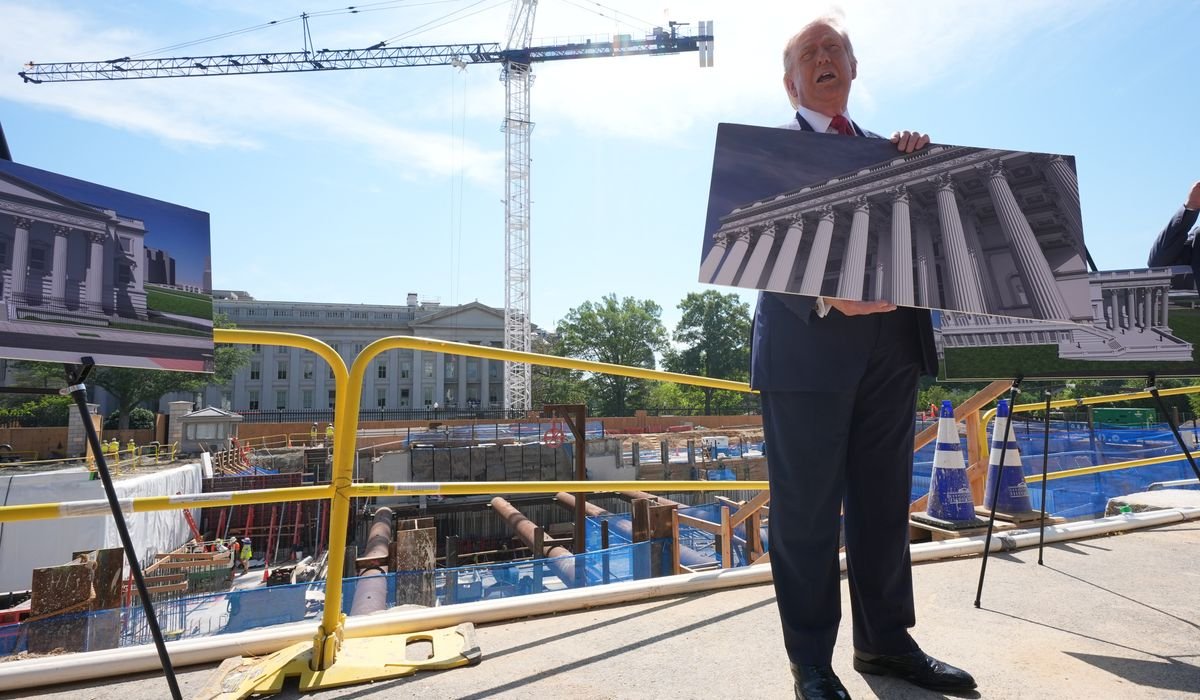
Congressional Republicans are navigating tricky political and procedural obstacles to funding security components at the new White House ballroom in a spending package for immigration enforcement that is moving through the Senate this week.
The Secret Service is requesting $220 million for “the above and below ground hardening requirements of the East Wing Modernization Project” as part of a broader $1 billion funding infusion for security, technology and training needs.
President Trump, speaking to reporters outside of the construction site on Tuesday, said the ballroom is a “gift” and that its construction “is not going to be paid for by the taxpayer.”
“This is all my money and donors’ money,” he said, but quickly added that Congress may approve some additional funding for securing the ballroom and the whole White House premises.
The president spoke about security elements of the construction project that are already underway, which may make it harder to justify to Congress why additional funding is needed.
He pointed to construction work taking place below ground and said the new East Wing will be “six stories deep” as the Secret Service and military officials will use the basement space for security operations.
“They’re building a hospital — it’s a military hospital. They’re building all sorts of research facilities, also meeting rooms and rooms that go hand in hand for the military using the ballroom,” Mr. Trump said. “The ballroom is really the shield, and protecting all of the things that are built here.”
The above-ground elements of the project are so intertwined with security that it is unclear where the private funding for the project would end and the taxpayer funding would begin.
Mr. Trump said the walls will be made of impenetrable steel and windows of 4-inch-thick bulletproof glass.
The roof will serve as a “drone port” where the military will have a 360-degree view of Washington to protect against threats, he said.
Some Republicans remain on the fence about voting for any taxpayer funding for the project, which polls show is unpopular.
“In the end, it’s going to come down to what we have the votes to pass,” said Senate Majority Leader John Thune, South Dakota Republican.
The $1 billion in Secret Service security funding is also running into procedural obstacles.
The Senate parliamentarian ruled that the money would fall under the jurisdiction of more committees than the two allowed to write the bill, according to reconciliation instructions Republicans provided in their budget resolution.
“This thing dealing with the Secret Service is partly in my committee and partly in three or four other committees, and that’s why the parliamentarian turned it down,” said Senate Judiciary Chairman Charles E. Grassley, Iowa Republican.
He said the matter had been kicked up to Senate GOP leaders to resolve.
Mr. Thune said conversations are ongoing to “figure out how to fit it within the constraints and confines of having just two committees instructed.”
The Senate Homeland Security and Governmental Affairs Committee on Tuesday approved its $23 billion portion of the package in a party-line 8-7 vote.
That includes $13 billion for U.S. Customs and Border Protection, $7.5 billion for U.S. Immigration and Customs Enforcement and an extra $2.5 billion for the Department of Homeland Security to direct where needed.
The Senate Budget Committee on Wednesday will clear that title of the bill for the floor, where the Judiciary Committee’s portion, which is still being tweaked, would be added.
Senate Republicans hope to pass the bill by Friday morning, so the House can send it to Mr. Trump’s desk by the weekend.
The GOP is using the filibuster-proof budget reconciliation process to fund ICE and CBP because Democrats would not support funding the agencies in the annual appropriations, which led to a record 76-day shutdown of DHS.
“This committee will not let Senate Democrats block paychecks for our Border Patrol and other law enforcement,” said Homeland Security Chairman Rand Paul, Kentucky Republican. “We will not let them shut down inspections for fentanyl, weapons or nuclear material. And we will not stand idly by while they defund the interdiction of child sex trafficking across the border.”
Democrats sought to overhaul ICE and CBP after federal agents killed two U.S. citizens protesting enforcement actions in Minnesota early this year.
“We are doing this whole irresponsible and hyperpartisan spending exercise because the Republican majority does not want to pass common-sense reforms that would rein in ICE,” said Michigan Sen. Gary Peters, top Democrat on the Homeland Security panel.
Democrats offered amendments toward that end, including proposals to require immigration enforcement agents to wear identification, obtain a judicial warrant before entering a private home, improve their use of force standards and receive de-escalation training for interactions with civilians and protesters.
Mr. Paul moved to table every Democratic amendment, arguing they did not comply with the budget reconciliation rules.
Democrats said the amendments had yet to be litigated with the Senate parliamentarian and Republicans were using procedural excuses to dodge tough votes.
