
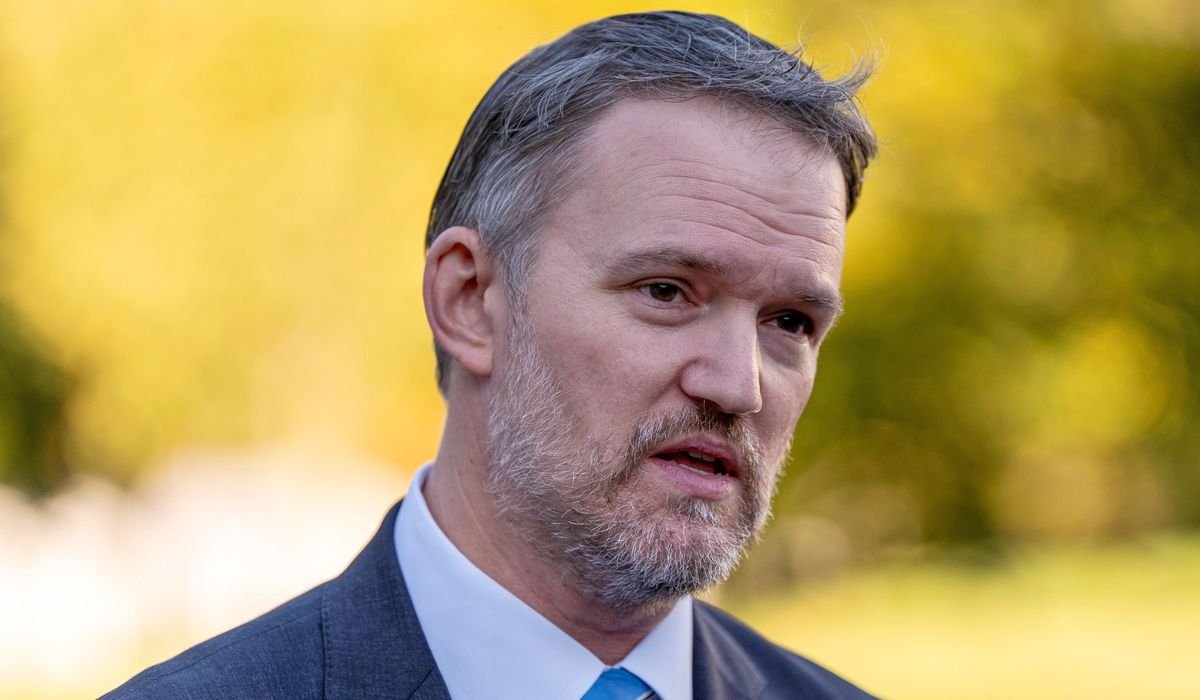
President Trump will keep tariffs at the center of his economic policy despite legal headwinds and Democratic complaints that levies fuel higher prices, U.S. Trade Representative Jamieson Greer told Congress on Wednesday.
Mr. Greer said the specific authorities that Mr. Trump is using to impose tariffs “have changed, but the trade strategy has not.”
“We are committed to continuing to use tariffs and to negotiate deals to support the reindustrialization of our economy, protect American workers and increase their wages and shrink our trade deficit,” Mr. Greer told the Senate Finance Committee.
The representative doubled down on the central plank of Mr. Trump’s trade policy five months after a Supreme Court ruling that struck down the White House’s ability to raise or decrease tariffs on individual nations under a 1977 economic-powers law.
President Donald Trump speaks during an …
more >
Mr. Trump issued a 10% blanket global tariff on all imports in the wake of the court’s ruling. Those tariffs are valid for 150 days and are set to expire Friday; Congress has not taken steps to extend them.
Instead, the president is trying to backfill his tariffs through legal provisions that let him target product sectors after conducting investigations into national security concerns or unfair and discriminatory trade practices.
The administration recently announced 25% tariffs on most Brazilian goods and 50% levies on a wide range of Canadian products, citing unfair trade practices that hurt U.S. workers.
Alongside those actions, Mr. Greer said the administration has entered 19 reciprocal or framework trade agreements that benefit American industries and workers.
Critics say U.S. consumers and importers often bear the cost of the tariffs, so the levies are self-defeating and corrosive to trade.
Oregon Sen. Ron Wyden, the committee’s top-ranking Democrat, said the tariffs have “put the cost of living crisis on steroids.”
He said he will file legislation requiring congressional approval of any tariff proposed by the president.
“It’s well past time to put Congress back in the driver’s seat on trade,” Mr. Wyden said. “I hope it will pick up support on both sides of the aisle.”
Sen. Sheldon Whitehouse, Rhode Island Democrat, said it would be in the administration’s own interests to reduce the cost burden on everyday Americans that can be traced to tariffs.
“Good luck with that,” Mr. Whitehouse said.
Mr. Trump’s latest round of levies is causing international pushback.
Canadian officials canceled an upcoming event to celebrate the opening of the Gordie Howe International Bridge between Windsor, Ontario, and Detroit.
“In light of trade action threatened by the United States earlier this week, it would be inappropriate to proceed with a celebratory event between the two countries,” Jenna Ghassabeh, a spokeswoman for Canadian Infrastructure Minister Gregor Robertson, told wire services.
The Trump administration said it took action after all but two Canadian provinces discontinued sales of American liquor, though they did not impose limits on alcohol from other countries.
Canada imposes tariff quotas on auto imports from the U.S. but not other countries, and it imposed tariffs on U.S. cheese while declining to impose similar tariffs on European Union cheese, according to a senior administration official.
Mr. Trump imposed tariffs under Section 338 of the Tariff Act of 1930, which lets a president impose tariffs of up to 50% if a country discriminates against the U.S. or burdens American commerce.
Mr. Greer said he spoke to Canadian trade officials, and “they did not say they are going to retaliate.”
He also assured lawmakers that talks to renegotiate the U.S.-Mexico-Canada Agreement would maintain market access for farmers.
Mr. Greer said he would like to map out new arrangements with Canada and Mexico before the end of the year.
“We’re moving with all due speed on all of this,” he said.
