
It’s strange how we get used to what was once extraordinary. At the start of July, two spacecraft have visited two previously unexplored asteroids, beaming back photographs and information about what are in essence, two new, small worlds. News of the encounters, which have become almost routine, have recently been made public.
To date, two dozen minor bodies in the solar system have been closely explored, and images of them transmitted. Six have been comets and the rest asteroids, including the dwarf planet Ceres. Two more have now been added to this list: Kamo’oalewa and Torifune.
Kamo’oalewa was visited by a Chinese probe, Tianwen 2. The latter’s name refers to the broader solar system exploration program, Tianwen 1, launched towards Mars in 2020 and a spectacular success. It was the first time an orbiter, a lander, and a rover were sent on the same spacecraft. All three functioned perfectly on the first attempt. The Chinese space agency also included several automatic cameras to photograph both the spacecraft orbiting Mars and the rover and lander on the surface in a famous “selfie” that went viral around the world.
Tianwen 2 is an asteroid exploration and sample-return spacecraft. Its target was a small rock orbiting close to Earth — so close, in fact, that it is considered one of our quasi-satellites. Since it was discovered by a telescope located in Hawaii, Kamo’oalewa was given a Hawaiian name, a reference to a line from a traditional Hawaiian song.
Tianwen 2’s journey took only 400 days — very short compared to the typical duration of similar missions. This is because Kamo’oalewa follows an orbit around the Sun very similar to that of Earth, and it has nearly the same orbital period: about 365 days. That’s why it never strays very far from us.
To get to it, the spacecraft used an ion engine with a very low thrust, but that is capable of operating for days on end. Rendezvous and orbital insertion maneuvers are performed using chemical thrusters, which are much more powerful.
Before launch, Kamo’oalewa was thought to be about 100 meters in size. But photos transmitted by Tianwen 2 show that it is much smaller, just shy of 99 feet, side to side. Since with its solar panels extended, the spacecraft has a wingspan of 39 feet, once it lands on the surface, it will cover almost half the asteroid. Its relative size recalls the baobab shoots the Little Prince must uproot each day to keep them from destroying his Asteroid B-612.
On such a small mass, gravity is practically non-existent. This makes it a very tricky place to land. The European probe Philae attempted to do so on the Churyumov-Gerasimenko comet. Though it was equipped with harpoons and drills to affix itself to the ground, its attempts didn’t work, with the vehicle bouncing when it tried to fall into a fissure on the meteor’s surface.
After learning from that experience, the Chinese vessel was equipped with more docking systems: four flexible feet to reduce impact on the ground, and tiny “claws” on its contact pads designed to grip small cracks in the regolith. In addition, the base of the pads is covered with a synthetic material that “sticks” to the ground, much like the feet of lizards that allow them to climb vertical walls.
To collect samples, Tianwen 2 will make use of drills mounted on its legs. They are not traditional motor-driven drill bits. Not only are they very heavy, but when they bite into the ground, they cause the entire spacecraft to be propelled upward by simple reaction. Plus, regolith dust could clog the drill bit’s flutes.
Chinese engineers have opted for ultrasonic drills on the country’s ship. These consist of a rod that rests gently on the ground, thereby preventing the rebound effect. Through this rod, piezoelectric crystals transmit high-frequency vibrations powerful enough to pulverize rock in a process similar to that of the lithotripsy equipment used to treat certain kinds of kidney stones.
With this system, Chinese technicians hope to collect around 100 grams of samples and bring them back to Earth. That’s more or less the same quantity obtained by NASA from the Bennu asteroid in 2023, and much more than Japan collected on its two previous missions in 2005 and 2018, during which it came back with less than a milligram on the first attempt and a modest five grams on the second.
When will it happen? All operations in low-gravity environments are extremely critical. Any mistake could send the spacecraft back out into space. For now, Tianwen 2 is in an orbit nearly 19 miles from the asteroid’s surface, where it has been taking the first of its photos. Over the next few weeks, it will gradually descend, first to an altitude of two miles, then to just shy of 1,000 feet, where it will identify its most suitable landing sites.
Its final approach and sample collection will take place in early 2027. Once this is done in April, it will fire its chemical engines to break out of orbit around the asteroid and return to Earth’s vicinity to release the capsule containing its collected material. It will then use Earth’s gravitational pull to accelerate toward its next and most distant target: Comet PanSTARRS, which it is scheduled to encounter in January 2035.
China announced the success of its visit to Kamo’oalewa on July 5. The following day, Japan’s space agency, JAXA, released a similar announcement. Its Hayabusa 2 spacecraft, a veteran probe with more than 12 years under its belt, had just visited another asteroid that had never been seen up close. It was so unknown it didn’t even have a name, just a number: 98943.
At the beginning of 2023, JAXA convened a public vote on the best name for the asteroid. From 3,000 proposals, a jury of nine children selected “Torifune,” from a mythological boat that was “fast as a bird and solid as a rock.”
And my, was it fast. The probe passed by it like a streak of lightning, at a relative speed of 11,000 miles per hour. It was also as solid as its namesake. The flyby took place 2,600 feet from the center of the asteroid — that is, just 980 feet from its surface. Never before had such a close encounter been carried out.
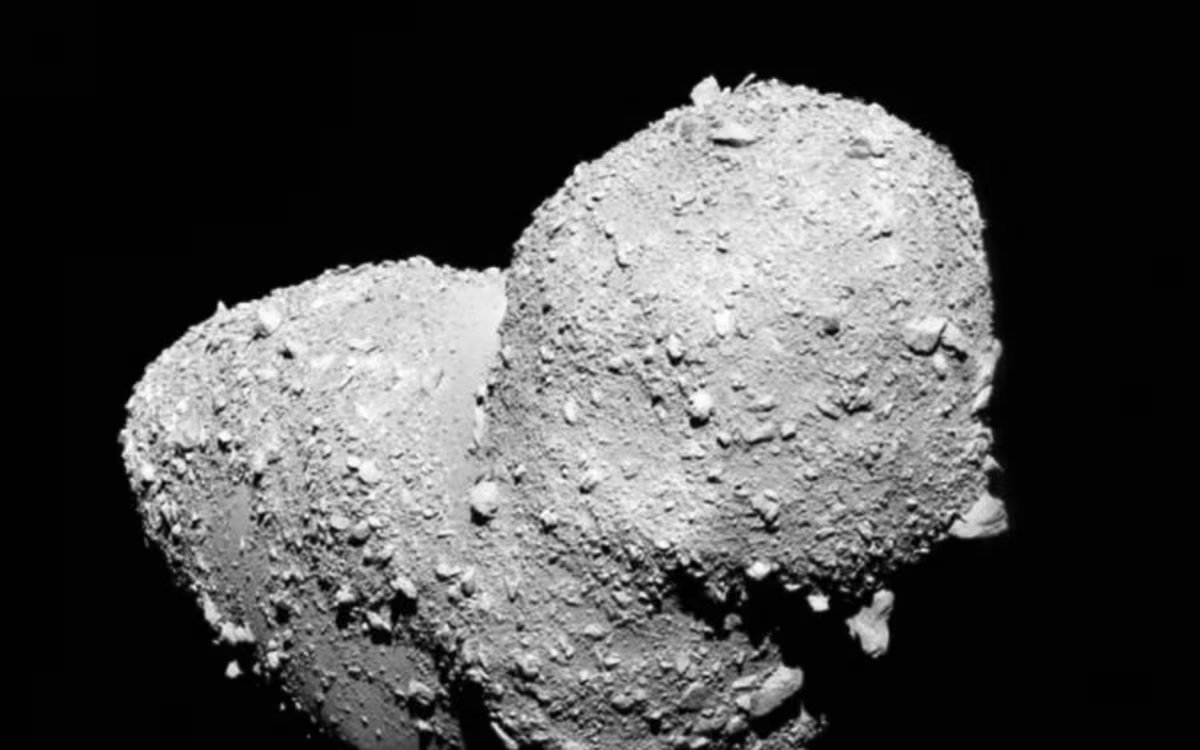
In the few seconds that the final maneuver lasted, the cameras had just enough time to take a photo of the asteroid. Cue the surprise: Torifune is peanut-shaped, almost a twin of Itokawa, the target asteroid of the first Hayabusa probe in 2005.
Both Itokawa and Torifune are masses of debris consolidated into a single body by their own gravity. They are likely fragments produced by an impact that occurred 4.5 billion years ago, during the formation of the solar system. They are what is referred to as “contact asteroids.”
While the material from which they are made originated from a violent collision, their formation millennia later was a much gentler process. Their two lobes, created by the accumulation of debris, gradually drew closer together through pure gravitational attraction. They began to orbit one another, until tidal forces and the loss of orbital energy gradually brought them together, and they made contact. They are held together by their extremely weak gravity and the friction of their materials.
Contact asteroids appear to be more common than previously thought. In addition to Itokawa and Torifune, Comet Churyumov-Gerasimenko — which was visited by the European Rosetta probe — is also a contact asteroid, possessing two nearly spherical protrusions that make it resemble (depending on one’s viewpoint) a rubber duck. That shape is similar to that of Arrokoth, the most distant object that has been observed to date, located beyond Pluto. It was photographed by the New Horizons spacecraft in 2019.
At any rate, no matter how common their morphology, it is surprising that Itokawa and Torifune appear almost identical in both shape and size (about 500 meters in length). It is difficult to tell one from the other, though this may be due to the angle at which its image was captured.
The goal was not merely to set a speed record in approaching Torifune. Almost the entire approach was carried out using autonomous guidance. Onboard cameras first detected it as a faint point of light several weeks ago, and the spacecraft’s thrusters adjusted its trajectory with exacting precision.
Autonomous navigation capability will be vital in eventually establishing an anti-meteorite planetary protection program. Years ago, a direct impact against a small rock orbiting another asteroid was already tested, and succeeded in significantly deflecting it from its trajectory. The Hayabusa 2 mission is another step in the process of achieving an autonomous protection system.
The Japanese probe’s mission, like that of its Chinese counterpart, doesn’t end here. It has two more years of space travel ahead of it, two close encounters with Earth to adjust its trajectory, and a new encounter with another asteroid that for now is known only as 1998 KY26.
It is an even smaller target than Torifune: about 10 meters in diameter, roughly the size of a bus. Hayabusa 2 will attempt to enter into its orbit, a true feat of ultra-precise navigation. From above, it will investigate the mystery of how a rock spinning wildly on its axis every five minutes is not torn apart by centrifugal force.
And, if it still has fuel left, it may be possible to land the spacecraft on that miniature world.
Sign up for our weekly newsletter to get more English-language news coverage from EL PAÍS USA Edition
