
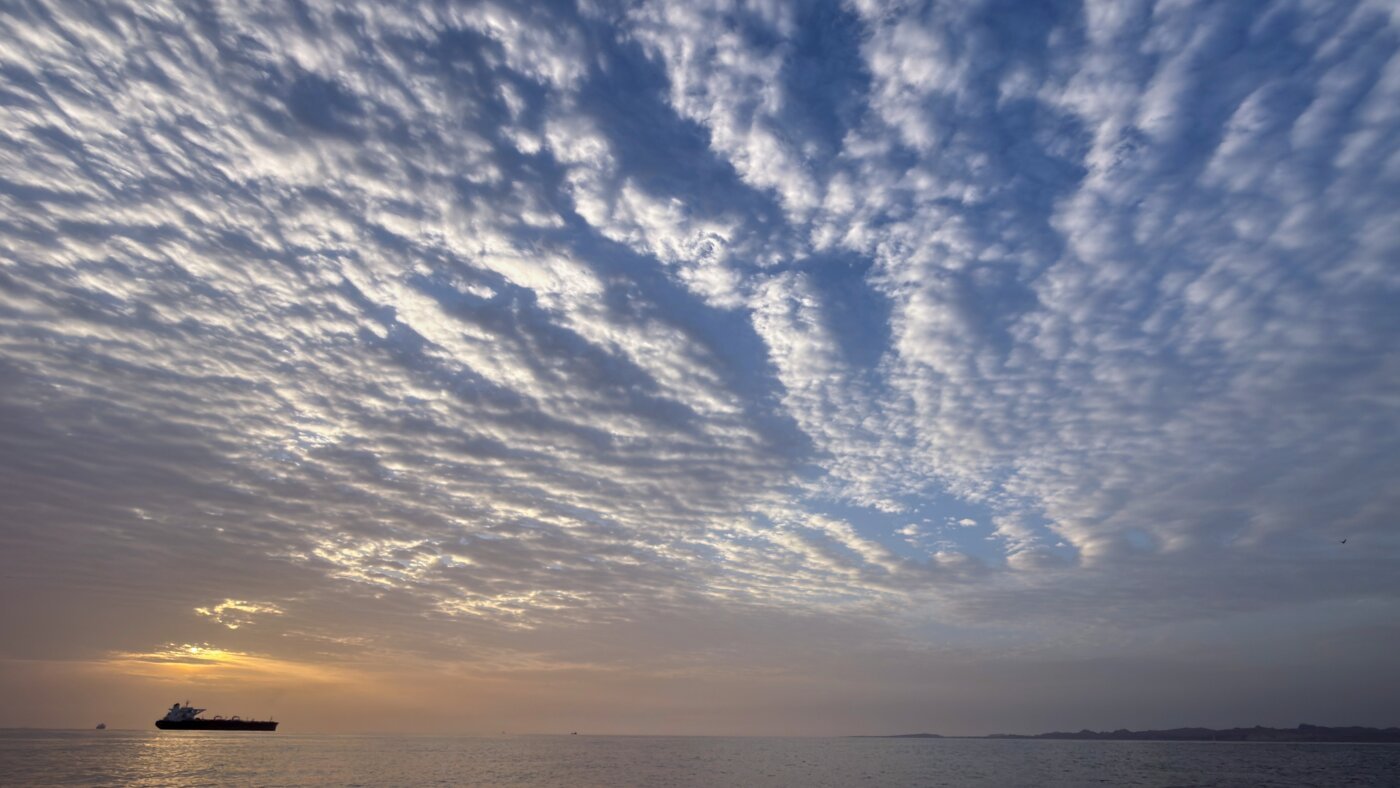
After briefly reopening the vital economic waterway, Iran has again closed the Strait of Hormuz, saying it will restrict ships from passing through as long as the U.S. continues its blockade of Iranian ports.
Iran’s chief negotiator, parliamentary speaker Mohammed Bagher Qalibaf, was unequivocal in comments made on Iranian state TV overnight, stressing: “It is impossible for others to pass through the Strait of Hormuz while we cannot.”
The U.S. military said on X that it forced 23 ships to turn around as part of its blockade of Iranian ports. About 20% of the world’s crude oil and natural gas typically passes through the narrow waterway, which Iran has essentially closed to international tankers since the U.S. and Israel launched a war on the country at the end of February.
On Sunday morning, in a post on his social media site Truth Social, President Trump wrote: “Iran decided to fire bullets yesterday in the Strait of Hormuz — A Total Violation of our Ceasefire Agreement!”
Trump praised the U.S. blockade of the strait, saying it was costing Iran “$500 Million Dollars a day” while the United States “loses nothing,” and said his representatives were going to Pakistan for negotiations on Monday evening.
He added: “We’re offering a very fair and reasonable DEAL, and I hope they take it because, if they don’t, the United States is going to knock out every single Power Plant, and every single Bridge, in Iran. NO MORE MR. NICE GUY!”
On Friday, Trump cast doubt on how the U.S. will proceed when the precarious ceasefire with Iran expires on Wednesday. Trump said the U.S. might “have to start dropping bombs again,” but has also said he thinks a deal could happen.
Here are more updates on the Middle East conflict:
Indian ships come under attack
India’s foreign ministry summoned Iran’s ambassador in New Delhi after what it said was a shooting incident that involved two Indian-flagged vessels in the Strait of Hormuz.
During the brief re-opening on Saturday, India said there was “a serious incident of firing on merchant ships.” India has urged Iran to allow Indian ships to resume safe passage across the strait as soon as possible.
On Saturday, the UK’s Maritime Trade Operations Centre also said it received a report that two Iranian revolutionary guard gun boats fired on a tanker.
It didn’t say if the tanker was Indian-flagged.
More than 20,000 seafarers have been stuck on hundreds of ships in the Gulf since the war began in late February.
In a statement released to Iranian state media, the country’s National Security Council said that Iran is “determined to exercise supervision and control over traffic through the Strait of Hormuz until the war is definitively ended and lasting peace is achieved in the region.”
French Peacekeeper, Israeli soldiers killed
The separate ceasefire between Israel and Lebanon is being tested, but still holding for now.
A French peacekeeper and two Israeli soldiers were killed in southern Lebanon over the weekend.
President Emmanuel Macron confirmed the death of French peacekeeper Florian Montorio, which he said appeared to be caused by fire from Hezbollah, and described as an attack on the UN’s peace service. The Iran-backed militant group denied any responsibility.
The Israeli military says one of its soldiers, Sgt Maj Barak Kalfon, was killed when his engineering vehicle ran over a bomb. Three additional soldiers were injured.
Another soldier, Staff Sergeant Lidor Porat, was also killed in battle in southern Lebanon and eight others injured.
Meanwhile, polls show most Israelis oppose the ceasefire, which comes as they believe their army was making progress in routing the group.
The Israel Defense Forces said on X that the day before the ceasefire came into effect more than 150 Hezbollah “operatives” were “eliminated” and approximately 300 military infrastructure sites were struck.
Since the start of what Israel calls Operation “Roaring Lion”, over 1,800 Hezbollah operatives were eliminated, according to the statement.
Eleanor Beardsley in Jerusalem, Durrie Bouscaren in Van, Turkey, Betsy Joles in Islamabad, and Diaa Hadid in Colombo, Kate Bartlett in Johannesburg, and Robbie Griffiths in London contributed to reporting.
