
The United Nations high commissioner for human rights on Wednesday said that “disappearances remain one of the most serious and painful human rights challenges in Mexico” and the Mexican state must strengthen search mechanisms and investigative capacities to “address the crisis.”
Volker Türk’s remarks came at a press conference in Mexico City at the conclusion of his four-day visit to Mexico, which included meetings with President Claudia Sheinbaum, Interior Minister Rosa Icela Rodríguez, Attorney General Ernestina Godoy, Foreign Affairs Minister Roberto Velasco and Supreme Court Chief Justice Hugo Ortiz.
I’m here in #Mexico on an official visit to meet civil society, authorities, victims of human rights abuses & families of the disappeared, and to discuss human rights challenges at national, regional & global levels. – UN Human Rights Chief @volker_turk pic.twitter.com/mDWZ8gTbtS
— UN Human Rights (@UNHumanRights) April 19, 2026
Türk’s trip to Mexico came after the U.N. Committee on Enforced Disappearances (CED) published a report earlier this month that asked the U.N. General Assembly to examine the situation of enforced disappearances in the country, concluding that crimes against humanity have been and continue to be committed here. The Mexican government rejected the CED’s report, with Sheinbaum saying that its aim was “essentially to criticize the government of Mexico” rather than present an accurate portrayal of the missing persons problem.
According to the United Nations’ own definition, “an enforced disappearance is considered to be the arrest, detention, abduction or any other form of deprivation of liberty by agents of the State or by persons or groups of persons acting with the authorization, support or acquiescence of the State.”
Sheinbaum asserted earlier this month that enforced disappearances “no longer occur in Mexico.”
Mexico’s disappearances ‘crisis’
In addition to saying that “disappearances” — note the omission of the word “enforced” — “remain one of the most serious and painful human rights challenges in Mexico,” Türk said that such cases “cause unimaginable and prolonged suffering for families.”
“They deeply erode trust between the population and the State, which is responsible for preventing, investigating, prosecuting, and punishing those responsible,” he added.
More than 132,000 people are currently listed as missing in Mexico, a country where many victims of kidnapping are never found and impunity for such crimes is exceedingly high.
After noting that he met with the families of disappeared persons in Mexico and expressed his “solidarity and empathy” to him, Türk said that “Mexico has a legal and institutional framework with great potential.”
He noted that Mexico has a General Law on Enforced Disappearance of Persons and a National Search System, but asserted that “it is essential that the State continues to strengthen search mechanisms, forensic identification processes, protection measures, and investigative capacities to address” the missing persons “crisis.”
“The recent adoption of an updated national search protocol represents an important step. Its effective implementation, together with ongoing efforts to strengthen investigative capacities, coordination among institutions, and adequate resources, will be key to achieving meaningful progress in locating the disappeared and combating impunity,” Türk said.
Mexico rejects UN findings that country’s enforced disappearances are crimes against humanity
“I recognize the political will to continue strengthening existing institutions,” he said.
“… I have observed a social consensus that disappearances are a tragedy that must be addressed. We need a national commitment that goes beyond political positions or the term of any one government,” Türk said.
“… I conveyed to the Government and all my interlocutors my Office’s readiness to provide technical assistance, support, and follow-up to these efforts.”
Protection of journalists, organized crime and pretrial detention
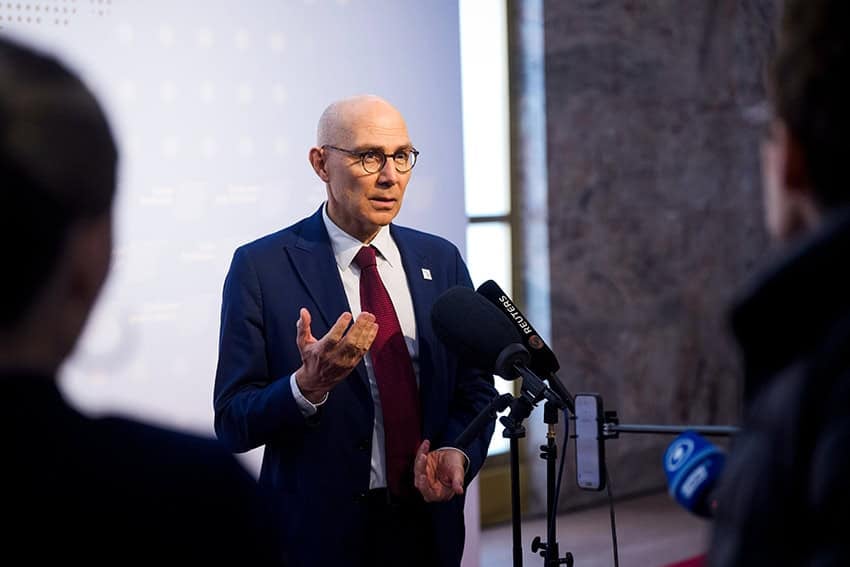
Türk, an Austrian lawyer who has worked for the U.N. for decades, commented on a range of other topics at his Mexico City press conference. Here is a selection of his most relevant remarks:
On the protection of human rights defenders and journalists, many of whom have been killed in Mexico:
“The Protection Mechanism for Human Rights Defenders and Journalists constitutes a highly relevant model and a reference in the region, particularly due to its governance structure, which actively incorporates civil society. Ensuring timely access for those who need it and strengthening its preventive capacity will enhance its effectiveness. I spoke with the Attorney General of the Republic, and we agreed on the need to increase investigative capacity following attacks against defenders and journalists.”
On insecurity:
“I am fully aware that public security remains one of the most complex challenges facing Mexican society. Organized criminal groups continue to operate in various parts of the country and have a significant impact on the enjoyment of human rights by the population.”
“I recognize … efforts made by the authorities to address violence and strengthen security institutions, within the framework of a complex and decentralized federal system, marked by high levels of corruption and institutional fragility. In this context, it is essential that security strategies continue to move towards strengthening civilian and professional institutions, fully subject to accountability mechanisms.”
On impunity:
“The issue of impunity has emerged in all my conversations with victims, defenders, and civil society organizations. It is their main demand: an end to impunity, justice for crimes committed, and effective accountability processes that include recognition of the suffering endured, reparation, and guarantees of non-repetition.”
On Mexico’s judicial reform, including the popular election of judges:
“Mexico has undertaken a broad reform of the judicial system that has increased its representativeness. It is essential that the independence of judicial institutions, their integrity, and professional competence be preserved, and that judges have effective safeguards against any undue interference.”
On pretrial detention:
“I am concerned about mandatory pretrial detention due to its impact on the presumption of innocence, personal liberty, and due process. I encourage strengthening judicial oversight, prioritizing alternative measures, and reducing its duration, always ensuring its exceptional nature and a case-by-case assessment.”
On the empowerment of women and ‘the principle of parity’:
“The Ministry of Women is also implementing numerous good practices, as the first ministry exclusively dedicated to mainstreaming gender perspectives across all public policy. Efforts to reach the entire territory, as well as to protect victims and empower all women, were very encouraging.”
“The principle of parity, enshrined in the Constitution and applicable at all levels of government and across all branches of the State, constitutes a significant advance in balancing positions of power and ensuring the full participation of women.”
Sheinbaum touts ‘very good conversation’ with Türk
Although she was highly critical of the CED’s report on disappearances in Mexico, Sheinbaum said she had a positive meeting with Türk.
In a social media post, she noted that she met with the high commissioner for human rights as well as three other U.N. officials on Wednesday.
Recibí a Volker Türk, Alto Comisionado de las Naciones Unidas para los Derechos Humanos; Matthias Behnke, director regional para las Américas de la Oficina del Alto Comisionado; Humberto Henderson, representante en México de la Oficina del Alto Comisionado; y a Allegra Baiocchi,… pic.twitter.com/q9Qv7oek43
— Claudia Sheinbaum Pardo (@Claudiashein) April 23, 2026
“We had a very good conversation and agreed on ways to collaborate. Respect and the promotion of human rights in our country is a common goal,” Sheinbaum wrote.
At her Thursday morning press conference, she said that Mexico had requested collaboration with the U.N. on issues related to Indigenous people, the protection of activists, missing persons and “many other matters related to human rights in Mexico.”
Sheinbaum said that Türk and U.N. representatives in Mexico were willing to “open all these channels of collaboration.”
She stressed that the high commissioner’s visit to Mexico wasn’t solely focused on the issue of disappearances.
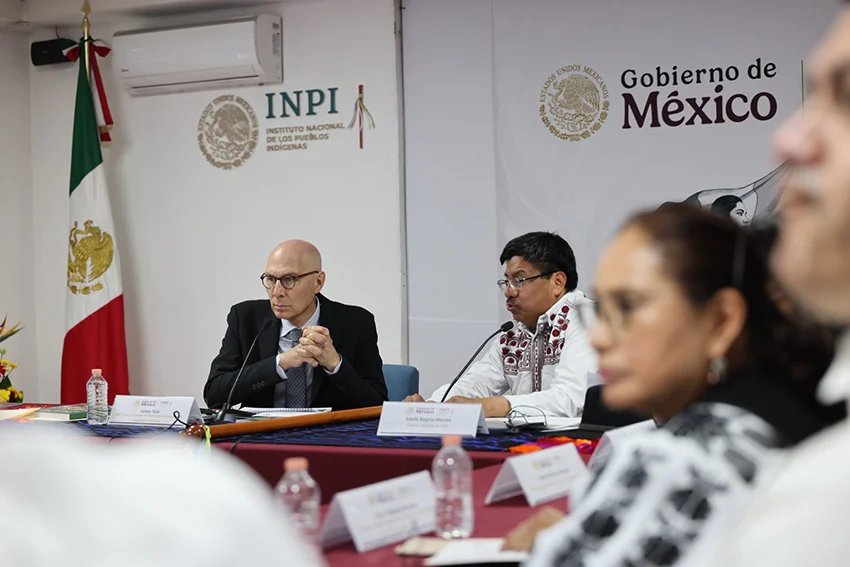
“He came to review other issues as well. For example, he went to the National Institute of Indigenous Peoples. He was very surprised about how we carry out consultations with Indigenous people, how we carry out the methodology established by the United Nations,” Sheinbaum said.
She didn’t mention that in 2019, the U.N. found that the consultation on the government’s Maya Train project failed to meet all international human rights standards.
Regarding Türk’s remarks on disappearances in Mexico, Sheinbaum said she agreed with his assessment that the issue is not one of “political debate.”
“It’s an issue of attending to victims and addressing this crime, which, obviously, concerns all of us,” she said.
Sheinbaum has said that “attending to the problem of missing persons” is a “national priority” for her government.
Mexico News Daily
