
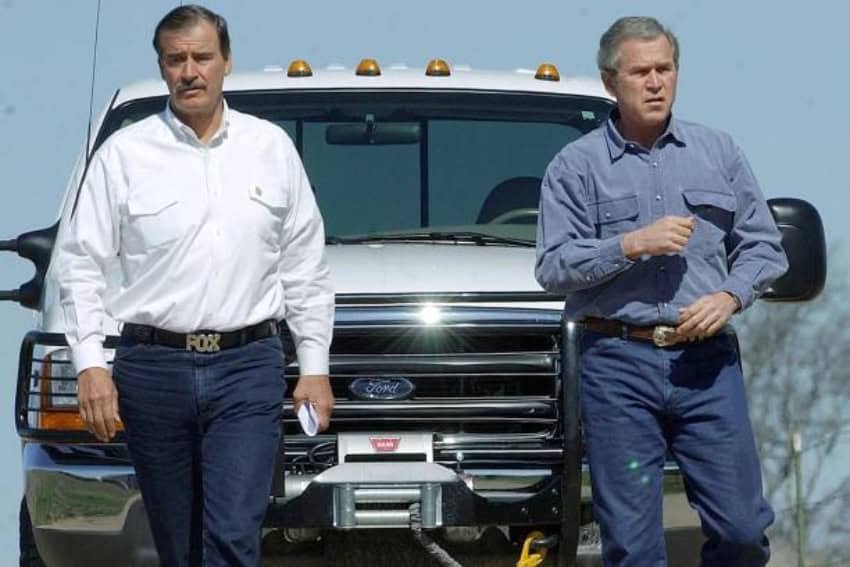
It’s February 2001, and George W. Bush is in Guanajuato, Mexico, on his first foreign trip as president. He’s there to visit Vicente Fox, the man who just ended 71 years of one-party rule in Mexico. The two leaders share several parallels: both are cowboys, both are conservative and both are new to the job. On vegetables, however, they differ greatly.
The difference nearly caused an international incident.
The two men met on Fox’s Rancho San Cristóbal, in the heart of Mexico’s agricultural export country, surrounded by fields of broccoli and cauliflower crops bound for U.S. supermarkets, through which Fox’s family had built a sizable income. Naturally, he offered Bush a plate of broccoli.
Bush gave it an immediate thumbs-down.
“Make it cauliflower,” he said. Reporters scrambled.
Had the U.S. president just insulted the Mexican president on his own land?
The short answer is no. The long answer is also no, but it deserves some attention.

A Bush family tradition
Apparently, an aversion to green crucifers ran in the family.
George H.W. Bush — the 41st president of the U.S. and father of the man now standing in a Mexican broccoli field — had already publicly declared war on the vegetable a decade earlier.
During a 1990 press conference, H.W. made his position plain:
“I do not like broccoli. And I haven’t liked it since I was a little kid, and my mother made me eat it. And I’m President of the United States, and I’m not going to eat any more broccoli.”
Like father, like son.
Birds of a feather
On paper, the duo was well matched. Both projected a certain folksiness that went over well in their respective heartlands.
Fox had just ended seven decades of one-party Institutional Revolutionary Party (PRI) rule with his 2000 election victory, although his rancher credentials were inherited at best. It was his father who had dedicated his life to the land and moved the family to a 1,000-acre ranch in the municipality of San Francisco del Rincón, Guanajuato.
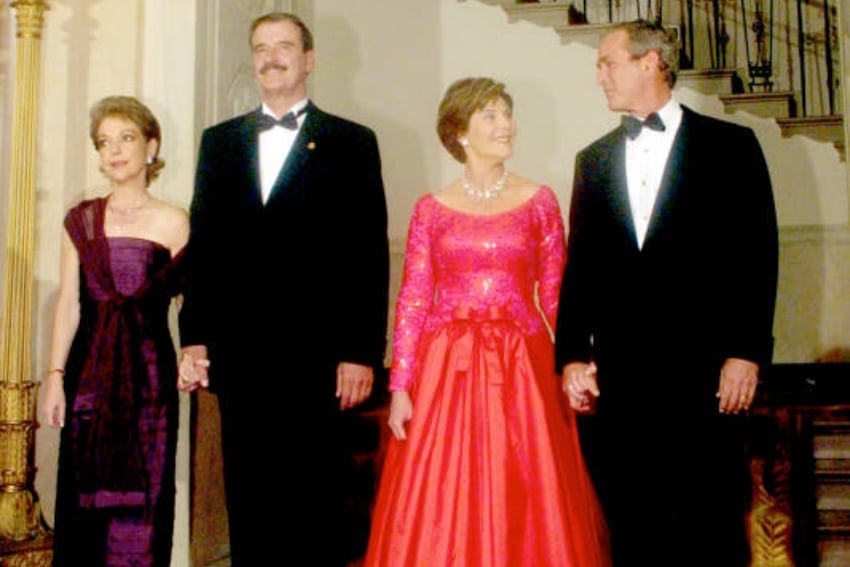
Vicente grew up to run Coca-Cola in Mexico before pivoting to politics, not that this mattered much to the electorate. Not unlike Bush’s attempts to convey a down-home image during his presidential bid, Fox campaigned in cowboy boots and a belt buckle and won the election, promising to modernize Mexico’s economy and drag its political system out of institutional stagnation.
Fox, who had campaigned not just on modernization but also openness, seemed the perfect U.S. ally. Bush’s Texas upbringing, meanwhile, gave him enough Spanish to exchange pleasantries with Fox, and he slipped comfortably into the role of a willing American suitor.
So why was Bush here, on a broccoli farm in Guanajuato, on his very first trip abroad as president?
With Fox’s election, Mexico had turned a historic page, and Washington was eager to be on the right side of it. The hope was that the two countries could enter a new era, one where a thriving NAFTA trade agreement would deepen cooperation on border infrastructure, commerce and security.
The visit to Rancho San Cristóbal was choreographed accordingly: two leaders comfortable on a ranch, figuring out the future of North America.
Fox, for his part, had an ambitious agenda ready. He pushed for what he called the “whole enchilada” — a broad deal that might include regularization for undocumented Mexicans already in the U.S., plus new legal channels for future workers. It was an audacious ask, and Bush, at least publicly, wasn’t dismissing it.
But before anything could move forward, September 11, 2001, happened.
An unraveling enchilada
The bilateral agenda Fox had staked so much political capital on shifted almost overnight. Immigration reform, the new era of North American cooperation — everything was on hold as Washington pivoted to security and war.
In 2003, as the U.S. pushed for United Nations backing to invade Iraq, Mexico held a rotating seat on the Security Council. Fox’s vote was unusually important to the U.S. president: While his vote wasn’t vital, it was symbolic.
Pressure from the White House was intense, but Fox chose to align with Mexican public opinion, which was overwhelmingly antiwar. Surveys showed 80% of Mexicans were against the invasion, shaped in part by fears of economic shock, possible border tightening and a long history of distrust for Mexico’s northern neighbor.
Outside the U.S. Embassy in Mexico City, protesters hung a banner reading “Today Iraq, Tomorrow Mexico,” a slogan that captured how many Mexicans saw the war as part of a broader pattern of U.S. interventionism.
Recovering from back surgery in a Mexico City hospital, Fox told reporters that Bush had “insistently” tried to convince him but that Mexico’s decision would be a state one, not a personal one.
Bush went ahead without him.
Now nothing more than a meme
These days, what most people remember is “the broccoli incident”: that moment at Fox’s ranch in San Francisco del Rincón when Fox offered “Dubya” some broccoli and Bush famously gave it an immediate thumbs-down, saying, “Make it cauliflower.”
The clip lives on in social media, resurrected by history accounts and meme pages as evidence that George W. Bush was, indeed, a quirky character. Mexican commentators file it alongside Fox’s other ridículos internacionales, of which there were plenty, the most notable being a leaked phone call in which Fox asked Fidel Castro to eat lunch and leave a Monterrey summit early so as not to cross paths with Bush. Castro was offended, and that blooper ended up on front pages worldwide.
Years later, in Fox’s memoir, he would describe Bush as “the cockiest guy I have ever met in my life,” and a “windshield cowboy,” afraid to ride a powerful horse.
For the record, photos of an adult George W. Bush on horseback are nowhere to be found.
Bethany Platanella is a travel planner and lifestyle writer based in Mexico City. She lives for the dopamine hit that comes directly after booking a plane ticket, exploring local markets, practicing yoga and munching on fresh tortillas. Sign up to receive her Sunday Love Letters to your inbox, peruse her blog or follow her on Instagram.
