
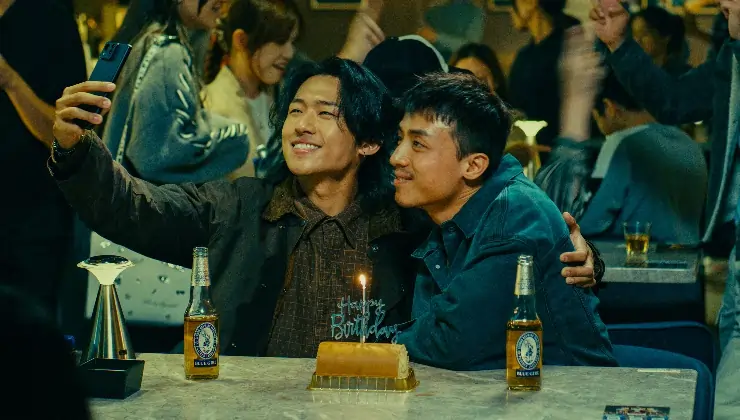
Herman Yau is a truly fascinating director. For many, he was one of the pioneers of Category III filmmaking, with bold 1990s genre films like The Untold Story and Ebola Syndrome, or he was the face of modern Chinese action cinema with a slew of features such as the Shock Wave films, Customs Frontline, and Moscow Mission. A man of many trades, his latest feature, We’re Nothing at All, marks a bold new direction for the auteur, returning to a more drama-led approach of his earlier work. However, this film is not safe and represents a significant creative risk within modern Hong Kong filmmaking.
It’s Valentine’s Day 2025, and an explosion occurs on a busy street, killing and injuring dozens of people. Detective Leung (Patrick Tam) is brought out of retirement to assist with the investigation. As he investigates, we soon learn that the explosion is tied to a gay couple, Fai (Anson Kong) and Ike (Ansonbean), who, over the course of their relationship, face abuse, homophobia, and despair as they struggle to survive in a “booming” Hong Kong.
Right from the outset, this one may be unsettling for some viewers. While its depiction of the explosion’s victims is deeply grotesque—showing corpses burnt to black, ash-ridden husks or bright red flesh smeared across the concrete streets of Hong Kong—it is the film’s exploration of homophobia, discrimination, and wealth disparity that proves most nerve‑racking. As someone who believes we should strive to ensure that everyone can live without the fear of homelessness, of being unable to put food on the table, and that everyone is treated equally.
We’re Nothing at All is a slap in the face to all these ideals, a bleak glimpse into modern reality. Seeing the housing block that Fai lives in is a grim reminder that hundreds of people still live in accommodation that is far from adequate. It would not be surprising to see a rat or another creature running down its narrow corridors. Herman Yau has produced a film that is as blunt as a machete. However, making a precise or subtle message would diminish the story he is trying to tell, which is one of brutal honesty. While a revelation in its final moments can feel like an act of added cruelty rather than added depth, the rest of the film is filled to the brim with bite and purpose, making it easy to forgive.
READ OUR EXCLUSIVE INTERVIEW WITH THE CAST AND DIRECTOR OF WE’RE NOTHING AT ALL HERE
However, even in the darkness, there is beauty and love. Watching Fai and Ike form a genuine bond and connection is nothing short of beautiful. In particular, a scene where Fai confides in Ike about his past is deeply emotional and heartfelt. Similarly, when we explore Detective Leung’s past and uncover the reason he was forced into early retirement, what initially comes as a shock ultimately becomes a story of acceptance and understanding. At its core, We’re Nothing at All is about becoming better people, and how love and acceptance, while not a cure for society’s problems, are the crucial first steps toward making the world a better place.
Allowing the film’s themes to flourish as effectively as they do are the strong performances. Tam is excellent as Detective Leung, a role that could have easily fallen into cliché but instead feels deeply nuanced, elevating the film’s themes of acceptance through his performance. Kong and Ansonbean are also marvellous as Fai and Ike, respectively, making every aspect of their characters feel believable. We understand why ending their lives in an explosion is an inevitable outcome rather than a shocking revelation. Their performances evoke both sympathy and understanding, showing that they were driven down this path, not by their own nature, but by a society that led them there.
Despite being locked in what seemed like an “action jail” for the past few years, Herman Yau has continued to evolve as a director, with the film feeling like the culmination of decades of work. At times, the film can feel slow, but this seems intentional. We are given time to sit with the characters and understand every action they take. Alongside cinematographers Mandy Ngai and Hing Wa Siu, Yau brings a new vision of Hong Kong to life—one that many fans of the cinema have never seen before. It is bleak and dark, yet there is an organic beauty to it. The colour grading is also striking, beautifully showcasing the vibrant tones that flood every inch of Hong Kongers’ lives.
We’re Nothing at All is a bold and dramatic piece of modern filmmaking, delivering a film that lingers with me days after watching it. Herman Yau’s first self-financed project is a confident work. Despite its bleak tone, by the time the credits roll, accompanied by Candy Lo’s “God Bless” as the title appears on screen, it is hard not to feel overwhelmed and begin to question whether I, too, am a snowflake in an avalanche, hoping to blame something else when I may also be a cause of tragedy. Truly exceptional filmmaking.
★★★★ 1/2
In UK cinemas from 29th May, previews 23/24th / Anson Kong, Ansonbean, Patrick Tam, Pak-Him Chu, Rachel Leung / Dir: Herman Yau / Trinity CineAsia / 18
Discover more from
Subscribe to get the latest posts sent to your email.
