
When a Cuban person on the island wants to refer to “those in charge,” they lightly tap their shoulder with two fingers. The subtle gesture, shaped by nearly seven decades of censorship, is a reference to the epaulet of a military uniform. In Cuba, people do not speak of the government or the party (the Communist Party of Cuba, the only legal one), but rather of the “country’s leadership.” It is a euphemism that points to the real political and economic power: the Revolutionary Armed Forces (FAR).
It is hard to imagine. But the hydra whose innards holds a parallel economy to Cuba’s — with multimillion‑dollar reserves in tax havens and accounts the government cannot audit — has its headquarters in a building with no name on its façade, on Avenida del Puerto, a road that runs along Havana Bay. It is the Grupo de Administración Empresarial, SA (GAESA), a military conglomerate that controls practically half of the island’s GDP. In one of his latest speeches, U.S. Secretary of State Marco Rubio pointed directly at the holding company: “Cuba is controlled by GAESA.”
The olive-green corporate empire monopolizes almost everything. The best way to sum up its reach is with Cuban sarcasm: “If dollars are involved, GAESA surely runs it.” Its portfolio ranges from hotels, transport, gas stations, and construction to wholesale and retail trade, telecommunications, remittances, foreign trade, and the Mariel Special Development Zone. And the crown jewel: the Banco Financiero Internacional (BFI), which handles Cuba’s international transactions. It also holds the accounts of diplomatic staff, embassies, foreign corporations in the country and the earnings of medical missions, which until a few years ago were the state’s main source of foreign exchange.
The U.S. order to fine Spanish companies that “traffic” with GAESA amounts to an invitation to leave the island and represents a shift in paradigm for a nationalized economy that could become market-based. Business sources very close to the Cuban government point to U.S. motives behind those sanctions. “They want to take over the Galician business” (referring to Spaniards who emigrated to Cuba at the end of the 19th century from the Spanish region of Galicia).
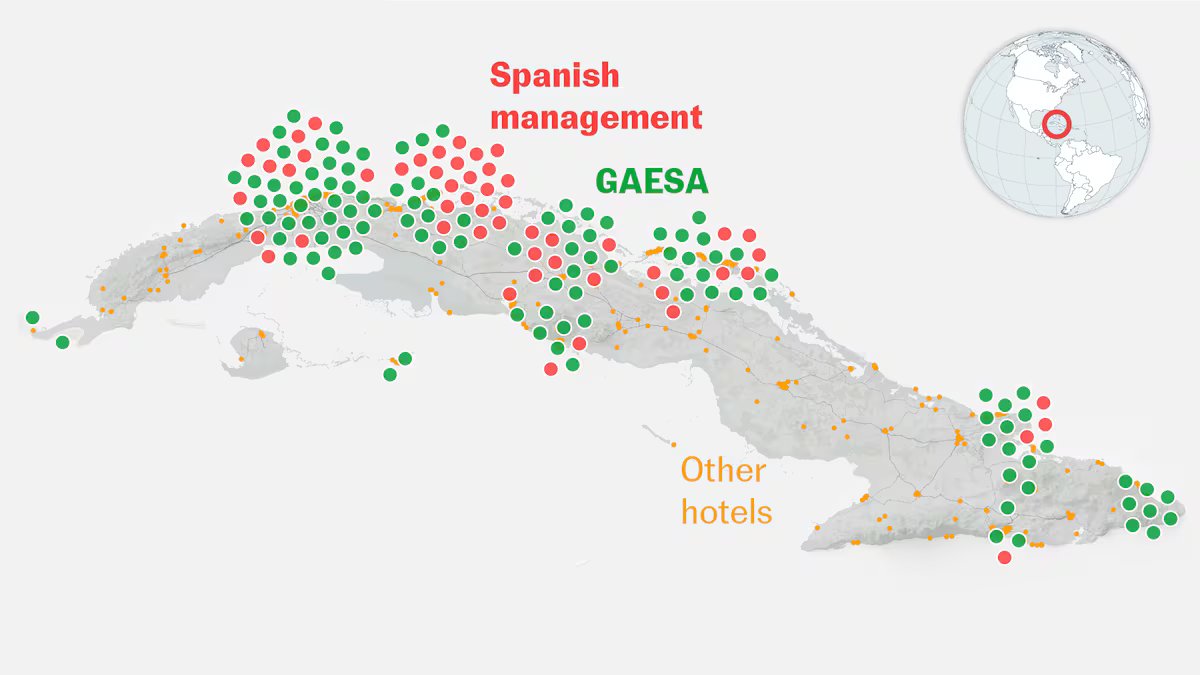
GAESA’s most important presence is in the hotel industry, which is one of the government’s main sources of revenue. Of the 120 hotels owned by Gaviota, the group’s hotel division, 62 (56.3% of the total) are managed by Spanish chains. Leading the list are Meliá, with 33 hotels, and Iberostar, with 18. The Meliá hotel chain prefers not to comment on the situation in Cuba, given the high degree of uncertainty. But the combination of power outages, difficulties in securing supplies of food and beverages, and the loss of air connections from Canada — the largest source market — has led it to have half of its hotels closed at the moment due to lack of demand.
Iberostar operates 18 hotels and, since May 2025, has run the largest in Cuba: a 42-story property with 600 rooms and a state-backed investment of $232 million. The opening of this property received barely any public attention in Granma or other state media. This was due to the difficulty of advertising such a large expenditure amid an economic and energy crisis in Cuba that is beginning to take on humanitarian dimensions.
It was not the only major investment. The key point is that GAESA owns the properties, and in a hypothetical scenario of economic opening led by the United States, management contracts with Spanish chains could be unilaterally terminated and transferred to U.S. giants such as Marriott, Hilton, IHG, or Hyatt, which would find a new destination to serve the millions of travelers enrolled in their loyalty programs (Marriott alone has 271 million Bonvoy members).
Spain’s Secretariat of State for Trade says it is monitoring the situation in coordination with the Spanish Economic and Commercial Office in Havana. “This work also includes continuous contacts with some of the potentially affected companies to learn their specific situation, identify possible risks and support them in evaluating scenarios,” says the department, which depends on the Ministry of Economy. “The objective is to maintain direct dialogue with companies, anticipate potential impacts, and facilitate the capacity to respond to any developments.”
That scenario in which the U.S. could move to take control of the tourism sector because of its sizeable returns is no longer far-fetched. A clear example came on May 21, when Canadian miner Sherritt International, which had a joint venture with the Cuban government, announced a non-binding agreement under which Gillon Capital, a company linked to a former adviser to Donald Trump, could buy a 55% stake in the company. The decision was allegedly made under pressure from U.S. authorities and the threat of possible sanctions if they did business with GAESA. A stark warning to Spanish hotel chains.
GAESA was born in the 1990s, in the wake of the Special Period, the severe crisis after the collapse of the Soviet bloc. Reluctantly, Fidel Castro opened the economy slightly. He allowed tourism and decriminalized possession of the dollar. The firm emerged as a way to finance the military amid the economic collapse. The absorption of much of the state apparatus happened progressively when Raúl Castro, who had served as minister of the Revolutionary Armed Forces for half a century, assumed the presidency in 2006.
That is how Emilio Morales, president of Havana Consulting Group in Miami, sums it up: “GAESA was not powerful. It had a modest market share in Cuba. But it made its power play in 2016 when it absorbed the BFI, by an order signed by Raúl [Castro],” he says in a telephone interview.
No one knows who runs the holding. Its accounts are secret. Neither senior government officials nor state media mention it. Not even when the United States has sanctioned it, most recently in early May. In 2025, a small part of its economic empire was revealed. The Miami Herald obtained, through a leak, financial statements for March and August of 2023 and 2024. Renowned economist Pavel Vidal, who worked at Cuba’s central bank, analyzed the documents and concluded the group accounted for 40% of the economy.
In a telephone interview, Vidal laments how little is known about the conglomerate’s profits and says that, from the scant information available after the leak, it is clear GAESA operates as an economy separate from the country’s political and civil structures. “It is clear where the revenues come from. It is known that those revenues are, in part, in bank accounts, but it is not clear what is done with the profits,” he says. In an interview with the Spanish news agency Efe in May 2024, then-Comptroller General of Cuba Gladys Bejerano acknowledged that the state had no jurisdiction to audit GAESA. She was dismissed two months later. She had held the post for 14 years.
According to 2024 accounts, the conglomerate had liquid assets of $14.5 billion. However, in a recent study, the Economist Intelligence Unit said that by the start of the year, the holding’s reserves, hit by Cuba’s tourism crisis and sanctions, were below $1 billion. “Now [in 2026] I wouldn’t know how much money they have anymore because, obviously, GAESA has been affected like the rest of the country’s economy,” Vidal says.
As with many things in Cuba, all roads lead back to the Castro family. The military hydra was built by a man entirely trusted by Raúl: his late son-in-law, Luis Alberto Rodríguez López-Calleja. He is also the father of Raúl Guillermo Rodríguez, better known as “El Cangrejo” (The Crab), the former president’s favorite grandson, ex-head of security, and the bridge between Havana and Washington in the most recent contacts with the White House. Rodríguez has been present at the forefront of high-level negotiations without holding a formal post in the Communist Party, the government, or the Armed Forces. He was also part of the select group that recently met with CIA Director John Ratcliffe in Havana.
Little is known about GAESA’s lifelong chief executive, who died in 2022. It is as if the conglomerate’s secrecy were mirrored in its CEO’s persona. At the time of his death, international agencies struggled to find a photo of the man who steered the military giant. It is known that Luis Alberto Rodríguez López-Calleja was born in 1960 in the central province of Villa Clara, that he was the son of a comrade-in-arms of Fidel Castro in the Sierra Maestra, and that he studied business administration in the Soviet Union. On its website, the Communist Party highlights his time in military counterintelligence. In a note in the communist newspaper Granma, the paper said the funeral of Raúl Castro’s former son-in-law took place “without fanfare or unnecessary protocol, just as Luis Alberto was in life.” In an unusual move, Raúl Castro appeared in state media eight days after his former son-in-law’s death during a tour of the Mariel Special Development Zone, another of GAESA’s lucrative businesses.
The military’s economic empire is also visible in the landscape: large luxury hotels that stand out beside ruined buildings and streets piled with garbage. It is the contrast left by a gamble that has failed. The diplomatic thaw with Cuba during Barack Obama’s administration (2009–2017) sparked the conglomerate’s voracious appetite for building huge five‑star tourist complexes.
Over the years, even after the first Trump administration resumed hostilities against the island, GAESA continued erecting hotels. The sharp drop in tourist arrivals did not halt the construction boom. In 2024, the last year with annualized data, almost 40% of state investments were concentrated in that activity. That figure is 11 times greater than what was allocated to education and health combined, according to official statistics analyzed by Efe.
For Morales, GAESA’s activities have broken the social pact of the Cuban Revolution: “Before becoming an octopus that absorbs everything that smells of dollars, Cuba took away the people’s basic rights in exchange for meeting their needs. But now it has gone from being a socialist state to a mafia state.”
Sign up for our weekly newsletter to get more English-language news coverage from EL PAÍS USA Edition
