
THE LATEST:
- About 150 structures have been damaged or destroyed by the Bald Range fire, according to preliminary estimates from the Regional District of Okanagan-Similkameen.
- More evacuees from in and around Summerland returned on Sunday, and officials say they hope more will return in the coming days.
- The B.C. Wildfire Service (BCWS) says firefighting efforts on the Bald Range fire are expected to shift northwest, and it’s expecting hotter and drier conditions in the coming week.
- About 130 wildfires were burning throughout B.C. as of Monday morning, most of them sparked by lightning.
Regional district releases estimate of damaged or destroyed properties
The Regional District of Okanagan-Similkameen said Monday evening that about 150 structures have been damaged or destroyed by the Bald Range fire.
Graham Statt, chief administrative officer of the District of Summerland, said about 40 of the structures were in the municipality’s boundaries.
“It’s a rough number, it’s a live number,” said Statt.
At the moment, it’s unclear what kind of structures were damaged and officials were unable to say how many, if any, were homes.
Statt said efforts are being made to contact the property owners.
Summerland damage assessments complete
The mayor of Summerland says that damage assessments have been completed as more of his community’s residents return after being forced to flee due to the out-of-control Bald Range wildfire that was sparked on Aug. 7.
Around 22 per cent of the 5,500 properties that were on evacuation order due to the wildfire in the south Okanagan are now on evacuation alert instead, Summerland Mayor Doug Holmes said on Sunday.
The Regional District of Okanagan-Similkameen said the alerts are in effect for properties east of Highway 97 and the Trout Creek neighbourhood on the west side of the highway.
Holmes said that he hopes more evacuees return in the coming days, but fire conditions could change at any time.
“The reason we’re able to bring people back to Summerland is it’s growing away from Summerland,” he said of the fire. “But you know, the winds could change and … you never know, the fire could turn on itself.
“So we just need to be vigilant and not get ahead of ourselves.”
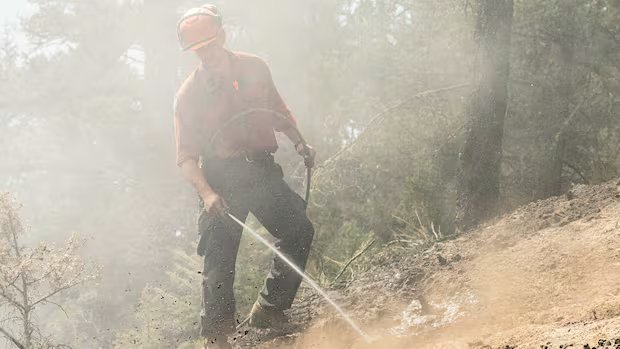
Hugh Murdoch with the B.C. Wildfire Service said crews are still busy clearing up hot spots in Summerland, and that they’ve had success in knocking down the fire perimeter closest to the communities.
He said residents can expect firefighting efforts to shift northwest, where blazes are burning into more forested areas, as hotter weather and drier conditions linger.

In an update on Monday, the BCWS said the northwestern portion of the fire near the Princeton-Summerland Road corridor has been a challenge but there’s still “considerable distance” separating the fire from the community.
It said residents can expect to see smouldering ground fire and smoke from within the fire perimeter over the coming weeks.
“This is common following large wildfires and is typically not a concern. Smoke rising from green, unburned fuels outside the fire perimeter should be reported,” reads the update.

Holmes acknowledged frustration from residents who don’t yet know if their properties survived the fire, but said they will start getting notified and being provided support now that damage assessments are complete.
“There’s still work to be done to get everybody back, but we should get most people back, you know, fairly soon,” he said.
‘A bittersweet joy’ to come home
For many residents, the road to recovery will be a long one.
Roie Manoff, a fighter pilot turned winemaker, has described the fire as being brutal, stormy, fast-moving and immense as it roared through town.
Manoff, the owner of Silkscarf winery, said the fire has left a lasting scar for many, as his friends and colleagues lost their homes.
He said he has weathered many storms in his life, and after more than two decades in business, he understands it would be a losing battle to fight nature.
“We have to understand that that’s probably a new norm. We have to be prepared,” Manoff said. “We have to be able to provide updated, reliable information to anyone in need … and cross fingers that one day things will be better.”

For Connie Denesiuk, returning to her Summerland home on Sunday was “bittersweet.”
“It’s sort of a bittersweet joy because we know that some of our other neighbours aren’t home yet and, you know, we feel for them,” she said on Daybreak South on Monday.
Denesiuk said she came home to “not as many dead plants as I anticipated,” and was able to successfully factory-reset her fridge.
“We understand that anxious feeling and just waiting to find out what they [will] learn when they do arrive home. So our thoughts are with them.”
Smoke to linger as winds remain light: BCWS
The BCWS said over the weekend that smoke will continue to linger in central and southern B.C., and winds will continue to remain light to start the week.
“The coming week the province will continue to see hotter temperatures and drier conditions with the exception of the far northwest part of the province,” it said.
Environment Canada said large swaths of southern B.C. are under either an orange or a yellow air quality warning due to wildfire smoke.
The weather agency says the areas are being impacted, or are likely to be impacted, by smoke over at least the next two days.
After the explosive growth of wildfires throughout B.C. last week, firefighting help arrived from other Canadian provinces and even from places like Mexico and Australia.
Blake Ross, the agency representative for the Australia-New Zealand contingent of firefighters, said there were 40 firefighters from his region that are tasked with tackling fires.
Ross said that conditions remain dynamic around B.C.’s most concerning fires, and that the weather shifts by the hour.
“It comes into a patch of dry fuel, and then you see these fires take off and building size quite quickly,” he said of the fire behaviour. “That sort of sort of stuff doesn’t really happen as much in Australia. You know, it’s more consistent.
“This seems to be a little bit more erratic than what we’re used to.”
He spoke to CBC News on Sunday near the Bald Range wildfire, which continues to burn out of control and was mapped at over 212 square kilometres as of Monday morning.
In other wildfire locations in the province, the Thompson-Nicola Regional District said it would be accepting all fridges and freezers this week free of charge from residents who have been allowed to return to evacuation zones in the Village of Clinton and surrounding areas.
On its website, the district said the appliances do not need to be cleaned out, but requested that they be sealed before being brought to the Clinton Eco-Depot for disposal.
The District also recommended residents who do not wish to dispose of their appliances to double-bag spoiled food, dispose of them as regular garbage, and use personal protective equipment while cleaning.
Food has been rotting in the appliances since the power went out and the Pear Lake fire threatened the communities last month.
The Pear Lake wildfire near Clinton is the province’s biggest active wildfire, at more than 1,600 square kilometres as of Monday.

Meanwhile, the Brunswick Creek fire complex near Boston Bar, which is made up of the Brunswick Creek fire and the larger adjacent Ainslie Creek fire, covers more than 740 square kilometres.
Those fires continue to burn out of control, and Highway 1 in the Fraser Canyon continues to be closed as a result.
