
Long before thousands of U.S. troops disembarked at the naval base in Rota in the province of Cádiz, other Americans were arriving at the capital’s port laden with wheat, flour, or rice. They came from Philadelphia, Baltimore, or Boston, sailing under a flag as new — the Stars and Stripes — as it was advantageous, given its neutrality in a Europe mired in various wars. That relationship was so intense and profitable that the United States opened one of its first consulates in Spain in Cádiz in 1790, alongside the one in Bilbao, just seven years after the Spanish Crown officially recognized the independence of the former British colony.
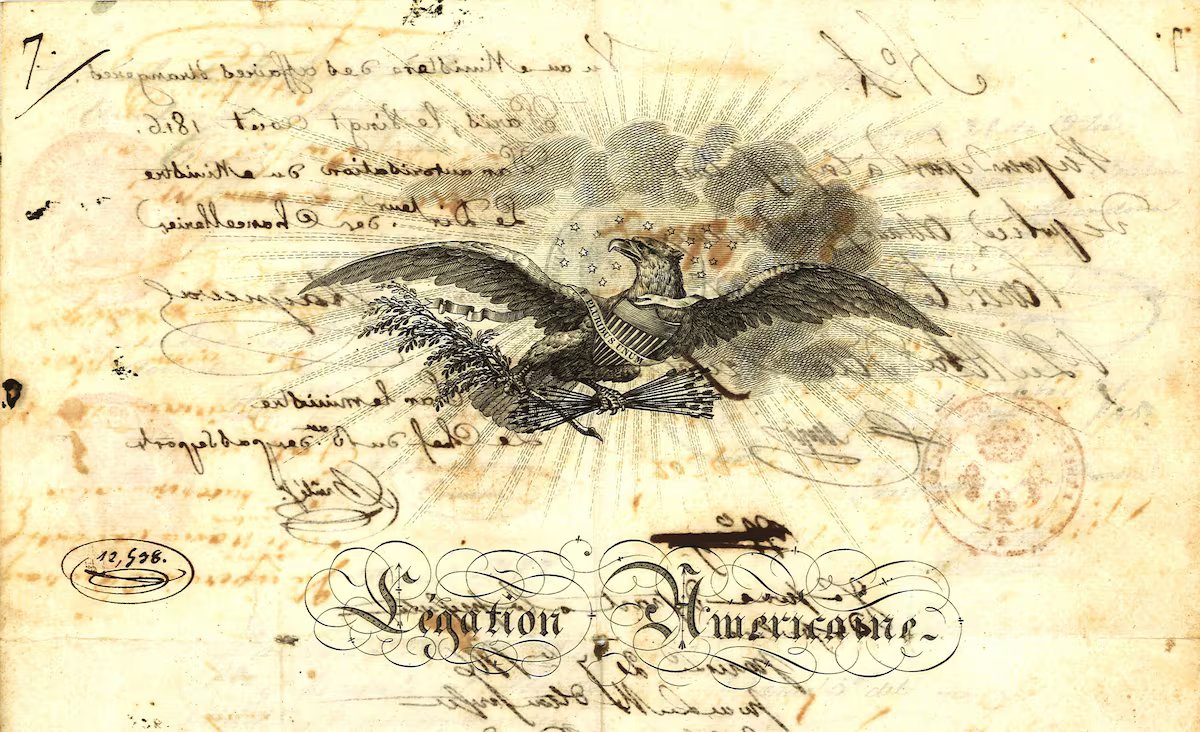
That tie, which later stretched over more than two and a half centuries, left a trail of paperwork issued by consular offices, warehouses, bodegas, shipping companies, and trading houses. It is exactly the thread the Provincial Historical Archive of Cádiz follows for its exhibition Cádiz: 250 años de relaciones transatlánticas con los Estados Unidos de América (Cádiz: 250 Years of Transatlantic Relations with the United States of America), organized to commemorate the 250th anniversary of the U.S. Declaration of Independence. The show, part of the archive’s annual Document of the Month initiative, will be on display in the courtyard of the mansion that houses the institution until the end of August. Administrative documents, commercial letters, passports, contracts, and photographs reconstruct a relationship that was far from episodic.
“We’re touching on different collections: public, notarial, private and governmental. I’ve been here for years and I’m still surprised — archivists are custodians of that heritage,” says Santiago Saborido, director of the Archive, curator of the exhibition, and author of the accompanying explanatory text. The tour begins long before the United States existed as a nation with the will of Pedro Menéndez de Avilés, founder of one of the earliest American towns, St. Augustine (in the state of Florida) in 1565. Shortly before his death in Santander in 1574, he recorded his legacy in Sanlúcar de Barrameda. The survival of that document itself is almost “a miracle,” after many notarial protocols from Sanlúcar were lost in the years before the Spanish Civil War.
But it was with the independence of the United States on July 4, 1776, that the relationship reached another level. “Ships stopped coming under the British flag and began arriving under the Stars and Stripes. Trade never stopped, even though nations changed and Cádiz continued to receive those vessels,” Saborido explains. Although the city no longer formally held the monopoly it had enjoyed for much of the 18th century on trade with overseas territories, it remained one of the Atlantic’s commercial hubs. That largely explains why the United States opened one of its first consulates in Spain here in 1790.
This happened because U.S. President Thomas Jefferson was keen to defend the commercial interests of the young republic in the main European ports. The international panorama of the time could not have been more favorable. The new country declared itself neutral in the conflicts dividing Europe. “The oceans were heavily monitored because of those wars and the United States, which has always been very sharp in business, sailed under a neutral flag and entered and left Spanish ports freely. That’s where they made their fortunes, and there is a record of it in our Archive,” the director adds. American ships brought cereals to a Spain in need of food and returned loaded with wine, salt, and other agricultural products.
Beneficial neutrality
“Those shipments provided a supply of fresh, undamaged flour to a Cádiz besieged by Napoleonic troops,” the Archive explains, referring to the French siege of the city in the early 19th century, one of the longest in history. Behind the merchandise there was already a diplomatic structure charged with protecting captains, merchants, and crews. The consulate issued certificates, processed maritime claims, intervened in insurance and inheritance matters and assisted its citizens. Proof of that activity is one of Saborido’s favorite documents: a passport filled with European stamps belonging to a New Orleans citizen from the early 19th century. The reach of the Cádiz Consulate is evident from the vast jurisdiction it came to cover: from the Portuguese border to Gibraltar and Ceuta, as well as points such as Seville and Ayamonte.
The head of the U.S. institution in Cádiz was initially Richard Harrison, but he did not remain long in the post. He was succeeded by José Iznardi, a wealthy Spanish merchant from Rota with interests in the United States, direct ties to Jefferson, and who served for decades. But the figure who best embodies that golden age of opportunity, fortune and misadventure is Richard W. Meade. After arriving from London at the start of the 19th century, he became a U.S. naval agent and one of the city’s main commercial operators. During the years of the French siege he prospered from supply and demand.
“He prospered from the start with exports to Cádiz and […] nearly monopolized all the agency work for American-flagged ships that came to our coasts,” the featured-document article recounts. The merchant sold flour, wheat, rice and other goods from the United States and became one of the main suppliers to Cádiz’s city authorities during the Peninsular War. He was also the father of George Gordon Meade, born in Cádiz in 1815 and later a Union Army general who defeated Robert E. Lee’s Confederate army at Gettysburg in the U.S. Civil War. The father fared worse: after advancing large quantities of merchandise to a Spanish administration ruined by war, he received promissory notes he could never collect and ended his days jailed and destitute.
The business ventures between the United States and Cádiz that developed in the 19th and early 20th centuries enjoyed better fortunes. The Archive’s holdings shift then from big names to the thousands of ordinary letters that tell of a profitable commercial relationship. Prominent among them are firms such as González de la Sierra, Bensusan, and Gómez. From the latter there are as many as 305 letters from the United States, “a huge documentary mass of commercial letters with clients and suppliers from all corners of the world from the 1830s to the 1960s.”
There are also curious cases, like two shipping companies that specialized in buying tens of thousands of tons of American oak to make the casks for Jerez wines. “But when they tasted that wine there, those same companies began sending back those same casks already wine-soaked. They made the return trip,” the Archive director adds. At the end of that commercial journey another notable name stands out: Rafael de la Viesca, founder of Radio Cádiz — now Cadena SER — and the first owner of a vehicle registered in the city. “He specialized in exporting American cars. The first motor vehicles arrived through the port of Cádiz,” Saborido notes.
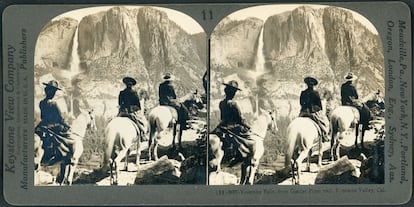
The exhibition also includes photographic collections from the United States, thanks to the collection assembled by the late Rafael Garófano, who donated it to the Archive. Among the roughly 300 19th-century American stereoscopic images preserved by the institution are giant sequoias, the groves of Mariposa and Calaveras, formations of El Capitan and, above all, landscapes of the Yosemite Valley. Two centuries after those first shipments of flour, the plates ended up in the Archive on Cristóbal Colón street in Cádiz. The journey comes full circle. Different ways of telling the story that, when the United States was just beginning to become the United States, Cádiz was already on the other side of the ocean.
Sign up for our weekly newsletter to get more English-language news coverage from EL PAÍS USA Edition
