
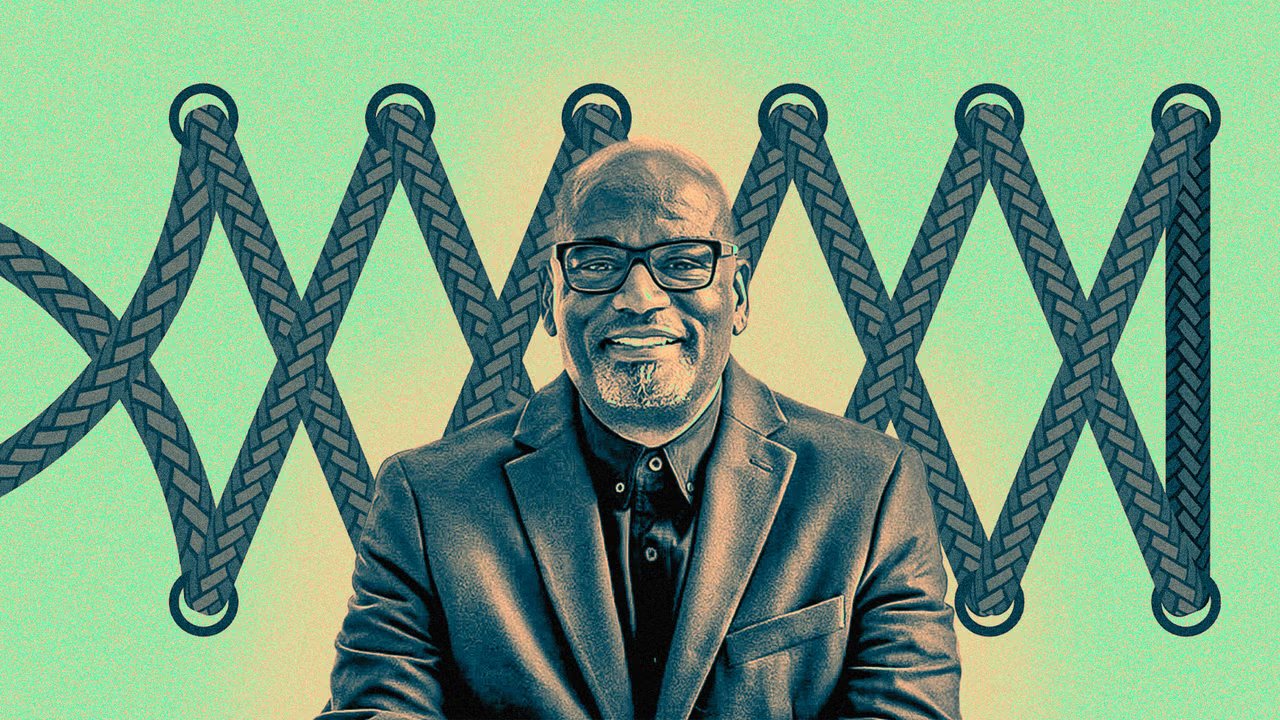
D’Wayne Edwards, legacy sneaker designer at Nike and president of Pensole Lewis College, has been studying Bruce Lee since he was in high school. “I thought he was this guy who did karate,” says Edwards. “But he was an incredible philosopher.” Having received his design education entirely on the job (first at Skechers and then at Nike), Edwards says he gleaned so much of his approach to design from watching and reading Lee’s work. “He doesn’t have a fighting style,” says Edwards. “His fighting style is whatever his opponent forces him to do. That’s how I look at design.”
Edwards says his design philosophy is not about him or his approach, but about the task in front of him: “I focus on becoming the creative or the designer for the problem I’m trying to solve.”
He is now leaning on his career in product design to reshape the state and future of design education at Detroit’s Pensole Lewis College of Business & Design, the only design-focused HBCU, and what Edwards hopes sets the standard for a design education of the future. Tethered to these philosophies and his lifelong love of art, Edwards frames design in problem-solving, business, and education. Here are his rules.
Break your life into chapters. I started out as an artist—I could draw anything I saw. Then I discovered design, and I used my artistic ability to become a designer. But the thinking was completely different; now I have to imagine things and make them real. I then started to understand that the human brain dictates my output. That’s when I transitioned from being a designer into being a creative.
Make creativity a daily exercise. We’re all creative. I look at creativity as an everyday action of walking down the street. How am I going to get past this pothole? I have to make a decision. Embracing everything through a lens of creativity is a much more fun, and more open, way to experience life. Wouldn’t you want a creative accountant? A creative lawyer? I would want to put “creative” in front of any person or word that can make my life better. You won’t get the same results. You won’t get the same static thing.
To best honor the task in front of you, avoid a design style. I have a visual design language that comes through when you see my work. If there is a philosophy, I’d say focus on becoming the creative or the designer for the problem you’re trying to solve.
Look at other industries for insight. I started meeting other types of designers or creatives, who live in different places and have a different approach to life. I developed creative circles that I can tap into for conversations, because something will come out of it. These people are energy givers. You are way better than before you talked to them. Then, there are energy takers, and there are way more of them in the world than givers. You have to be disciplined with who you allow in your life.
Have a morning routine. I developed mine when I was 20 and worked at Skechers. I wanted to know why Robert Greenberg, the chairman of Skechers, got in so early. When I got in “early” at 8 a.m., the dude was already there. It became a game. I showed up and he showed up. It was 5 a.m. He asked me, “Why are you here?” I said, “I’m trying to understand why you’re here.” He had a routine. He read industry and business information. He used a dictaphone from which his assistant wrote out his daily schedule. He settled himself before the day came. Now, I read inspirational quotes. I read industry information. I read sports. I protect what I receive. I’m not on social media. Good in, great out. Bad in, worse out.
Go into everything empty, with the goal of filling your cup. I’ve designed shoes for professional athletes, like Carmelo Anthony and Michael Jordan. The inspiration can be wide ranging. One time Carmelo said, “Man, my focus is I want to be quicker and more agile.” I said, “Damn, you’re 6’8″ and 230 lb. Let me dive into every word.” I had to understand what “quicker” meant to him; what “agility” meant to him. What is 6’8” and 230 lb., and quick and agile?
That led me to a jaguar. I went to the Oregon Zoo and talked to the people who care for the big cats and jaguars. As I got deeper, I better understood how they move. Consolidation of movement. Compression. That led me to pantyhose. The panty hose squeezes your muscles and ligaments to increase blood flow which makes you have more energy as you walk. It clicked. I designed it, and he tested it. He loved it. I usually hop from hole to hole and I try to find synergy between the holes. And then, you need a cohesive story.
Make boring subjects more interesting by problem-solving through a new medium. About five years ago, this math teacher in Boston reached out to me and said, “Can you come teach our kids geometry through sneaker design?” I thought, “Goddammit, she’s right.” Before this, I hadn’t explicitly realized that when you design a sneaker you start with a square inch. Your goal is to maximize all of the material in that square inch because you pay for that whole square inch. You have to learn the math, shapes, and outcomes to get to the maximum use of that material. If I knew that was geometry, I would have done a whole lot better in school.
Design is a broad term. Give it clarity to focus your career. There’s an incredible variation of design jobs out there. If I’m a parent and my kid comes to me and says, “I want to be a designer,” where can I go to find out what type of designer you want to become? If you’re a product designer, you don’t hang out with fashion designers. We have our own lanes. It’s so separated. That’s part of the problem. So clarifying your definition of design is the first step. Then, how closely does it mirror exactly how you’ll work in the job you want? You have to make the education mirror the reality of the job as closely as you can in order for it to truly be an effective design education.
Think about design education differently. I didn’t actually go to college and get a design education. I learned what a design education was by reviewing 1,000 portfolios every year for close to four decades. I was able to see what these kids were spending a lot of money on.
Education is now at a really serious impasse. It has to change its model. I came to this realization 16 years ago when I left the industry to become an educator. I looked at education as a designer, and with open eyes. Why are you paying for this? And what would make you want to pay for it?
