
Listen to this article
Estimated 4 minutes
The audio version of this article is generated by AI-based technology. Mispronunciations can occur. We are working with our partners to continually review and improve the results.
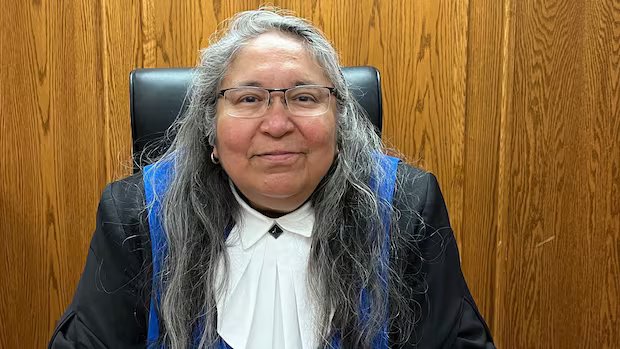
While presiding over a provincial court in the Estevan, Sask., area, Judge Michelle Brass noticed people bringing their own eagle feathers to court.
They had to do so because the courthouse often only provided religious texts for people to use when they were sworn in before testifying as witnesses.
On one occasion, “Someone had asked for a ceremonial item and there was none available, but I had a couple in my car,” Brass recalled in an interview with CBC Saskatchewan.
“I had a blade of sweetgrass in my car and I had some sage grass in my car. I realized there’s a need here that needs to be filled.”
Brass and her sister took action, donating 14 eagle feathers to the provincial court system for people to use while taking an oath to tell the truth in court.

For Brass, who is Saulteaux and from Peepeekisis First Nation in the Treaty 4 territory of Saskatchewan, this allows the principle of the oath to remain the same while expanding to include other people.
“Whether it be an eagle feather or a Bible or a Qur’an or a Torah or whatever, such items enable a person to indicate that they’re gonna be providing their evidence with truth and honesty,” she said.
Bob Mills, former chief of the Skidegate Band on Haida Gwaii, gave the feathers to Brass’s sister Cecile Brass. The Brass donation was made in honour of her father, who died in January.
Thirteen provincial court locations in Saskatchewan will each have an eagle feather and people can hold one or speak in front of one when making giving their oaths, according to a statement from Courts of Saskatchewan.

Judge Michelle Brass and her sister donated 14 eagle feathers to the provincial court system for people to use while taking an oath to tell the truth in court.
People could already bring an eagle feather to court, but it makes a difference when one is already present, Judge Brass said.
“I have found that people who recognize that there is an eagle feather available for them will readily use it and appreciate the fact that it’s there.”
The meaning of eagle feathers varies between Indigenous communities and it’s especially important for Saulteaux people such as herself, she said.
“The eagle feather is symbolic of the fact that an eagle is believed to be a bird or a creature that flies closest to the creator, and so that is that connection to a much higher being or a higher truth that’s beyond an individual.”
‘Larger than just an eagle feather’
For Dorthea Swiftwolfe, the City of Saskatoon’s Auntie Advocate, the importance of the eagle feather looms as large as the one hanging in her office.
“I hang it here proudly,” said Swiftwolfe, who is Cree and from the Peter Ballantyne Cree Nation. “It helps me and reminds me why I do the work that I do.”

The stained-glass replica from the Yorkton Tribal Council is one of many items people have given her in appreciation for her advocacy for missing and murdered Indigenous women and girls, and for community safety.
Swiftwolfe said she hopes the eagle feathers will make the provincial courts more inclusive.
“When I think about bringing the eagle feather into the courtroom, I think that it’ll give the capability for our families to feel recognized, to be heard, to be seen. It’s larger than just an eagle feather,” she said.
Audrey Armstrong, who is Cree with roots in the Thunderchild First Nation, is Truth and Reconciliation Coordinator of the City of Saskatoon. She said the eagle feathers at courthouses are a good start, but deeper issues remain.
“Having that representation in a system that wasn’t necessarily designed for us, to help us, is important,” she said.
“This is a small step towards the overall significance of reconciliation. There’s a lot of other work that needs to be done.”
