
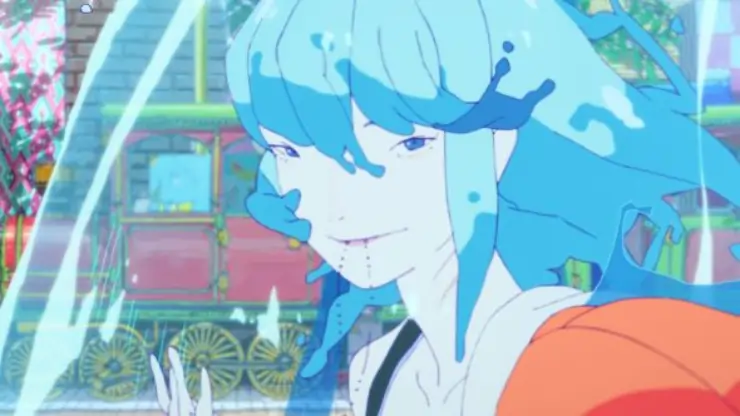
Being one of the only anime features on the 2025 BFI London Film Festival programme, ChaO was a must-watch film for this festival. As part of the festival’s coverage, I was able to secure an email interview with director Yasuhiro Aoki about his latest film ChaO.
ChaO is set in a future Shanghai. Stephan may hold the key to resolving the conflict between humans and mermaids, but his boss doesn’t respect him and instead assigns him to clean the company’s newest vessel. While scrubbing the deck, Stephan is nearly devoured by a mermaid that leaps from the sea. After the incident, Stephan wakes up in the hospital and learns that the mermaid is actually the princess of the merfolk called ChaO, and she has chosen him to be her fiancé.
In this exclusive interview, I asked Yasuhiro Aoki questions via email before the UK Premiere of ChaO at the 2025 BFI London Film Festival. We discussed deconstructing binary relationships, gender roles, and setting the film in Shanghai instead of Japan, as well as the behind-the-scenes footage that we see in the credits.
The film is set in Shanghai, so I wanted to understand if there is any particular reason why it is set there instead of Japan, and how it was approached from an animation perspective, considering Shanghai as presently one of the most advanced cities in the world and the film showcases an even more advanced incarnation?
Yasuhiro Aoki: The city—and the vibrant energy of its people—were essential to the heart of this story. I also constantly feel that an Asian aesthetic is something vital to the texture of the film. To convey a futuristic aspect, we introduced mermaid waterways running through the city.
However, we were careful not to push the futurism too far, as that might compromise the film’s sense of realism. That’s why we made sure to also depict the everyday lives of ordinary people. I believe this balance—between the fantastical and the familiar—is what grounds the film’s fantasy in something emotionally authentic.
ChaO, in a way, feels like a love letter to Studio 4°C, referencing previous works such as Tekkonkinkreet and Children of the Sea. I wanted to ask if this was intentional and if there were any works that you took inspiration from for ChaO?
Yasuhiro Aoki: Absolutely. In fact, this film is infused with my affection for the early works that marked the beginning of STUDIO4°C. It’s a heartfelt tribute and a thank-you to the projects I cherish and to the mentors who taught me so much. I also wanted it to embody a sense of henge—transformation—so that watching it feels like experiencing not just one film, but two or even three layered within a single journey.
ChaO appears to be a deconstruction of binary relationships, so I was curious about what it’s like to tackle this theme. Especially in 2025, a time when the world seems to be becoming more conservative?
Yasuhiro Aoki: The story of a mermaid and a human has been told countless times throughout history. And ultimately, these stories tend to arrive at one of a few familiar conclusions: they either come together, part ways, or find some fleeting understanding before separation.
What interested me was how to shift or subvert that established pattern—how to “tilt” the familiar arc just enough to surprise audiences who know these tales, while still engaging those encountering the mermaid mythos for the first time.
This very act of shifting the narrative pattern may be what gives rise to the sense that the film is questioning or dismantling binary relationships.
At the same time, I held firmly to a foundational idea: to “defy expectations, but never betray the audience’s hopes.”
And more than anything, I wanted audiences—no matter where they are in the world—to walk away feeling uplifted, with the sense that, “Maybe the world isn’t such a lost cause after all.”
Additionally, was there any discussion about ChaO adapting to and essentially accepting traditional gender norms, or was it more about showcasing ChaO adapting to human life?
Yasuhiro Aoki: There’s something universally compelling about someone who understands the intricacies of tradition and chooses to uphold them. Many powerful works have drawn their strength from that very conviction. In ChaO, the mermaid witnesses the death of the parents of Stephan—the boy who once saved her as an egg and embraced her as family.Sensing Stephan’s grief, and holding on to the ideal of honoring a promise, the mermaid’s commitment carries its own quiet beauty.
Within that emotional space, ChaO’s sincere efforts to connect with human society feel not only meaningful but deeply endearing. As for this aspect of the story, there were no particular debates within the creative team. It was a natural extension of the characters’ emotions and the relationships they built.
ChaO is visually stunning throughout, but what stands out most are the character designs. I wanted to ask what it was like working with Hirokazu Kojima, and whether there was any decissuion regarding whether all the human characters would have normal proportions compared to what appears in the final product?
Yasuhiro Aoki: When I was a child, there were many animated works based on old folktales. I grew up watching them, and they often featured unique, stylized character designs created by a wide range of talented artists. ChaO, too, begins as a kind of folktale—after all, it’s a mermaid story at its core. The characters are, of course, illustrations, but we deliberately gave them a distinctive, somewhat whimsical look.
Precisely because they are drawn, we believed that a sense of elation and emotional satisfaction after watching the film would be heightened by that uniqueness. The slightly uneven, quirky aspects of the character designs also served as a way to calibrate the film’s tonal “offbeatness”—a visual tool to help us strike the right balance between realism and fantasy.
The film employs a unique framing device, showing Stephan from the future before flashing back. I wanted to know how it was ensured that the film retained tension and drama despite the audience being able to grasp the overall direction early on?
Yasuhiro Aoki: With animation, nothing exists until it’s drawn—everything must begin with the act of drawing.
So during the storyboard phase, I made a conscious effort not to let the visuals become merely functional—just there to “process the script.” Instead, I tried to approach each scene, each cut, with a sense of generosity and a touch of playful mischief.
When it comes to sustaining tension, I believe it’s all about controlling the rhythm—the push and pull—of each scene.
I paid careful attention to those dynamics, ensuring that the dramatic flow would keep the audience emotionally engaged, even if they could sense where the story was heading.

I wanted to discuss when Stephan embarks on the journey to rebuild his relationship with ChaO, the film becomes somewhat of a man-versus-Kaiju scene. I was interested in knowing if there were any challenges in working on this scene and whether there were significant changes from the script to screen?
Yasuhiro Aoki: That’s an interesting take—“man vs. kaiju”! From the very beginning, I had the idea of making ChaO feel like an action film—one without kung fu, yet still filled with physical intensity. That’s why you’ll find these dynamic sequences—but in truth, very little of that was in the original script. Most of it was built up during the storyboard phase, where my sense of mischief and desire to entertain really came alive. As I added each beat, I imagined the reaction of the staff reviewing the boards—their surprise and laughter. That image guided me as I kept layering in the action.
During the credits, you include behind-the-scenes footage, which is quite rare for anime films and reminiscent of when bloopers used to be shown during credits. I would like to know why this decision was made and what you hope audiences take away from seeing this footage?
Yasuhiro Aoki: That idea actually came from the producer. I had simply asked that the ending preserve the emotional afterglow of the film. What we ended up with, I think, goes even further. In an age where CG and AI-generated animation are becoming increasingly common, this ending quietly affirms that ChaO was drawn by human hands. It feels like a kind of historical punctuation mark—a small but meaningful reminder of what hand-drawn animation can still be.
To be honest, I only realized that after the film. was finished. These days, there are so many visual techniques—hand-drawn, CG, AI, live-action… but in the end, maybe the method doesn’t matter. What truly matters is creating a film so immersive and emotionally rich that the audience forgets about how it was made altogether.
You can read our review for Chao here – Read our Review
Related
Discover more from
Subscribe to get the latest posts sent to your email.
