
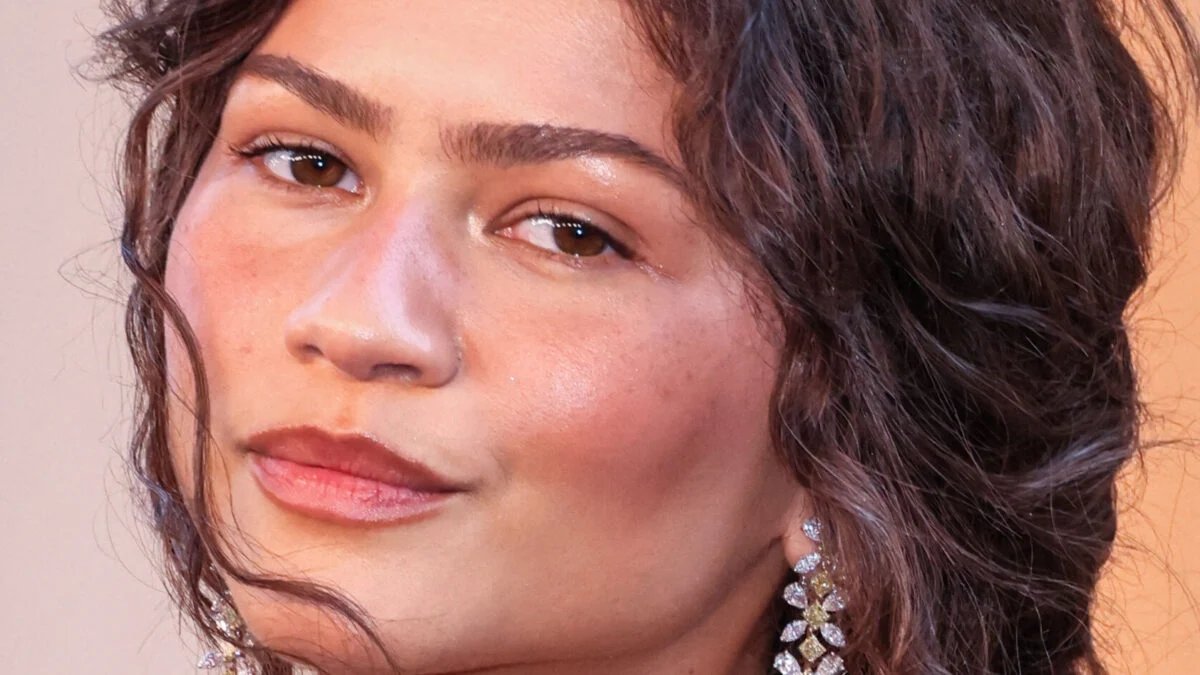
Zendaya’s carefully curated “The Odyssey” wardrobe has sparked a much larger debate about who should be allowed to wear (and own) ancient cultural artifacts.
The actress wore earrings made from roughly 3,000-year-old Iranian gold medallions during a London photocall for Christopher Nolan’s upcoming epic. While the jeweler insists the artifacts were mounted without being altered or damaged, critics argue the pieces should be preserved in a museum or returned to Iran rather than worn as celebrity accessories.
Questions surrounding the earrings are further complicated by the Ziwiye hoard itself, a disputed collection whose objects entered the antiquities market without being recovered through a documented archaeological excavation.
Zendaya, who plays the goddess Athena in Nolan’s adaptation of Homer’s “The Odyssey,” paired the ancient earrings with a flowing white Jacquemus dress selected by her longtime stylist, Law Roach.
According to CNN, the earrings contain gold medallion discs attributed to the first millennium B.C., making them approximately 2,000 to 3,000 years old. The pieces originated in ancient Iran and have been linked to the Ziwiye hoard, a collection of gold, silver, and ivory objects reportedly discovered in the country’s northwestern Kurdistan province during the late 1940s.
London jeweler Glenn Spiro later placed the discs inside an 18-karat yellow gold setting bordered by diamonds. Fine jewelry company Barron London acquired the earrings in 2020 and says they are held in its private collection, not offered for sale.
Barron London Defends The Earrings’ Setting

Barron London stressed that the original medallions were not pierced, reshaped, or permanently altered when they were converted into earrings. The “ancient gold discs are held within a simple, noninvasive claw setting that does not alter or damage the original objects in any way,” the company told CNN.
The jeweler also welcomed conversations about preservation and the earrings’ history. “Cultural heritage rightly inspires important conversations, and we welcome informed dialogue about provenance, preservation and the appreciation of exceptional craftsmanship,” its statement read.
Barron London suggested that displaying the earrings could draw attention to Iran’s artistic history at a time when the country is frequently discussed through the lens of war and political conflict. “We hope these earrings can serve as a reminder of the country’s enduring artistic, cultural and historical legacy,” the jeweler added.
Critics Say The Artifacts Belong In A Museum

The company’s explanation did little to satisfy critics who believe artifacts of that age and cultural significance should not be treated as fashion accessories. “This is unethical,” one user declared, as someone else called the move “disgusting.” “As an archaeology student, I hate this,” another social media user wrote. “They should be in a museum.”
Meanwhile, some Iranian critics argued the underlying issue was not whether Zendaya and Roach handled the earrings carefully, but how the artifacts left Iran and entered a private collection in the first place. “This piece is a part of Iran’s history and cultural heritage, and it should not be in the hands of anyone other than Iran and its people,” one commenter wrote.
Zendaya has not publicly responded to the criticism.
The Ziwiye Hoard Has A Complicated History
Although the medallions are attributed to the Ziwiye hoard, that label does not provide a fully documented ownership history.
The collection was reportedly discovered near Ziwiye in 1947, but the objects were not recovered through a controlled archaeological excavation. According to the Penn Museum, pieces quickly entered the antiquities market after the find and were divided, damaged, or melted down.
As reported by Pakistani Art, archaeologist Oscar White Muscarella later challenged whether every item marketed as part of the Ziwiye hoard actually came from the same location. He noted that the pieces passed through dealers rather than being formally documented at the site. That uncertain history is significant because “attributed to Ziwiye” does not necessarily establish when an individual object left Iran, who initially sold it, or whether its removal complied with the laws in effect at the time.
Objects associated with the treasure are now scattered across private holdings and museum collections, including institutions in New York, London, Paris, and Tehran.
The Timing Intensifies The Backlash

The controversy has also been heightened by the renewed war involving the United States and Iran. More than 3,000 people were reported killed in Iran during the earlier phase of the conflict, according to figures cited by Reuters. Fighting has since resumed, making the appearance of ancient Iranian artifacts on a Hollywood press tour feel especially insensitive to some observers.
“While they’re bombing Iran, mind you,” one TikTok user wrote. Still, there is no indication that Zendaya selected the earrings to make a statement about Iran or knew the full debate surrounding the Ziwiye hoard’s provenance.

