
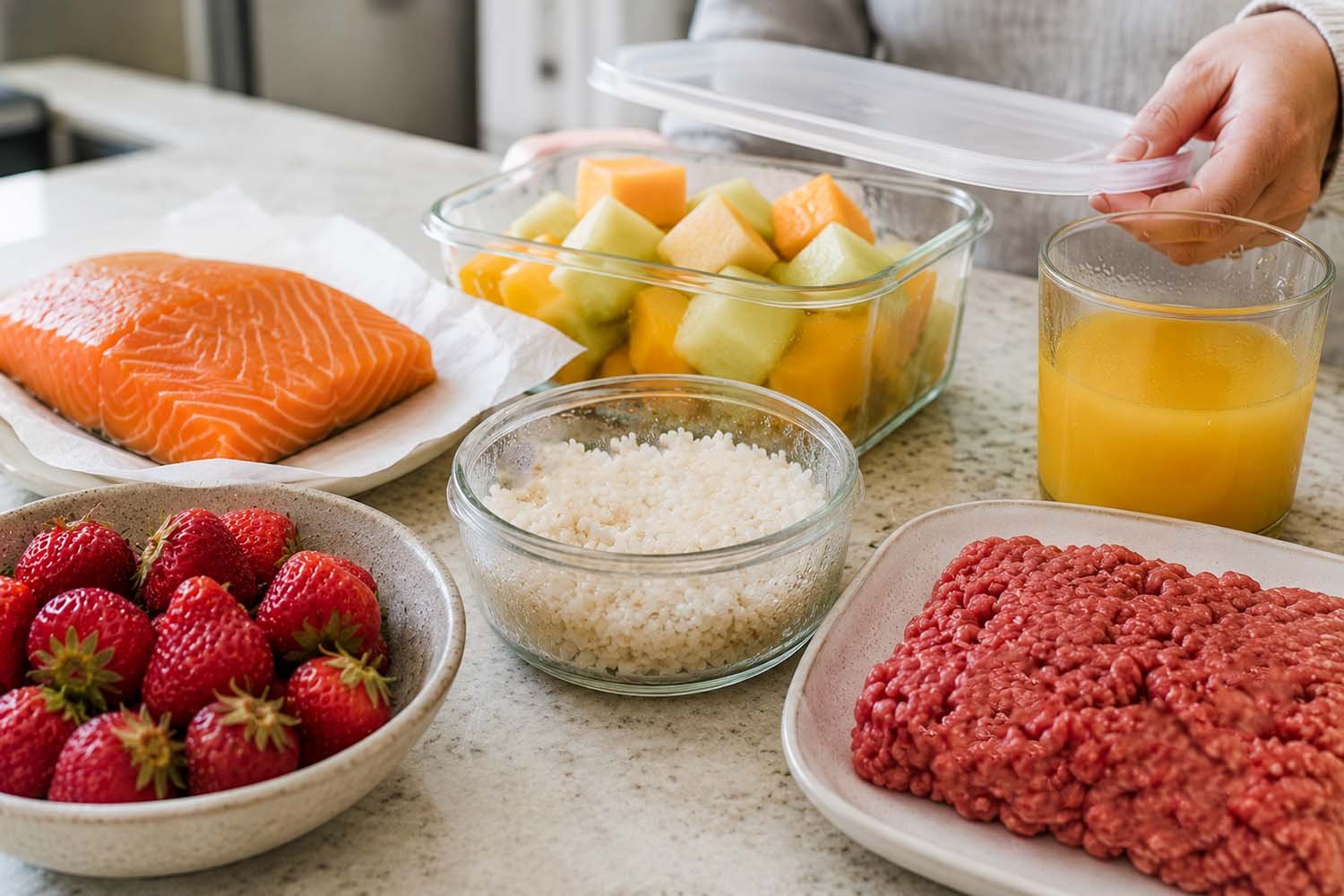
You bought it a week ago. It looks fine. It smells mostly fine. And then you take a bite and know immediately it was not fine. Certain foods spoil on a timeline that does not match what most people expect, and the consequences range from a ruined dinner to a genuine food safety problem. Knowing which foods are deceptively short-lived changes how you shop, how much you buy, and how you store what you have.
Which foods go bad faster than you think?
The short answer: Fresh-squeezed juice, fresh fish, raw ground meat, cooked grains, brown rice, ground spices, cut melon, homemade tomato sauce, natural nut butters, opened cooking oils, and fresh berries all spoil significantly faster than most people expect. Several carry food safety risks, not just quality issues, when left past their window.
For a complete reference on storage times and spoilage signs, see our Food Storage Guide.
📋 Foods That Go Bad Faster Than You Think: At a Glance
| 🍊 Fresh-squeezed juice | 🐟 Fresh fish |
| 🥩 Raw ground meat | 🍈 Cut melon |
| 🍚 Cooked grains (quinoa, brown rice) | 🌶️ Ground spices |
| 🍅 Homemade tomato sauce | 🥜 Natural nut butter |
| 🍓 Fresh berries | 🥗 Leftovers (all types) |
| 🥦 Broccoli and cruciferous vegetables | 🧀 Opened soft cheese |
🔑 Key Takeaways
- Fresh-squeezed juice lasts only 2 to 3 days in the refrigerator. Without pasteurization, bacteria can reach unsafe levels faster than most people realize, and the FDA warns that unpasteurized juice poses genuine foodborne illness risks for children, older adults, and pregnant women.
- Fresh fish is one of the most perishable proteins in the kitchen. It contains cold-adapted bacteria that keep growing even under refrigeration, which is why the USDA recommends using fresh fish within 1 to 2 days of purchase.
- Raw ground meat lasts only 1 to 2 days in the refrigerator, according to USDA FoodKeeper. Most people assume it lasts as long as whole cuts of beef or pork, which last 3 to 5 days. It does not.
- Cooked grains like quinoa, farro, and brown rice last only 3 to 5 days in the refrigerator. Many people assume cooked starches last a week or more. They do not.
- Ground spices do not go bad in a safety sense, but they lose meaningful flavor potency within 6 to 12 months of opening under typical kitchen conditions.
- Leftovers of all types should be eaten within 3 to 4 days, according to FoodSafety.gov. Many foodborne illness-causing bacteria produce no detectable smell or visible mold before they reach dangerous levels.
Why These Foods Fool Us
Most spoilage is obvious. Milk turns sour. Bread grows mold. Meat discolors. But the foods on this list often look and smell acceptable right up until they are past their safe or quality window. Some spoil through bacterial growth that produces no visible or olfactory warning. Others lose their value through chemical degradation, oxidation, or moisture loss rather than microbial activity, so they never smell off even when they are worthless. Both types catch people off guard in different ways.
🔬 The Two Types of “Going Bad”
Food scientists distinguish between two separate processes. Spoilage is microbial: bacteria, mold, and yeast consuming the food and producing byproducts that make it unsafe or unpleasant. Quality degradation is chemical or physical: oxidation, moisture loss, enzyme activity, and structural breakdown that make food tasteless, mushy, or nutritionally diminished without necessarily making it dangerous. Ground spices and cooking oils degrade in quality without becoming dangerous. Fresh fish, ground meat, and homemade juice spoil in ways that can make you sick. Both matter, but for different reasons.
15 Foods That Go Bad Faster Than You Think
1. Fresh-Squeezed Juice
Freshly squeezed or cold-pressed juice lasts 2 to 3 days in the refrigerator. That is the window before bacterial growth reaches levels that can cause illness. The FDA is direct on this: when fruits and vegetables are fresh-squeezed or used raw, bacteria from the produce surface can end up in the juice. Without pasteurization or another treatment to destroy harmful bacteria, juice from a home juicer or juice bar can harbor pathogens including E. coli and Salmonella. The FDA requires warning labels on unpasteurized juice sold commercially for exactly this reason.
The FDA specifically flags children, older adults, pregnant women, and anyone with a weakened immune system as the highest-risk groups for illness from unpasteurized juice. If you make fresh juice at home, drink it the same day if possible, and always within 2 to 3 days. Keep it refrigerated and sealed. Never leave it at room temperature for more than 2 hours. Our apple cider vinegar tonics use pasteurized ACV rather than fresh-pressed juice, which sidesteps this issue entirely.
How long it actually lasts: 2 to 3 days refrigerated. For comparison, commercially pasteurized refrigerated orange juice lasts 7 to 10 days after opening.
2. Fresh Fish
Fresh fish is one of the most perishable proteins in any kitchen, and the window is narrower than most people assume. The USDA recommends using fresh fish within 1 to 2 days of purchase. Fish contains cold-adapted bacteria that remain active even at refrigerator temperatures (around 40 degrees Fahrenheit), unlike the bacteria in beef or pork that are slowed much more effectively by cold. Fish also contains enzymes and polyunsaturated fats that break down rapidly, producing the off-smell that signals spoilage, but by the time that smell is distinct, the fish is already past its best and potentially unsafe.
If you will not cook fresh fish on the day of purchase, store it on a bed of ice in a container in the coldest part of your refrigerator (the back of the lowest shelf). Pour off water and refresh ice as it melts. This can extend freshness by an extra day compared to standard refrigerator storage. For fish you will not use within 2 days, freeze it on the day of purchase rather than waiting. Our tuna tostadas and clam corn chowder are both good ways to use seafood the day you buy it.
How long it actually lasts: Fresh fish: 1 to 2 days refrigerated. Shellfish: 1 to 2 days. Smoked fish: 14 days unopened, 5 to 7 days after opening. Canned fish after opening: 3 to 4 days refrigerated in a sealed container.
3. Raw Ground Meat
Whole cuts of beef, pork, and lamb last 3 to 5 days in the refrigerator. Raw ground meat is a completely different story. Ground beef, ground turkey, ground pork, and ground chicken all last only 1 to 2 days in the refrigerator, according to USDA FoodKeeper. The grinding process dramatically increases the surface area of the meat exposed to air and bacteria, and it also distributes any surface contamination throughout the entire batch. A steak that has bacteria only on the surface can be made safe by searing; ground meat has bacteria distributed throughout, which is why it must be cooked to a higher internal temperature (160 degrees Fahrenheit for beef) and used much sooner.
The USDA Food Safety and Inspection Service notes that ground meat is particularly vulnerable to contamination because grinding mixes surface bacteria into the interior, where cooking temperatures may not always reach them fully if the meat is left rare or undercooked. Always use or freeze raw ground meat within 1 to 2 days of purchase. If it has turned gray-brown throughout, has a sour smell, or feels slimy, discard it regardless of the date. Our classic meatloaf and burger recipes are both best made with freshly purchased ground meat.
How long it actually lasts: Raw ground meat (beef, turkey, pork, chicken): 1 to 2 days refrigerated. Freeze immediately if you will not use within that window: frozen ground meat is good for 3 to 4 months.
4. Cooked Grains (Quinoa, Farro, Brown Rice, Oats)
Most people treat cooked grains the way they treat cooked pasta: as something that will last in the refrigerator for a week. They will not. Cooked quinoa, farro, barley, and similar whole grains last 3 to 5 days in the refrigerator according to USDA FoodKeeper. Cooked oatmeal lasts 3 to 5 days. Cooked rice (all varieties) lasts 3 to 5 days. These are significantly shorter windows than most home cooks assume, particularly for people who batch-cook grains at the start of the week expecting them to last until the weekend.
Cooked grains, particularly rice, can harbor Bacillus cereus, a bacterium whose spores survive cooking and can produce toxins during improper storage. FoodSafety.gov recommends cooling cooked grains quickly and refrigerating them within 2 hours of cooking. Never leave cooked grains at room temperature for more than 2 hours. Reheat to 165 degrees Fahrenheit throughout before eating. Do not leave cooked grains in a covered pot on the stove overnight: room temperature is the ideal breeding ground for Bacillus cereus. Our red lentil soup and teriyaki pork bowls both use grains or legumes and are best eaten within 4 days of cooking.
How long it actually lasts: 3 to 5 days refrigerated for most cooked whole grains and rice. Freeze cooked grains for up to 1 to 2 months if you will not eat them within that window.
5. Brown Rice (Uncooked)
White rice is one of the most shelf-stable pantry staples you can own, lasting 4 to 5 years or more in a sealed container. Uncooked brown rice is a fundamentally different product. Brown rice retains its bran and germ layers, which are rich in natural oils. Those oils go rancid over time through oxidation, giving old brown rice a bitter, musty smell and taste. At room temperature in a sealed bag, uncooked brown rice lasts only 3 to 6 months, according to USDA and USA Rice Federation guidance. Most people buy it expecting it to behave like white rice. It does not.
Transfer uncooked brown rice to an airtight container and store it in the refrigerator, where it lasts up to 12 months, or in the freezer, where it maintains quality for up to 12 months as well. Buy brown rice in smaller quantities you will use within 3 to 6 months rather than stocking up in bulk. See does rice go bad for full guidance on both cooked and uncooked rice storage.
How long it actually lasts: Uncooked brown rice: 3 to 6 months pantry, up to 12 months refrigerator or freezer. Compare to white rice: 4 to 5 years pantry.
6. Ground Spices
Ground spices do not spoil in a food safety sense, but they go dead in a culinary sense faster than almost any home cook realizes. USDA FoodKeeper data places dried ground spices at up to 2 to 3 years for quality under ideal airtight storage in a cool, dark pantry. In the real world, most spice jars sit in a rack next to the stove, exposed to heat, light, and humidity every time someone cooks. Under those conditions, ground spices can lose meaningful potency within 6 to 12 months of opening. A two-year-old jar of ground cumin stored above the stove is contributing almost nothing to your food. The color fades, the aroma disappears, and the volatile flavor compounds are gone.
Rub a small pinch between your fingers and smell it immediately. Fresh ground spice releases a clear, strong aroma within seconds. If the smell is dusty and flat rather than sharp, replace the jar. Whole spices (peppercorns, cumin seeds, cinnamon sticks) last 3 to 4 years because far less surface area is exposed to air. Buying whole and grinding as needed is always the better quality choice. Our carrot ginger dressing and red lentil soup both depend on spices being at their freshest to deliver the right flavor.
How long it actually lasts: Ground spices: 6 to 12 months at peak flavor after opening under typical home kitchen conditions. Whole spices: 3 to 4 years. Dried herbs: 1 to 2 years.
7. Cut Melon
A whole uncut watermelon, cantaloupe, or honeydew can sit on the counter for up to 10 days without meaningful quality loss. Once you cut into it, that window collapses to 3 to 5 days in the refrigerator, according to USDA FoodKeeper. Cut melon must be refrigerated immediately. At room temperature, cut melon enters the bacterial danger zone quickly because the exposed flesh is moist, sugar-rich, and at an ideal temperature for rapid bacterial growth. The FDA and CDC have both linked improperly stored pre-cut melon to Salmonella and Listeria outbreaks.
✅ Storage Fix
Refrigerate cut melon immediately, covered tightly with plastic wrap or in a sealed container. Keep cut cantaloupe and honeydew away from strong-smelling foods, as they absorb odors easily. Use within 3 to 5 days. Avoid buying pre-cut melon that has been sitting out at a buffet or salad bar for an unknown period of time.
How long it actually lasts: 3 to 5 days refrigerated once cut. Whole uncut: up to 10 days on the counter. The difference is dramatic.
8. Homemade Tomato Sauce
Store-bought jarred tomato sauce keeps for 5 to 7 days in the refrigerator after opening because it is commercially processed, often contains preservatives, and starts with a much lower bacterial load than homemade. Homemade tomato sauce, made from fresh tomatoes, onions, garlic, and herbs, typically lasts only 3 to 5 days. Many home cooks treat a big batch of homemade sauce the way they treat a jar of Rao’s, leaving it in the refrigerator through the week. By day 5 or 6, it may look and smell fine but be approaching unsafe bacterial levels.
How long it actually lasts: 3 to 5 days refrigerated. Freeze in airtight containers for up to 3 months. Our strawberry jalapeno salsa is best made fresh and used within 5 days for the same reason: fresh ingredients mean a shorter safe window than the commercial version. For tomato-based dishes that freeze beautifully, our tortilla soup stores well for up to 3 months.
9. Natural Nut Butter
Commercial peanut butter with hydrogenated oils is shelf-stable at room temperature for 3 months after opening. Natural nut butter (peanut, almond, cashew, sunflower seed) contains no stabilizers, and the oils in it go rancid significantly faster. Natural peanut butter lasts about 1 month at room temperature after opening and 3 to 6 months in the refrigerator. Natural almond butter has a similar timeline. Most people buy a jar, leave it in the pantry, and continue using it for months past its peak. Rancid nut butter tastes noticeably bitter and sharp, and regular consumption of oxidized fats is not optimal for health.
Always refrigerate natural nut butter after opening. Refrigeration extends shelf life to 3 to 6 months and slows oil separation. Store the jar upside down before opening to pre-mix the separated oil back into the paste, then refrigerate right side up after opening. See does peanut butter go bad and does peanut butter need to be refrigerated for full guidance.
How long it actually lasts: Natural nut butter: 1 month pantry after opening, 3 to 6 months refrigerated. Commercial peanut butter with stabilizers: 3 months pantry after opening.
10. Fresh Berries
Berries are among the fastest-spoiling produce in the refrigerator. Strawberries last 5 to 7 days. Raspberries and blackberries last only 2 to 3 days. Blueberries last 1 to 2 weeks. The problem is mold, which spreads rapidly through a container once a single berry is affected because mold spores travel through air and surface contact. The container format works against you: berries packed together retain moisture and bruise each other, creating ideal mold conditions.
Do not wash berries until immediately before eating. Moisture on the skin dramatically accelerates mold. Line the storage container with a dry paper towel to absorb excess moisture. Remove any moldy or damaged berries immediately: one bad berry will contaminate the rest quickly. For blueberries specifically, spread in a single layer rather than piling them. See how to store berries for full guidance. Extra berries work beautifully in our mixed berry smoothie or frozen for our banana cream protein shake.
How long it actually lasts: Raspberries and blackberries: 2 to 3 days. Strawberries: 5 to 7 days. Blueberries: 1 to 2 weeks.
11. Leftovers
Leftovers of all types should be refrigerated within 2 hours of cooking and eaten within 3 to 4 days, according to FoodSafety.gov. This timeline applies to cooked meat, poultry, casseroles, soups, and mixed dishes. Most people assume leftovers last a week if they look and smell fine. They often do not, because many of the bacteria that cause foodborne illness (Listeria, Salmonella, certain strains of E. coli) produce no detectable odor, visible mold, or color change before reaching dangerous levels. The phrase “when in doubt, throw it out” exists precisely because these pathogens are invisible.
⚠️ The Danger Zone
The USDA defines the temperature danger zone as 40 to 140 degrees Fahrenheit. Within this range, bacteria can double in number in as little as 20 minutes. Leftovers left at room temperature for more than 2 hours have been in the danger zone long enough for bacterial counts to increase substantially, even if you then refrigerate them. The 2-hour rule is not conservative advice: it is based on documented bacterial growth rates. After a party or large meal where food sits out for hours, discard anything that has been at room temperature past that window.
How long it actually lasts: 3 to 4 days refrigerated for most cooked dishes. Freeze for 2 to 3 months for longer storage.
12. Broccoli and Cruciferous Vegetables
Raw broccoli looks sturdy and feels like it should last a while. It will not. Uncooked broccoli lasts only 3 to 5 days in the refrigerator before the florets begin to yellow and the stems become limp. Broccoli is also ethylene-sensitive, meaning it deteriorates faster when stored near ethylene-producing fruits like apples, bananas, and pears. Cauliflower, Brussels sprouts, and cabbage have similar short windows. Most people buy a head of broccoli expecting it to last a week and find themselves cutting away yellowed florets by day 4.
Store broccoli unwashed in the refrigerator in a loosely sealed bag that allows some airflow. A fully airtight bag traps moisture and promotes mold. Keep it away from apples, pears, and bananas. Use within 3 to 5 days. Blanch and freeze any excess: blanched broccoli florets keep well in the freezer for up to 12 months. Our crustless veggie quiche and spinach artichoke dip are both good ways to use vegetables before they turn.
How long it actually lasts: Raw broccoli: 3 to 5 days. Raw cauliflower: 4 to 5 days. Brussels sprouts: 3 to 5 days.
13. Opened Soft Cheese
Soft and high-moisture cheeses (brie, camembert, fresh mozzarella, ricotta, cottage cheese, cream cheese) have significantly shorter shelf lives after opening than most people assume. Cream cheese lasts 1 to 2 weeks after opening. Ricotta and cottage cheese last 5 to 7 days after opening. Fresh mozzarella should be used within 3 to 5 days of opening the package. These cheeses have high moisture content that makes them far more hospitable to bacterial and mold growth than aged hard cheeses.
How long it actually lasts: Cream cheese: 1 to 2 weeks opened. Ricotta: 5 to 7 days opened. Cottage cheese: 5 to 7 days opened. Fresh mozzarella: 3 to 5 days opened. For full guidance, see does cream cheese go bad, does ricotta go bad, does cottage cheese go bad, and does mozzarella cheese go bad.
14. Avocados (Once Ripe)
The window between a perfectly ripe avocado and an overripe, brown-fleshed one is shorter than almost any other common fruit: about 1 to 2 days at room temperature once fully ripe. Moving a ripe avocado to the refrigerator immediately buys 3 to 5 more days. Most people buy avocados underripe, leave them on the counter to ripen, and then either miss the window or forget about them by a day. A ripe avocado left on the counter will not wait for you.
The moment an avocado is fully ripe (dark skin, slight give when pressed), move it to the refrigerator immediately. Cut avocado should be stored cut-side-down in an airtight container with a squeeze of lemon juice to slow browning. For full guidance, see do avocados go bad and do avocados need to be refrigerated. Our tuna tostadas and Greek meze board are both great same-day uses for a ripe avocado.
How long it actually lasts: Ripe avocado: 1 to 2 days counter, 3 to 5 days refrigerated. Unripe: 4 to 7 days at room temperature to reach peak ripeness.
15. Hard-Boiled Eggs
Many people hard-boil a batch of eggs at the start of the week intending to eat them over 10 to 14 days. The actual safe window is much shorter. According to the USDA, hard-boiled eggs, whether in the shell or peeled, should be consumed within 1 week of cooking when refrigerated. The shorter shelf life compared to raw eggs comes from two factors: commercial eggs in the US are washed at the processing plant, which removes the natural bloom that protects the shell. Cooking then further compromises the shell’s barrier, making hard-boiled eggs more permeable to bacteria and odors from the refrigerator. A hard-boiled egg left out at room temperature for more than 2 hours should be discarded.
How long it actually lasts: Hard-boiled in shell: 1 week refrigerated. Peeled: 1 week refrigerated in a sealed container or submerged in cold water changed daily. Compare to raw shell eggs: 3 to 5 weeks refrigerated. For technique and full egg storage guidance, see do eggs go bad and the perfect boiled egg.
Quick Reference: Expected vs. Actual Shelf Life
| Food | What People Assume | Actual Window | Source |
|---|---|---|---|
| Fresh-squeezed juice | 5 to 7 days | 2 to 3 days | FDA |
| Fresh fish | 3 to 5 days | 1 to 2 days | USDA FoodKeeper |
| Raw ground meat | 3 to 5 days (like whole cuts) | 1 to 2 days | USDA FoodKeeper |
| Cooked grains (quinoa, rice, farro) | 7 days | 3 to 5 days | USDA FoodKeeper |
| Uncooked brown rice | Years (like white rice) | 3 to 6 months pantry | USDA / USA Rice Federation |
| Ground spices (peak flavor) | Years | 6 to 12 months after opening | USDA FoodKeeper |
| Cut melon | 1 to 2 weeks | 3 to 5 days refrigerated | USDA FoodKeeper |
| Natural nut butter (opened) | Months in pantry | 1 month pantry, 3 to 6 months fridge | USDA FoodKeeper |
| Raspberries | 5 to 7 days | 2 to 3 days | USDA FoodKeeper |
| Leftovers (all types) | 5 to 7 days | 3 to 4 days | FoodSafety.gov |
| Hard-boiled eggs | 2 to 3 weeks | 1 week | USDA |
Frequently Asked Questions
How long does fresh-squeezed juice last?
Fresh-squeezed juice lasts 2 to 3 days in the refrigerator. Without pasteurization, bacteria from the produce surface can multiply rapidly. The FDA warns that unpasteurized juice poses genuine food safety risks, especially for children, older adults, pregnant women, and immunocompromised individuals. Drink it the same day if possible, and always within 3 days.
How long does cooked chicken last in the fridge?
Cooked chicken lasts 3 to 4 days in the refrigerator, according to USDA FoodKeeper. This applies to roasted, grilled, baked, or poached chicken, whether whole, in pieces, or shredded. Chicken soup or chicken-based casseroles follow the same 3 to 4 day rule. Freeze cooked chicken for up to 2 to 6 months if you will not use it within that window. Always reheat to 165 degrees Fahrenheit throughout before eating.
How long does cooked quinoa last?
Cooked quinoa lasts 3 to 5 days in the refrigerator, according to USDA FoodKeeper. Many people assume it lasts a week or more. It does not. Cool it within 1 to 2 hours of cooking, refrigerate promptly in an airtight container, and freeze anything you will not eat within 5 days. Cooked quinoa freezes well for up to 1 to 2 months.
How long do leftovers last in the fridge?
Most leftovers last 3 to 4 days in the refrigerator, according to FoodSafety.gov. This applies to cooked meat, poultry, soups, casseroles, and mixed dishes. Many foodborne illness-causing bacteria produce no smell or visible mold before reaching dangerous levels. The 3 to 4 day rule is based on documented bacterial growth rates, not an overly cautious estimate.
How do you know if leftovers have gone bad?
Sometimes you cannot tell without checking the date. Many dangerous bacteria (Listeria, certain E. coli strains, Salmonella) produce no detectable odor, color change, or visible mold. That said, clear signs of spoilage include: a sour or off smell, visible mold of any color, a slimy texture on meat or cheese, and an unusual change in color (especially grayish or greenish tones on protein). If leftovers are past 4 days regardless of appearance, discard them. When in doubt, throw it out.
Yes. Uncooked brown rice lasts only 3 to 6 months at room temperature because the bran and germ layers contain natural oils that oxidize and go rancid. White rice lasts 4 to 5 years under the same conditions. Store uncooked brown rice in an airtight container in the refrigerator or freezer to significantly extend its usable life. Signs it has gone rancid: a bitter, musty, or off smell and a slightly oily texture. See does rice go bad for full guidance.
How long do ground spices last?
Ground spices remain safe to use indefinitely but lose flavor potency over time. USDA FoodKeeper data indicates dried ground spices can retain quality for up to 2 to 3 years under ideal airtight storage in a cool, dark pantry. Under typical home kitchen conditions (next to the stove, in a clear jar), that window is much shorter, often 6 to 12 months after opening. Test freshness by rubbing a pinch and smelling immediately. A weak or flat aroma means replace the jar.
How long does fresh fish last in the fridge?
Fresh fish lasts 1 to 2 days in the refrigerator, according to USDA FoodKeeper. Fish contains cold-adapted bacteria that remain active even under refrigeration, which is why the window is so much shorter than for beef or pork. If you will not cook fresh fish within 2 days of purchase, freeze it immediately on the day you buy it.
How long does raw ground beef last in the fridge?
Raw ground beef lasts only 1 to 2 days in the refrigerator, according to USDA FoodKeeper. The grinding process dramatically increases the surface area exposed to bacteria and distributes any surface contamination throughout the entire batch. If you will not use raw ground meat within 1 to 2 days of purchase, freeze it immediately. Frozen ground beef is good for 3 to 4 months.
Smell it. Rancid oil consistently smells like crayons, paint, wax, or something chemical. Fresh olive oil smells grassy and fruity. Fresh sesame oil smells nutty and rich. Fresh avocado oil smells mild and slightly buttery. If those descriptors have been replaced by a flat, waxy, or chemical smell, the oil is rancid. A borderline smell can be confirmed with a taste: rancid oil tastes bitter and sharp. For full guidance, see does olive oil go bad, does sesame oil go bad, and does avocado oil go bad.
Hard-boiled eggs, whether in the shell or peeled, should be consumed within 1 week of cooking when refrigerated, according to the USDA. This is significantly shorter than raw shell eggs, which last 3 to 5 weeks refrigerated. The shorter window is because commercial eggs are washed before sale, removing the natural protective bloom, and cooking further compromises the shell’s barrier function. For full guidance, see do eggs go bad.
Homemade tomato sauce lasts 3 to 5 days in the refrigerator. Homemade salsa lasts 5 to 7 days. Both go bad faster than their commercial equivalents because they lack the preservatives and controlled processing that extend commercial shelf life. Freeze homemade sauces in airtight containers for up to 3 months. See does salsa go bad for full guidance.
Raspberries have very thin, delicate skin with no protective coating, high moisture content, and a hollow structure that traps water. They are also easily bruised during harvest and transport. These factors make them one of the fastest-spoiling fruits available. Mold spores spread quickly through a container once a single berry is affected. Refrigerate immediately, do not wash until just before eating, and use within 2 to 3 days. See how to store berries for full guidance.
Yes, natural peanut butter should be refrigerated after opening. Without stabilizers, the oils in natural peanut butter go rancid at room temperature within about 1 month. Refrigeration extends shelf life to 3 to 6 months. Commercial peanut butter with stabilizers is shelf-stable at room temperature for up to 3 months after opening and does not require refrigeration. See does peanut butter go bad and does peanut butter need to be refrigerated.
What food goes bad the fastest?
Fresh fish and raw ground meat top the list, both lasting only 1 to 2 days refrigerated. Fresh-squeezed juice and raspberries are close behind at 2 to 3 days. Cut melon, cooked grains, and leftovers all spoil within 3 to 5 days. The foods that fool people most are the ones that look and smell fine even as they approach unsafe bacterial levels: leftovers, cooked grains, cut melon, and raw ground meat all fall into this category.
Further Reading
Better Living may earn commissions through affiliate links and may occasionally feature sponsored or partner content. If you make a purchase through our links, we may receive a small commission at no cost to you.
