
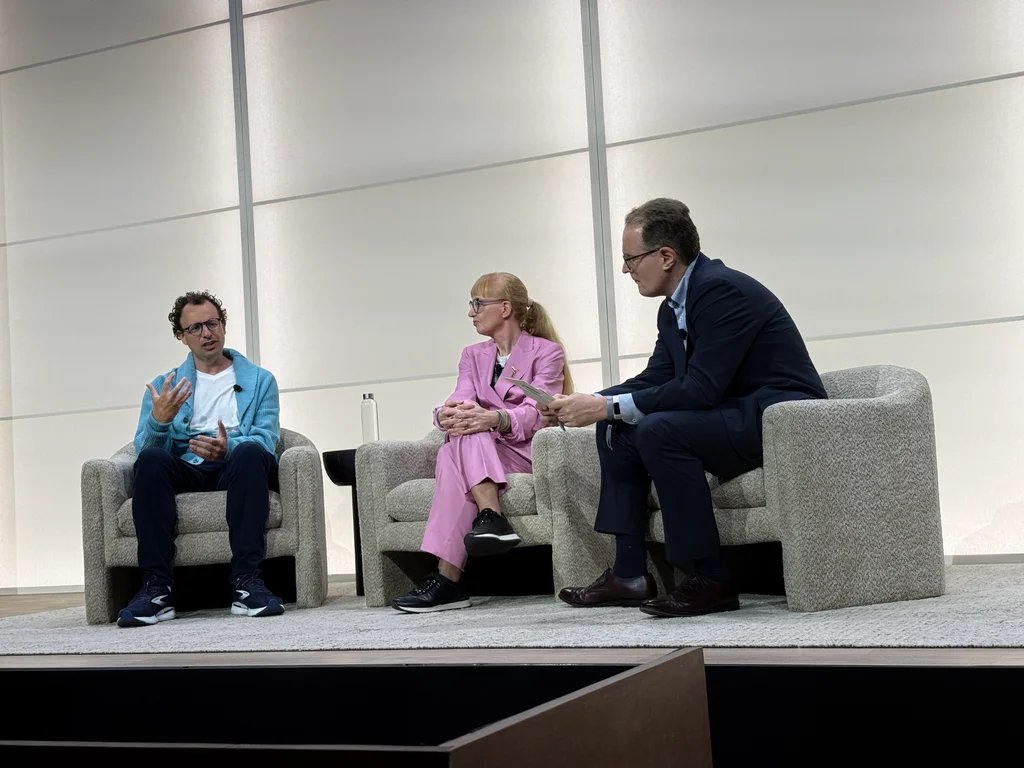
Even compared to most CEOs of AI companies, Anthropic cofounder and CEO Dario Amodei is known for making jaw-dropping predictions. In his October 2024 essay “Machines of Loving Grace,” he made one of his most famous: “AI-enabled biology and medicine will allow us to compress the progress that human biologists would have achieved over the next 50-100 years into 5-10 years.” He called the effect the “compressed 21st century.”
On June 30, at an Anthropic event in San Francisco called “The Briefing: AI for Science,” Amodei didn’t declare that AI’s impact on biology and other sciences had unleashed that effect, or was about to pull it off. Instead, he emphasized that he doesn’t expect it to transpire in the next couple of years. He floated that it “might” happen a decade from now.
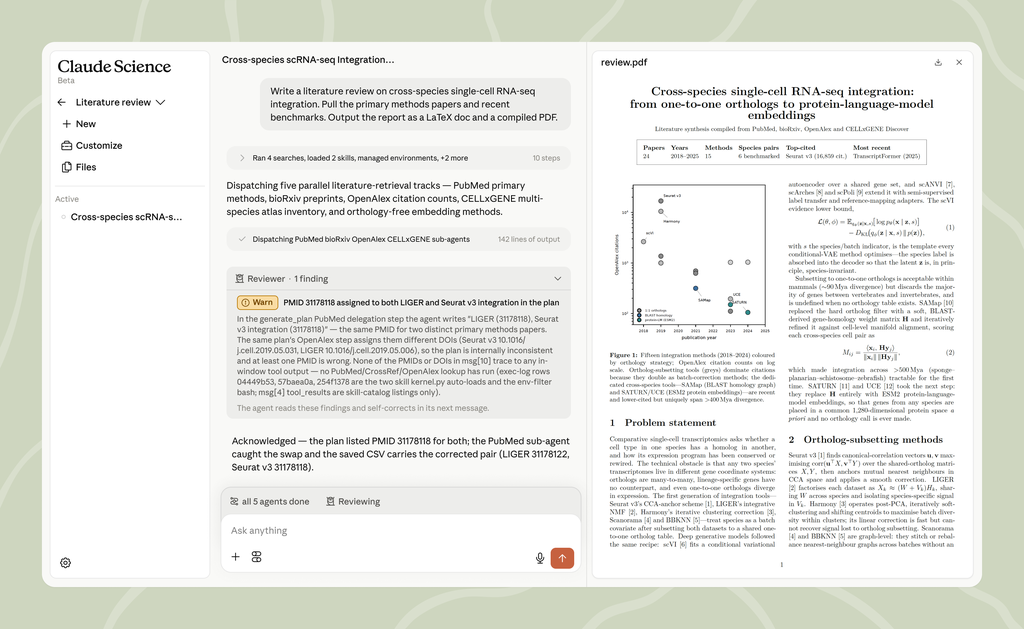
In AI, 2036 feels like the incredibly distant future. But the point of Anthropic’s event was to make the case that the company is working toward the compression that Amodei wrote about. In particular, it unveiled Claude Science, a new version of Claude, tuned for scientific research, that’s launching in beta today. Alexander Tarashansky, who led development of the product, did an extended on-stage demo.
Most of the remainder of the event was dedicated to panel discussions, with participants including Amodei, GLP-1 drug inventor Lotte Knudsen, Bristol Myers Squibb CEO Chris Boerner, Novartis CEO Vas Narasimhan, and Genentech executive VP Aviv Regev.
Though optimism about AI’s impact on the sciences certainly prevailed, it wasn’t unbridled. The conversations were surprisingly substantive, acknowledging that even rapidly improving AI can do only so much to advance fields such as drug discovery.
As I sat in the audience at the Yerba Buena Center, here’s some of what I found most worthwhile about the event, one of the better tech-company events I’ve been to in recent years:
1. Claude Science looks cool
I don’t expect to personally use Claude Science to create any breakthrough drugs. Not being a scientist, I may not use it at all. But I was impressed by Tarashansky’s demo, which showed how the product has the basic feel of a chatbot but also a much richer set of tools for finding, manipulating, and understanding information.
In particular, Claude Science can create infographics on the fly—not just as potential PowerPoint fodder, but to help explore data in ways that can’t be achieved by staring at mere numbers on a page. (“Science is a very visual affair,” noted Eric Kauderer-Abrams, Anthropic’s head of life sciences.)
When the infographics had problems—hard-to-read labels and a legend covering some of the info it was supposed to explain—Tarashansky added brief annotations, and Claude Science was smart enough to fix them.

Some aspects of Claude Science, such as the corpus of research materials it can draw upon, may not make their way to the versions of Claude that most of us use. But I do hope that the way it goes beyond largely textual sequences of prompts and responses is reflected more broadly in tools from Anthropic and everyone else in AI.
2. Fixating on “curing cancer” is misguided
Seemingly every discussion about how AI might radically improve human life quickly turns to the possibility of it curing cancer. That’s shorthand for it bringing forth otherwise unattainable medical breakthroughs that could save millions of lives; I, for one, would be equally thrilled if it cured heart disease first.
But I came away from Anthropic’s event resolving not to fixate on one or two big, audacious medical goals when thinking about AI and science. If all we get are hundreds or thousands of smaller, more quickly achievable advances, that’s hardly reason to conclude that AI’s promise turned out to be overblown.
“There’s a lot of possibility and opportunity here with this technology, but we also need to make sure we don’t set expectations for what we’re going to be able to accomplish that we simply can’t deliver on,” argued Boerner. “When you hear ‘cure cancer in our lifetime’—we’re going to make a lot of progress on cancer in our lifetime, but we don’t want to get over our skis.”
3. Science can be sped up only so much
Along with aiding scientific discovery itself, AI could help with other, more mundane aspects of getting drugs to market. “Sometimes, you have to recruit 20,000 people for a five-year study and it takes two years to recruit the people,” said Knudsen, who sees promise in AI for accelerating the sprawling administration involved in such tests.
Speaking of Amodei’s vision of squeezing decades of scientific advancement into years, she did caution that elements such as five-year studies can’t be radically downsized no matter how much AI you throw at them.
“I think we really will see a large compression, but we still need the clinical trial data,” she said. “So it’s probably hard to imagine that you can go below five years.”
Even if naturally slow processes such as clinical trials foil Amodei’s theoretical 10X speedup, less-dramatic progress is still progress. “You can get this down from 12 years from when we actually have a candidate to the end of this journey, down to 7 to 8 years—which, if you compound over this entire industry, is massive,” said Narasimhan.
4. Scientists may need to become “bilingual”
Industries of many kinds are currently in a weird trap involving overexcited executives not understanding AI well enough to actually use it responsibly (I’m looking at you, Ford). Knudsen, who seemed enthusiastic about the technology without any hint of irrational exuberance, said it’s essential for science to be full of people she described as “bilingual.”
“I don’t mean people who speak two languages,” she clarified. “I mean people who are completely fluent in some scientific topic as well as in digital and AI. And then, one person in each team can do wonders, because you cannot just say to people, ‘Use AI.’”
5. Don’t expect hallucinations to disappear
At one point, interviewer Matthew Herper of Stat News told Amodei that he’d asked Claude for assistance with questions to pose on-stage. The chatbot didn’t encourage him to lob softballs. According to Herper, it told him to ask “Why should pharma trust AI predictions when your models hallucinate?“
Amodei responded by saying that hallucinations “have gotten better and better over time—you don’t hear as much about hallucinations,” which is true. Ultimately, however, he contended that AI imagining things is inseparable from its ability to tease new insights out of what it knows.
That’s also true of humans, he said: “In order to be creative, you’re often straddling the boundary between making things up and having good ideas. And so I think [hallucinations] are never going to fully go away.”
Amodei didn’t quite get around to addressing what hallucinations being inevitable means for science. Still, I was impressed by his willingness to deconstruct his own predictions about scientific advancement, and to let others do so on a stage he was paying for.
AI already has more grand pronouncements than it really needs, but calmer, more measured discussions are always welcome. They might even be the best way for the industry to break through the public skepticism that dogs its every move.
