
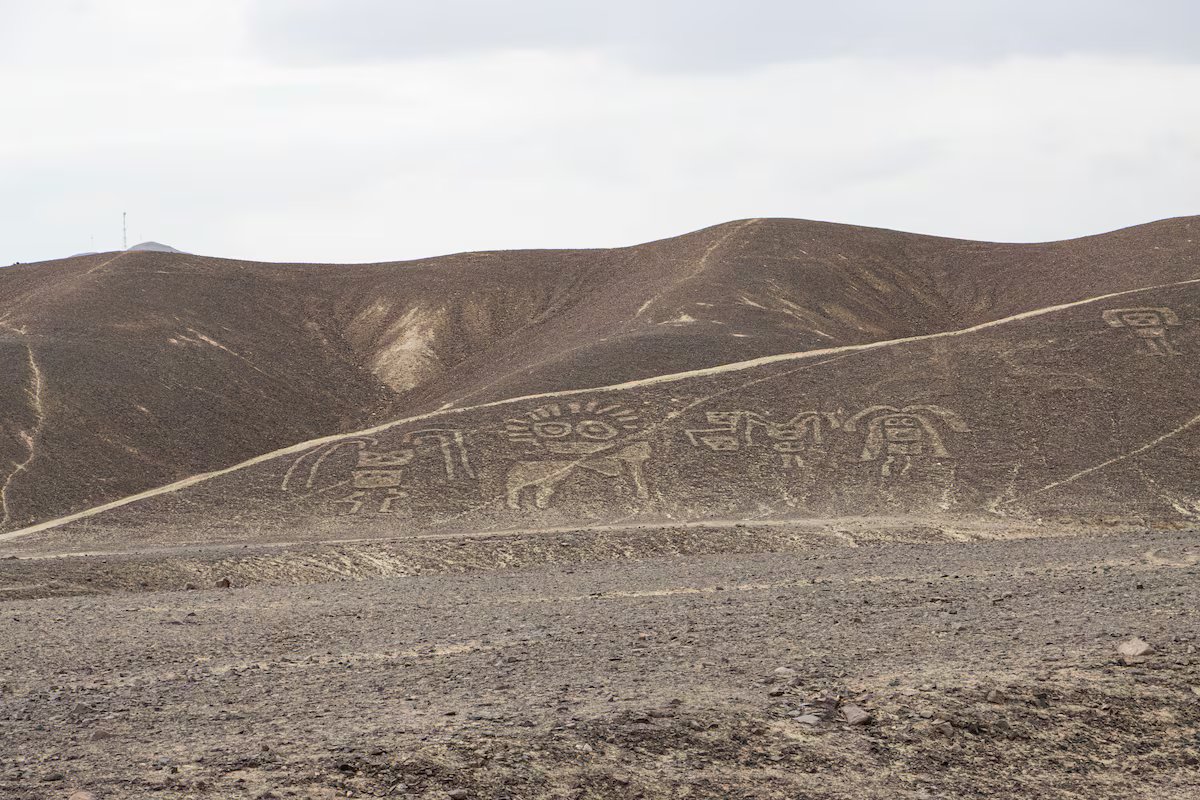
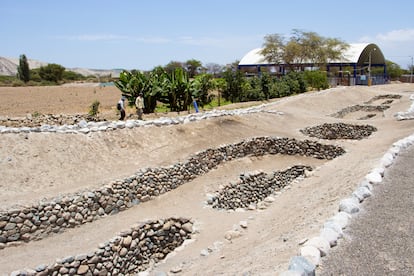
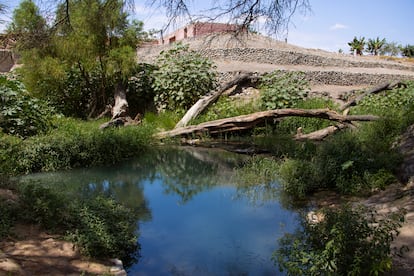
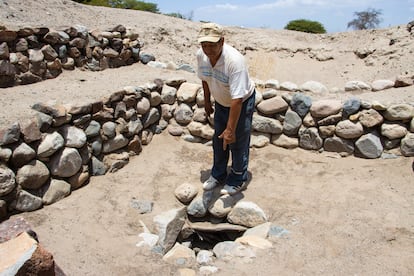
Antonio Aguilar, a robust 77-year-old man, describes his work. “Two weeks ago, I went down there to clean,” he says, pointing to the edge of a well with stones neatly arranged around its rim and about seven meters deep. “I went down, removed the trash, entered the tunnel that leads to the other well, cleaned that one too, and climbed back up.” A trickle of water runs at the bottom, emitting a soft sound that echoes the conversation. In the distance, more wells can be seen, linked together. It is an aqueduct built by the Nazca culture some 1,500 years ago, the same culture that created the famous geoglyphs of Peru depicting men and animals, and who lived in this area between 100 and 800 AD.
Both in the complex of wells and tunnels, called the Santa María de Taruga Aqueduct by the Ministry of Culture, and in the drawings that have given rise to outlandish theories (such as the one that attributes their construction to extraterrestrials), there is a thread of continuity that sends a message to the present. “All the animals drawn on the Nazca and Palpa plains are associated with water and fertility rituals,” explains Johny Isla, an archaeologist with the Decentralized Directorate of Culture of Ica (DDCI), the department where these astonishing pre-Hispanic remains are located. The spider, for example, is an arthropod that symbolizes the regeneration of life through the hundreds of offspring that emerge from the nests upon hatching. The hummingbird “is a pollinator par excellence and fertilizes plants,” Isla also points out.
There’s even a drawing, mistakenly called “The Hand,” but which is actually “a toad about to jump.” To this day, the men and women of the countryside know that when this animal appears, a good year of rain is coming, just as their ancestors knew centuries ago. It’s accumulated wisdom that remains very useful today, when there’s a high probability of the coastal El Niño phenomenon developing, and the abnormal warming of the sea off the coasts of Peru and Ecuador threatens to cause heavy rains and flooding in several departments, including Ica.
The complex of aqueducts, geoglyphs, and lines drawn in the desert was related to survival in an adverse environment, with frequent climate changes and where water was a scarce resource. Water had to be obtained by drawing it from the subsoil and creating a chain of wells connected by underground tunnels to bring it to the fields. “These ancient aqueducts constitute a unique system in the Andean world,” Isla states.
“There are 42 in total, of which 29 are still functioning.” One of them is precisely the one Aguilar carefully maintains. It’s used to irrigate fields where beans, lima beans, and watermelons are grown. Without these providential wells, also called puquios, it wouldn’t be possible.
For Ana Cecilia Mauricio, an archaeologist at the Pontifical Catholic University of Peru (PUCP), all those pre-Hispanic constructions “should be called science and recognized as such.” Developing such a way of preserving water required a spatial understanding and intelligent management of ecosystems—something that has been lost over time.
Life for the inhabitants of the Nazca society was bearable at times thanks to the abundance of water and fertile fields during certain periods of their history. However, according to archaeological and paleoclimatic studies published in the scientific journal Catena, a gradual process of desertification began around 150 AD, becoming particularly acute between 350 and 400 AD.
Isla notes that there were up to 80 years of water scarcity, yet a powerful culture developed, producing very fine pottery and featuring a ceremonial center called Cahuachi. Around 600 AD, an extreme drought erupted, marking the decline of this society, as he and his colleague Markus Reindel point out in a 2013 article published in the journal Diálogo Andino.
The famous geoglyphs had been under construction since 100 AD, over several generations, not in a short period. But it was during the most dramatic periods of drought that they grew larger and more numerous. The explanation for this is intriguing: they were used to call upon a deity in the heavens, asking him to see them and send rain.
Isla says it was “like a mythical flying god” (whom some researchers call ‘Kon’) and that, like all gods, “it was in the sky.” The drawings on the pampa that still survive today would have been dedicated to this deity. A clue that this was their purpose is that there are older and smaller geoglyphs, placed on the hillsides by the Paracas culture (800 to 200 BC), when droughts were less frequent and praying to the heavens was not as necessary.
Each culture faced its own challenges, and all indications are that the Nazca people had to contend with a harsh, dry climate and territory. According to the late historian María Rostworowski, “they were immersed in a magical environment, where the entire universe—the sea, the wind, and the earth—throbbed with life in unison with humankind.” And where, at the same time, a cult of the hills and water developed.
Isla adds that the geoglyphs were like a plea to this supreme being, who also appears on the pottery of this pre-Hispanic culture, to become benevolent, not punitive, and to listen to them. They turned to him when there was a water shortage. It is also presumed that rituals with this purpose were performed in the pampa where the lines and drawings are located.
Climate lessons
Can the legacy of the Nazca people be used to address the consequences of current global warming? Francesca Fernandini, another archaeologist from PUCP, agrees with Isla, stating that “there was a change in the settlement pattern of this society between 300 and 400 AD, so it is presumed that they faced a possible climate crisis characterized by a drought.”
It is precisely during times of crisis, of drought, that this hydraulic technology emerges, he adds. And when they run out of farmland, “they have to think outside the box and start figuring out how to irrigate barren lands.” All that knowledge, however, was almost completely lost during the colonial period and also in republican times, as if it were useless.
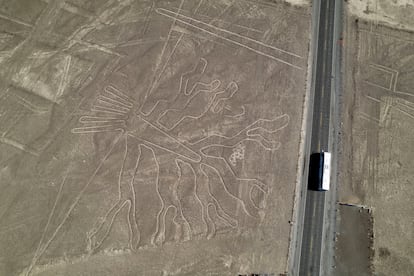
One example is that the current Pan-American Highway, built around the 1930s, cut across the pampa and bisected some of the geoglyphs, including the one known as “The Tree.” Their importance wasn’t fully recognized until 1940, when archaeologist and mathematician Maria Reiche dedicated herself heart and soul to preserving the Nazca Lines and geoglyphs.
This contributed to their designation as a World Heritage Site in 1994, at a time when they were already popular with tourists and known worldwide. What hadn’t been sufficiently recognized was their importance, not only as a pre-Hispanic site, but also as a place where technologies for survival were developed. Now, as the global climate crisis intensifies, there is a legacy to be reclaimed there. According to Fernandini, it was precisely with the arrival of the Spanish that a rupture occurred in the inherited knowledge.
The coming risks
The Nazca Lines are sometimes impacted by the sudden onset of heavy rains originating in the Amazon that reach the coast, or by events such as El Niño, although these effects are mild. Back in 2009, the Geological, Mining and Metallurgical Institute issued a report detailing the effects of unusually heavy rains on the lines.
Some ancient ravines were activated due to the enormous flow of water from the Andean foothills, affecting the geoglyphs known as “The Tree” and “The Hand.” The impact occurred because, when the floodwaters reached the Pan-American Highway, the water was dammed up after hitting the raised platform on which the road is built.
The problem wasn’t necessarily related to climate change. However, if this phenomenon worsens, heavy rains could fall near the area where the geoglyphs are located, and some streams could become difficult to control. Therefore, as Josué González, director of the DDCI (Directorate of Indigenous and Cultural Heritage), points out, the Ministry of Culture is monitoring the neighboring ravines, even though most of the drawings are in sheltered areas, far from any large watercourses, because the Nazca society was quite conscious of where to build and live.
Other threats looming over the Nazca Lines are the advance of illegal mining, which is already present in the area, and the uncontrolled expansion of the agricultural frontier, which could deplete the water table, the resource from which the wells and tunnels still in use were devised centuries ago. These are the same wells and tunnels that Aguilar, guardian of the Taruga aqueduct, has known since he arrived in these plains at the age of 12 from the Andean department of Ayacucho. “Back then there was plenty of water,” he recalls, while observing the faint trickle running at the bottom of a well.
Sign up for our weekly newsletter to get more English-language news coverage from EL PAÍS USA Edition
