
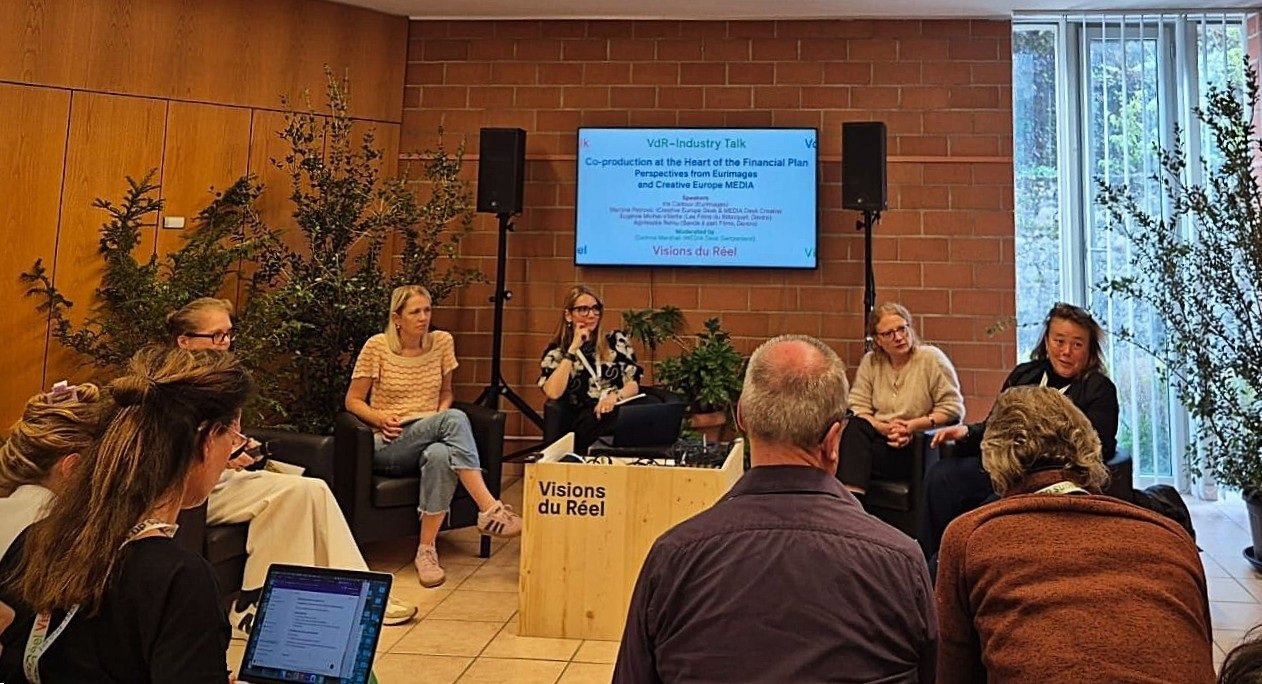
– Panellists concluded that co-production isn’t just a creative choice for documentary filmmakers, but also shapes how projects are structured, financed and brought to market
l-r: Corinna Marschall, Agnieszka Ramu, Martina Petrović, Eugénie Michel-Villette and Iris Cadoux during the panel
At this year’s Visions du Réel (17-26 April), a case study-driven industry talk explored how European documentary producers are increasingly building their financing plans around co-production, as supranational support schemes such as Creative Europe – MEDIA and Eurimages become ever more central to the way projects are developed, structured and brought to market.
Held on 20 April in Nyon, “Co-production at the Heart of the Financial Plan: Perspectives from Eurimages and Creative Europe – MEDIA” brought together institutional voices and producers to unpack both the logic and the practicalities behind cross-border documentary financing. Moderated by Corinna Marschall, head of MEDIA Desk Suisse, the session featured Martina Petrović, head of Creative Europe Desk – MEDIA Office Croatia; Iris Cadoux, of Eurimages; and producers Eugénie Michel-Villette (Les Films du Bilboquet) and Agnieszka Ramu (Bande à Part Films), who discussed the Franco-Swiss documentary Dentro by Elsa Amiel as a concrete case study.

Marschall opened by outlining Switzerland’s particular position outside the European Union, and therefore outside the Creative Europe framework, despite the country’s long-standing efforts to maintain ties with European collaboration schemes through national compensatory measures. She noted that co-production has become a “central pillar” in the financing of documentaries, and framed the discussion around what major funders now expect from producers in terms of both structure and strategy.
Petrović offered an overview of Creative Europe – MEDIA’s current tools for producers, focusing especially on co-development, mini-slate and slate support, as well as TV and online content. She stressed that, particularly for smaller territories, co-production is no longer optional, but essential. In her view, it is often the only way for producers from lower-capacity markets to remain competitive in a crowded European audiovisual landscape.
She argued that the programme actively rewards less predictable partnerships. By way of example, she explained that a Croatian-Icelandic co-production would score more strongly than a more habitual regional pairing because the scheme values uncommon alliances that broaden European exchange. Petrović also underlined that support is highly competitive: while the formal threshold stands at 70 points out of 100, actual selection levels can rise well above that.
At the same time, she sought to demystify the application process. “I still want to encourage you to apply to Creative Europe – MEDIA and not to run away from it,” she told the audience, acknowledging both the complexity of the system and the anxiety it can generate among producers. She also reiterated concerns around structural imbalance within the wider ecosystem, especially on the distribution side, where smaller countries still struggle to compete on equal terms.
Cadoux then shifted the focus to Eurimages, reminding attendees that the Council of Europe fund currently brings together 39 countries and supports theatrical feature co-productions, including documentaries. She explained that, in documentary, Eurimages allows for greater flexibility than in fiction or animation, notably in relation to shooting schedules: whereas principal photography is generally not supposed to begin before a decision is made, documentaries can already have a substantial amount of footage completed at application stage.
She noted that projects must present a convincing artistic and production package, after which they are assessed by independent experts and discussed within dedicated groupings, including one specifically for documentaries. Cadoux also made it clear that funders tend to respond positively when a co-production feels genuinely organic, rather than artificially assembled for eligibility purposes. Strong producer’s and director’s notes, she added, are crucial in making that case.
That issue of “organic” collaboration was at the heart of the discussion around Dentro, screening in the gathering’s International Competition. The film, set in a prison and shot over an extended period, was presented as a Franco-Swiss partnership that emerged naturally from the project’s development history, rather than from a financing strategy imposed after the fact.
Ramu and Michel-Villette explained that the Swiss side had been involved from a very early stage, after discussions with the director began long before production properly took shape. The producers then worked out which co-production set-up best reflected the film’s artistic and practical needs. Because the director has ties to both countries, the project was able to develop as a genuinely shared venture, rather than one requiring elements to be artificially “invented” to satisfy funding rules.
The producing duo described applications to MEDIA and Eurimages as something akin to a game, albeit one that demands rigour, patience and stamina. “You have to love the game,” they said, referring to the sheer amount of contractual, financial and strategic thinking required. If producers do not learn to engage with that logic, they suggested, they risk being overwhelmed by the process.
For both producers, the benefits were clear: Eurimages in particular brought in money that significantly changed the movie’s financial architecture, while the layering of different schemes helped plug a gap that would otherwise have been difficult to close. Still, they also acknowledged the timing challenges involved, especially when selective support decisions do not align neatly with production schedules.
In the end, the session made it abundantly clear that for today’s documentary producers, co-production is no longer simply a cultural or creative choice. It is increasingly the backbone of the financial plan – but one that only works when the artistic logic, the rights structure and the financing strategy all genuinely pull in the same direction.
