
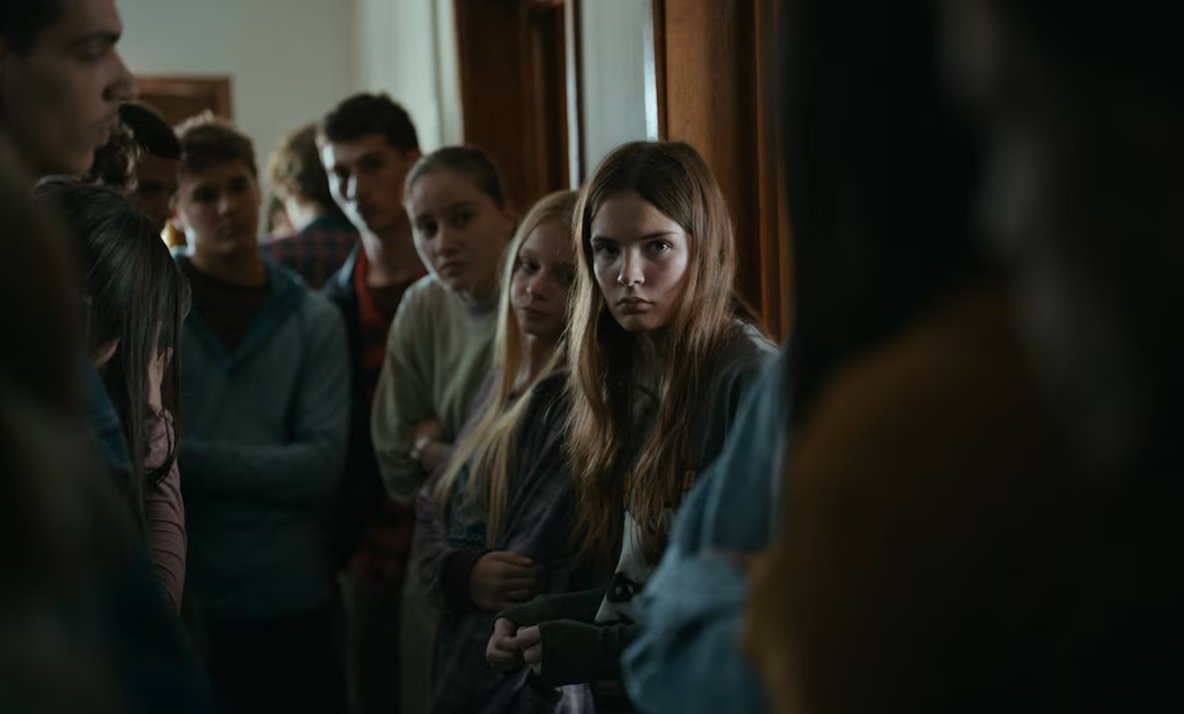
– CANNES 2026: Blerta Basholli brings an undeniably powerful clarity of perspective to her sophomore feature, which follows a teenage girl growing up in late-1990s Pristina
Pinea Matoshi in Dua
An increasing number of films emerging from the Balkans are continuing to redefine the classical coming-of-age genre. Rewardingly, they have become less about a compulsory sense of sexuality and more about girlhood identity as shaped by a harsh environment forced upon a young protagonist. Blerta Basholli’s Dua, written by herself and Nicole Borgeat, is another instalment in this welcome trend, yet still distinct and immensely emotional in its own right, playing out against the backdrop of the ethnic persecution of Kosovar Albanians and the war in 1990s Kosovo.
Acclaimed Kosovar-born filmmaker Basholli is known for her debut feature, Hive (2021), which collected the Grand Jury Prize, Audience Award and Directing Award in Sundance’s World Cinema Dramatic Competition, also becoming the first movie from Kosovo to reach the Oscars shortlist for Best International Feature. Now, she brings her sophomore feature to the Cannes Critics’ Week, where it world-premiered to a standing ovation mainly targeted at newcomer Pinea Matoshi, who plays Basholli’s titular 13-year-old protagonist with an arresting intensity.
As the youngest of four siblings – with her sisters Mimi (Fiona Abdullahu) and Tina (Kaona Sylejmani), and her brother Vegim (Andi Bajgora) – Dua is eager to grow up quickly. It just so happens to be in a world where she is on a first-name basis with the dead, killed at the hands of the Serbian police, although her father (Kushtrim Hoxha) refuses to flee. She makes friends with the athletic Maki (Vlera Bilalli), a refugee from another town who introduces her to judo and gets her in touch with the rage that fills her. Yet, “Not everyone is born to fight,” reprimands her mother – played by Yllka Gashi, who reunites with Basholli after playing the lead in Hive, now bringing to the table an enriching supporting performance.
The film’s moving core is reflected in Basholli’s ability to carefully navigate the tensions permeating the two key binaries of remembrance/escapism and rebellion/compliance. In doing so, she successfully de-simplifies the trope of wanting to be a teen while facing a plethora of external pressures, with the opening scene of Dua becoming an exemplar of the teenager’s central concerns. Conventional coming-of-age moments melt into the reality of the extreme peril she faces as a young Kosovar Albanian girl at this place and time, rather than pitting them against each other.
Basholli applies the concept of “camera as witness” to Dua’s life, whereby the film’s lensing is intently grounded in her perspective, hardly ever letting the girl out of sight. She and cinematographer Lucie Baudinaud prefer even a handheld camera to stay as close as possible to the teen for almost the entire running time, either following her from behind or in front and by her side. With this technique, the frame is so tightly trained on her that it seems to, at times, block out surroundings like her own defence mechanism. The emotional core of Dua is also heavily impacted by the atmospheric sound (owing to a skilled team of Sasho Blazhevski, Marc von Stürler and Philippe Ciompi) and string accompaniment (original music by Audrey Ismaël) that drive a mostly unsentimental audioscape.
Dua is of few words but possesses no inkling of naivety, and Matoshi’s performance is full of stares and small twitches of the lips; miraculously, at one moment, she can look far younger than she is, and at another, far older. The movie’s thoughtful build-up of her story makes the needle drop – of “Brazen” by British alt-rock band Skunk Anansie – during a passionate karaoke scene, with its dash of girlhood flair, worth every second.
Dua was staged by Kosovo’s Ikonë Studio and Switzerland’s Alva Film, and co-produced by France’s Kazak Productions. The Party Film Sales holds the rights to its world sales.
