
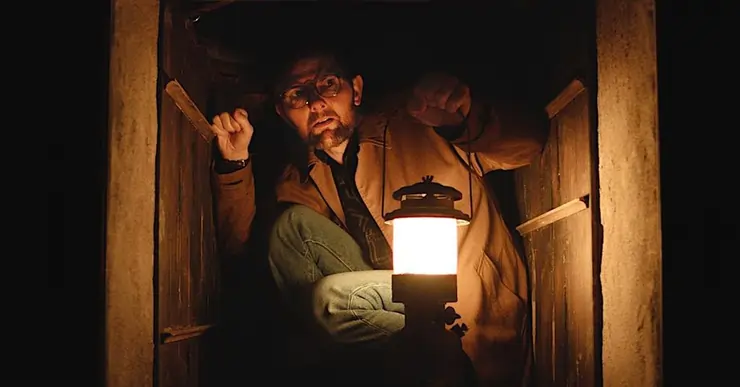
Hokum is a delightful creaky-floorboard of a film, a horror movie that revels in an oddly comforting tactile familiarity as it embraces the hoary old haunted-house clichés. Actually, make that haunted hotel: this is one location that will not be getting a 5-star rating on Airbnb anytime soon, but viewers willing to check in will have an enjoyably shiversome time.
The film comes from Damian McCarthy, an Irish genre filmmaker very much in the ascent after his acclaimed favourites Caveat and Oddity. Those who’ve seen West Cork-based McCarthy’s earlier works will know what to expect: he is plugged into the mythology of the Irish landscape (it won’t take long into Hokum before fans spot a familiar and all-important Easter Egg from his earlier works, not to be spoiled here), and he refreshingly forgoes cheap scares in favour of folkloric foreboding. However, that’s not to say that his films don’t deliver nasty jolts when needed. Rather, McCarthy prioritises spooky atmosphere with scares used as an occasional punctuation, a la the classic ghost story writers such as M.R. James and E.F. Benson.
A significant plus is the casting of Adam Scott in the lead role. Clearly buoyed by his newly minted status in Severance, the one-time ‘guy in the background of all those rom-coms’ gives a terrific and bravely unsympathetic performance (at least for the most part) as reclusive author Ohm Bauman, the author of a hugely successful historical fiction franchise. The film begins, somewhat unexpectedly, with a bold dramatisation of the character’s latest work-in-progress, a tale that promises to deliver a bleak climax in line with Bauman’s misanthropic worldview.
Bauman then travels to Ireland to scatter the ashes of his deceased parents, during which time it becomes clear that his mother passed away in mysterious circumstances. Their happiest memory came while honeymooning at a remote rural inn, and this is where Bauman takes up lodgings, immediately antagonising the staff, including scalding a blithe bellhop on the hand with a heated spoon, and dismissing the tales of a witch that haunts the gated-off honeymoon suite on the top floor. He also runs into the local hermit, Jerry (perennial scene-stealer David Wilmot from The Guard), who waxes about LSD-laden milk and witchcraft while remaining an object of suspicion for the local community after the unexplained death of his wife.
Bauman is inevitably drawn to the ominous honeymoon suite after the Halloween party disappearance of the hotel’s sympathetic worker, Fiona (Florence Ordesh), with whom he’d connected after sharing his dark philosophies as a writer. The staff, including obsequious front-of-house man Mal (Peter Coonan) and the police, claim they’ve searched everywhere – except, of course, for the one pivotal location. What constitutes a relatively brief physical journey from the bottom of the hotel to the top floor is transfigured into the classic metaphysical horror odyssey into the recesses of the self when said room starts to reveal its horrific secrets, including a horribly claustrophobic dumb waiter that prompts some of the film’s most alarming scenes.
Scott expertly physicalises Bauman’s isolation and inner torment: the pivotal scattering of the ashes scene is marked by a subtle but noticeable contrast in behaviour that speaks volumes about the character’s backstory with his parents. As with all classic ghost stories, we’re invited to find empathy with the avowedly difficult and less-than-empathetic, making the film’s steady slide into terror all the more arresting; after all, the best kind of horror only really arises when we care, as the assault on the central character subsequently feels more like an assault on our own senses. There’s also a nice stretch of subtle black humour, clearly arising from Scott’s dry proficiency with the comedy genre, that will possibly open Hokum up to a larger audience than the director’s previous films.
The film is a cobwebby marvel of design – full credit to DP Colm Hogan, production designers Til Frohlich and Ciara McKenna, and costume designer Lara Campbell for fully immersing us in the suggestive air of mould, mildew and tattered draperies that conceal awful revelations. Insidious and The Conjuring composer Joseph Bishara articulates fear efficiently with echoes of Ligeti and Bartok while reserving lyrical empathy for Bauman as the character steadily unravels.
There are jump scares, some predictable and others less so, but it’s Scott’s psychological descent that keeps us arrested, while McCarthy, in his usual manner, assimilates the worlds of the living and the dead smoothly. In fact, it’s often the former that yields the most antagonism with spiritual activity often arising out of a very human sense of apathy, ignorance or outright malice – McCarthy’s ability to locate these subtexts shows an acute awareness of folk fable conventions that stretch back millennia.
Hokum may not capitalise on the visual suggestion of folklore as successfully as Oddity did (there’s nothing quite as striking as that film’s wooden golem figure), and there are plot threads, including the TV reveal of a monstrous creature, that aren’t as well articulated as they should be. Nevertheless, it remains an enjoyable ride even if we’re familiar with the essential ingredients – the key lies in McCarthy’s ability to dust off the layers of familiarity, peeling back years of horror conventions to make them gleam anew.
★★★★
In UK cinemas 1st May / Adam Scott, Peter Coonan, David Wilmot, Florence Ordesh / Dir: Damian McCarthy / Black Bear UK / 15
Discover more from
Subscribe to get the latest posts sent to your email.
