
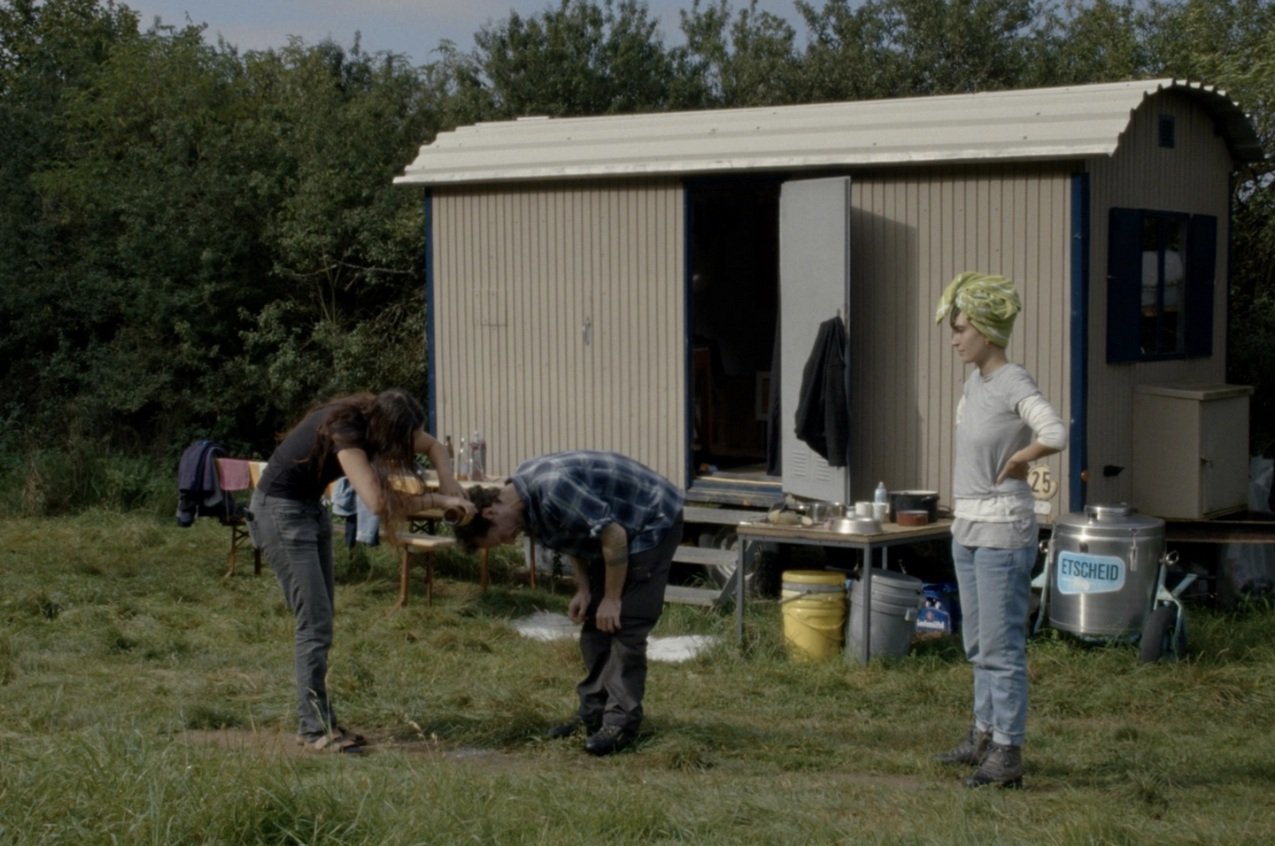
– In his documentary, Leonhard Pill observes the cycles of nature, of sheep, and of their shepherdess
The modern world and contemporary lifestyle tend to offer satisfaction through comfort, rather than through the sense of accomplishment that comes from working hard to achieve something. They also tend to overwhelm us with information at a rapid pace and burden us with making decision after decision based on it. That may be one reason why some people choose alternative, simpler, old-fashioned ways of life. A personal desire, and the need for detachment from modern living, is perhaps the only way to explain the choice made by Valeria, the protagonist of Leonhard Pill’s documentary Does the Horse Have to Work, Too?, which has world-premiered in the Regional Competition of ZagrebDox.

Valeria left her previous life to work as a shepherdess somewhere in the Austrian mountains. She lives in a metal container in the middle of nowhere and tends to the every need of every “member” of her flock – taking them to pasture, keeping them safe, helping the females give birth, separating mothers and newborn lambs in the enclosure, treating injuries and trimming hooves. When the time comes, she also takes them to the slaughterhouse, skins them and disposes of the remains. In her free time, she practises crafts and listens to extreme metal, either to set the rhythm of her work or to “wash out” the cacophony of the day’s dissonant bleating that she must endure. She does everything with patience and a certain self-assurance, and she is paid the minimum monthly wage for her work, so it is clearly not about the money. Perhaps the visit from her sister Fidelia, and the opportunity to engage in an in-person conversation with another human being, may shed some light on her motivations…
Does the Horse Have to Work, Too? is not that kind of documentary, as Leonhard Pill opts for a strictly observational style in order to create space for the viewer’s own meditation on topics that rarely extend beyond passing thoughts. He is highly methodical and notably unsentimental in this approach, showing his protagonist’s life and work across all four seasons, with snapshots of incidental beauty, such as landscapes in the light of the setting sun, or the occasional ugliness and cruelty of natural law: stillborn lambs, babies dying for a variety of reasons, or old animals being killed. Much of the imagery captures the sheer mechanics of it all: a large flock moving from one point to another, two young rams head-butting, and Valeria carrying out her daily work with a sense of calm and serenity.
Although the documentary sometimes risks getting lost in repetition with only minimal variations, it is commendable for the filmmaker’s uncompromising attitude in showing things as they are, without explanation or sentimentality. He also undertakes most of the work himself: he serves as his own cinematographer, sometimes steps in front of the camera, or asks his protagonist questions about the specifics of her work and life, to which she responds in laconic fashion. Even the tracks she listens to are provided by his own band. The editing by Florian Lambrecht keeps the pace of the documentary in sync with natural processes, and suits the style Pill has chosen. Does the Horse Have to Work, Too? emerges as a highly sincere documentary that should connect with its niche audience.
Does the Horse Have to Work, Too? is an Austrian production independently produced by the filmmaker himself.
