
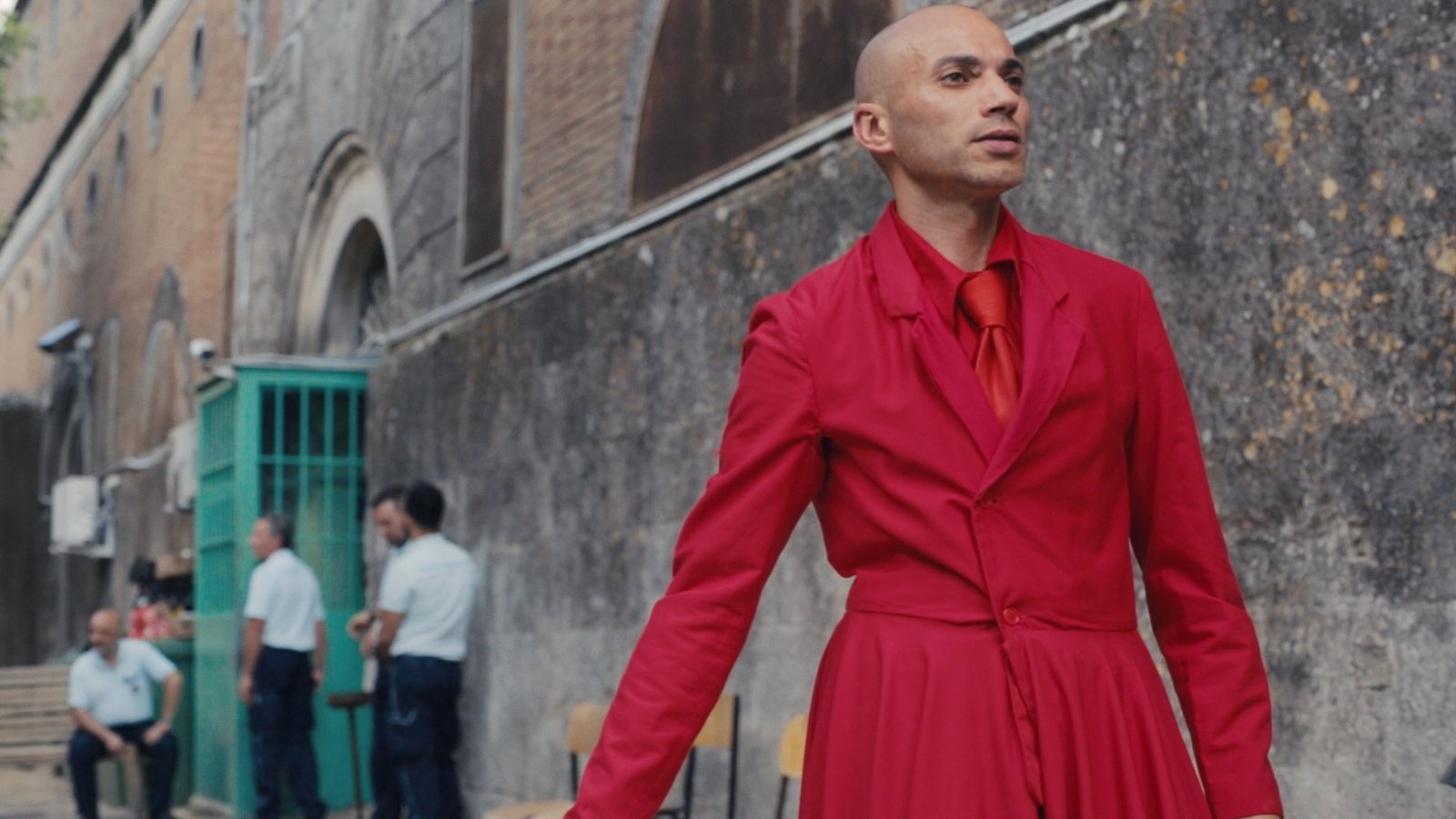
– The latest feature by French-Swiss director Elsa Amiel examines the magical nature of the stage as a meeting point, but also for discovering oneself and the beauty of the world
A trusty explorer of bodies, transformed into mysterious and unspoiled lands through the power of cinema (we’re mostly thinking of Pearl, revolving around an astonishing bodybuilder), French-Swiss director Elsa Amiel explores the notion of detention as a place of artistic research and experimentation in her latest feature film, Dentro, which was selected in Visions du Réel’s International Feature Film Competition.
Elsa Amiel discovered the theatrical work of her protagonist, Armando Punzo, somewhat by chance, as if destiny had brought them together. Intrigued by his artistic practice, and the fact that he’d chosen a prison as the venue for his theatrical works, the director decided to move closer to his world. As she herself describes, after spending time in prison with her camera off so as to understand and absorb the creative process driving Punzo, Elsa Amiel realised that her film would be fuelled by the same fire and by the same desperate search for freedom. Dentro is the filmic transposition of this intense human encounter, of theatre’s poetic power but also its political potency. Where deprivation reigns supreme, bodies and words can allow people to dream of a freedom which many of them had given up on.
Dentro revolves around the work of Armando Punzo, a theatre director who has locked himself away in Volterra prison in Tuscany for over thirty years, in order to create highly poetic works with some of the prisoners. Forged on the ground, steeped in the oppressive yet mysterious atmosphere of prison, a place cut off from the world where very specific rules must be respected to the letter, Punzo’s working methods are unique. Prison becomes a metaphor for the human condition and theatre the means by which to transcend the principle of reality. Through words which stem from encounters with prisoners – a starting point and essential component of Punzo’s work – human interactions morph into astonishing moments of discovery. In this sense, theatre becomes a space in which to act and interact with unusual dynamics, which are both liberatory and destabilising.
On stage, everyone can be who they want to be, they can liberate their bodies as if suddenly becoming a blank page on which to rewrite their own stories. Because bodies, over and above words, are the main focus and undisputed protagonists of Amiel’s film. Whether it’s a question of intimate moments off-stage, creative moments, or rehearsals ahead of performances, the actors’ bodies appear as if imposing wax statues which might melt at any moment under the spotlights. But their disintegration and disappearance is a cathartic rather than a destructive act. The focus on bodies allows the actors to escape an ordinary life governed by rules, imposed timings and unnatural rhythms, and cross over into an alternative space where anything is possible, where you can change skin and observe the world with the wonder of a person suddenly waking from a dream.
According to Punzo, much like a spiritual practice theatre allows actors to transcend the banality of everyday life and reach another level where they can be truly present, acknowledging the world’s beauty with emotion, amusement and, occasionally, fear.
With Dentro, the director allows us to observe these changes and participate in this liberatory yet complicated and, at times, challenging metaphor. And that’s the film’s strength: it shows Punzo’s complexity and occasional ambiguity, the fact that he can be an uncompromising friend and mentor, reassuring but wilfully inflexible. Theatre – and life itself – can be like this too: contradictory and ambiguous, a source of poetry but also, inevitably, uncertainty.
Dentro was produced by Les Films du Bilboquet (France), Bande à part Films (Switzerland) and RTS – Radio Télévision Suisse (Switzerland).
(Translated from Italian)
