
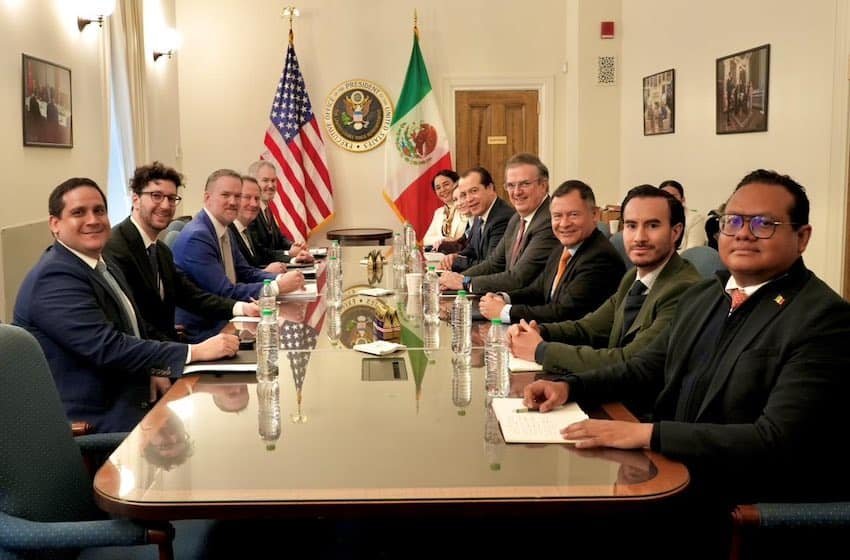
Every time I sit down with American government officials, thought leaders and think-tankers in D.C., I come away more convinced: U.S. global economic priorities have shifted for good. The sooner we all grasp that shift and start building a new North American paradigm together, the less self-inflicted damage we’ll inflict on ourselves.
In previous essays, I’ve sketched the outlines of the regional utopia we could create — if we fully leverage our shared border, our complementary demographics, our small and medium-sized enterprises and our integrated energy platform. But before I write anything else, we need to talk about the single most important “contract” binding our three countries: the United States-Mexico-Canada Agreement (USMCA).
Catch up on Pedro Casas’s “Regional Utopia” series here.
Nothing I’ve proposed is realistic unless the legal framework actively encourages it.
Trade deals come in two basic flavors. One type simply lowers barriers so cheaper goods can flow between distant economies; the CPTPP or the Free Trade Agreement between Mexico and the European Union, for instance, connects countries separated by oceans with little hope of deep productive integration. The other type aims to knit economies together at the factory floor. That’s what the USMCA (and its predecessor, NAFTA) was meant to be.
Right after NAFTA took effect, intra-regional exports exploded. Anyone writing at the turn of the century would have bet that North America was on track to become more integrated than Asia — and maybe, if you were feeling bold, as tightly woven as Europe. It didn’t happen. Integration plateaued, then slipped. The reason is painfully simple: China entered the game.
The United States pivoted toward a purely commercial relationship with Asia instead of doubling down on productive integration with its closest allies. We all know how that story ended.


U.S. Imports. The thicker the arrow, the higher the amount of imports from that country to the U.S. Source: McKinsey Global Trade Explorer
So where do we stand today? First, we need to agree on a basic premise: the U.S.-Mexico economic relationship is fundamentally different from any other the United States has. Mexico is America’s largest buyer of goods worldwide. In manufacturing, we trade mostly intermediate goods — we are literally co-producing the final product. As a result, our bilateral “deficit” looks very different from the one-way flows with countries that buy little or nothing from the U.S.
Goods made in Mexico increasingly incorporate U.S. inputs, and vice versa. OECD TiVA data drives the point home: U.S. value-added in Mexican manufacturing exports stands at 14.9%, compared with just 1.6% for China (co-producing vs. simple trading). The bilateral deficit, when viewed through a value-added lens, shrinks dramatically — by as much as 82% in the automotive case — because so much of what crosses the border is co-produced, not one-way dumping.
As Dr. Luis Foncerrada states, the needs of our two countries are deeply complementary. Mexico should no longer be viewed merely as a trading partner, but as an integral component of the U.S. productive system, a key element in any effective Asian containment strategy, a stabilizing force for regional macroeconomic stability, a vital partner in recovering the Western Hemisphere’s economic momentum and a trusted ally in advancing shared security goals across North America.
For more than two decades, however, we ceded ground to China and its partners, letting them steal technology, integrate vertically and compete against North America — essentially for free. Enough lamenting. It’s time to look forward.
The current tariff regime often rewards competitors outside the region while weakening our own incentives. Sections 232 and 301 apply equally to allies and adversaries alike; they do little to reward regional content or vertical integration.
Take the auto sector: as a region, we lost roughly 2% of global market share to Asia last year. Uncertainty about the USMCA’s duration and the terms of its 2026 review makes companies reluctant to commit to long-term investments. Persistent irritants — non-tariff barriers, uneven energy regulations and unfair Chinese competition — continue to drag on us.
Trade volumes have soared, yet per-capita GDP convergence has lagged. Pure trade integration, it turns out, is not enough. We need joint industrialization.
The upcoming USMCA review — set for its first formal milestone on July 1, 2026 — gives us the perfect moment. A clean 16-year extension is still possible. Major surgery is improbable; targeted, high-impact upgrades are realistic and overdue.
US and Mexico set May 25 date for first official USMCA negotiating round
Here’s what a smarter deal could look like:
1. Make tariffs work for regional integration, not against it.
Grant genuine preferential treatment to goods that meet (or exceed) Rules of Origin — especially in strategic sectors — by shielding them from Section 232-style national-security tariffs. Today, Mexico faces a disadvantage versus Japan, South Korea and the EU, which enjoy relatively flat tariffs despite lower North American content and often higher Chinese inputs.
2. Create real-time transparency on external risks.
Build a shared, public-facing dashboard tracking all significant Chinese (and other non-market) investments in Mexico and the U.S. — amounts, employment, input sources, final products and trade regimes used. True investment screening is the best disinfectant against circumvention.
3. Extend the agreement with teeth.
Extend the USMCA for at least another 16 years while monitoring compliance, measuring progress on non-tariff barriers and keeping pressure on irritants. Predictability is the oxygen for long-term investment needs.
4. Deepen vertical integration across the board.
Move explicitly from trade to joint industrialization. Prioritize binational investment in semiconductors, critical minerals, advanced manufacturing and the digital/AI ecosystem. Formalize a U.S.-Mexico Critical Minerals Partnership to counter China’s dominance. Harmonize energy regulations in a non-discriminatory way consistent with the agreement, unlocking more investment and revenue opportunities for U.S. firms while improving reliability for everyone.
5. Rebrand and reposition.
Launch a fresh, high-profile rebrand of the agreement that explicitly aligns it with U.S. national and economic security priorities. Call it what it is: the cornerstone of North American productive resilience in a world that no longer rewards unsupervised globalization.
Imagine a North America where a simple capacitor’s journey no longer zigzags through Asia for compliance theater — it flows smoothly from Michigan design to Juárez assembly to Ontario finishing, faster and cheaper every time. Where data centers and AI server plants in Guadalajara and Querétaro function as natural extensions of the U.S. tech ecosystem. Where supply-chain resilience is measured not in distance but in shared prosperity, strategic autonomy and immunity to shocks from outside our territory. Bringing jobs and production back to the hemisphere.
We already co-produce more than most regions dream of. With a slightly sharper rulebook — smarter tariffs, real transparency, predictable enforcement and a bias toward vertical integration — we can close the gap with Asia, deliver stronger GDP convergence, and build the world’s most dynamic, secure, and competitive bloc.
Pedro Casas Alatriste is the Executive Vice President and CEO of the American Chamber of Commerce of Mexico (AmCham). Previously, he has been the Director of Research and Public Policy at the US-Mexico Foundation in Washington, D.C. and the Coordinator of International Affairs at the Business Coordinating Council (CCE). He has also served as a consultant to the Inter-American Development Bank. Follow his Substack here.
