
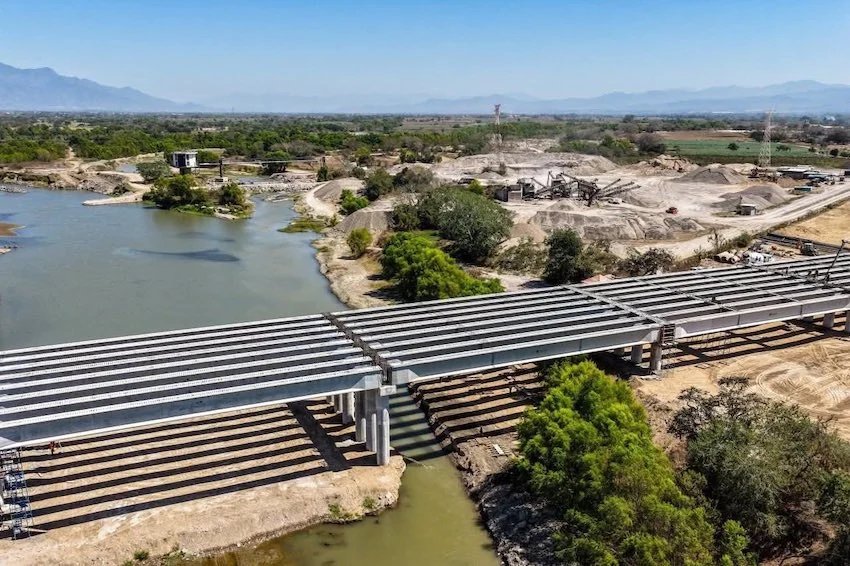
The Amado Nervo Bridge, which will connect the states of Jalisco and Nayarit over the Ameca River, has reached 70% completion, according to the most recent reports.
With an investment of 930 million pesos (US $54.7 million), the 2-kilometer overpass is expected to benefit 480,000 residents by lopping 25 minutes off the commute times between the Riviera Nayarit and Puerto Vallarta.
The bridge will have two lanes in each direction, authorities have decided, in addition to a bike path and pedestrian walkway. It is expected to improve traffic flow toward Federal Highway 200 and State Highway 544, speeding up transit for those whose origin or destination is the metropolitan area of Puerto Vallarta and Banderas Bay.
It will be toll-free and is expected to be completed by July of this year.
Named at President Sheinbaum’s behest after the turn-of-the-century Mexican poet and diplomat born in Tepic, Nayarit’s capital, the Amado Nervo Bridge is considered a priority project of the current administration, given that it will meet the demand of thousands of people who cross the Ameca River daily. The Infrastructure, Communications and Transport Ministry anticipates an average annual daily traffic of between 20,000 and 21,000 vehicles.
The major construction project includes 20 spans, each 40 meters long, forming a total of 800 meters of main structure. There are 1,220 meters of access roads, with 364 meters on the Nayarit side and 856 meters on the Jalisco side.
It includes key elements such as 21 pile-column supports, 126 piles with a diameter of 1.5 meters, and 160 beams. In total, some 2,970 tons of steel and 18,500 cubic meters of concrete are being used.

The project is part of the president’s President Claudia Sheinbaum’s National Road Infrastructure Plan 2025 to 2030, whose objective is to carry out modernization, expansion, rehabilitation and construction works of roads, highways and freeways in addition to 21 bridges and road interchanges.
Notable projects that are also expected to be completed this year include the Rizo de Oro Bridge in Chiapas – measuring 405 meters in length and featuring a unique “mixed arch” design – and the Nichupté Bridge in Quintana Roo, which involves the construction of five highly complex bridges.
With reports from Infobae
