
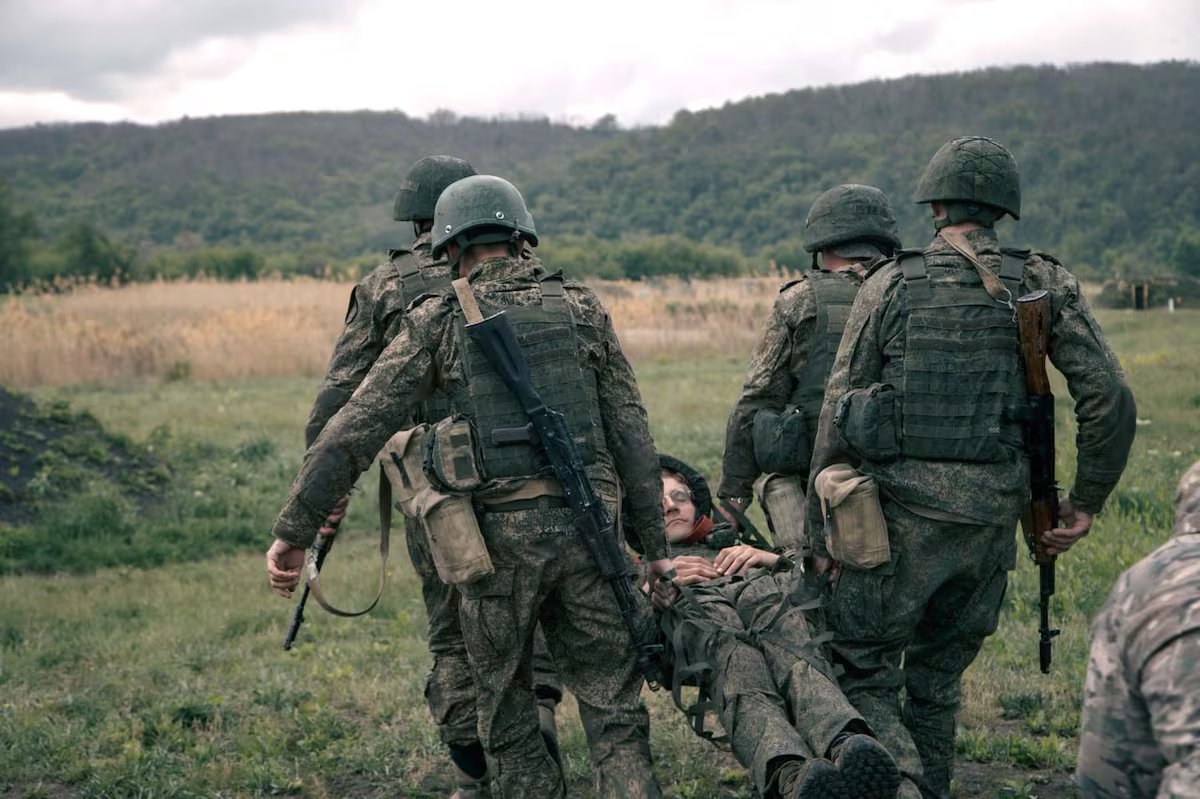
Russia’s invasion of Ukraine is now in its fifth year and shows no signs of ending. The strain on the militaries on both sides of the border has increased both countries’ reliance on recruiting thousands of foreigners, who are primarily sent to high-risk operations on the front lines. Several governments have warned against this practice and urged their citizens not to fall for the lucrative offers, which are often deceptive. A new report published on Wednesday by the International Federation for Human Rights (FIDH) and two other organizations analyzes the recruitment of foreigners in Russia and documents Moscow’s campaign to target vulnerable populations through misleading strategies.
According to Ukrainian intelligence cited in the study, 18,000 foreigners are fighting in the Russian ranks. Moscow’s army increased overseas recruitments by 30% between last September and February. The study argued that this “reflects Russia’s strategy to diversify and expand its pool of available fighters” with citizens from foreign countries. After recruiting citizens from key areas of influence such as Central Asia and Africa, the Kremlin has now also turned to Latin America in its war against Ukraine. Cuba and Colombia are the main recruitment hotspots in the region, along with some isolated cases in Argentina and Brazil.
The use of foreign volunteers in this war is not new. Since March 2022, just weeks after the start of the Russian invasion, both Ukraine and Russia have authorized the incorporation of fighters from other countries. Ukraine created the International Legion, and Russia launched a major campaign to facilitate the entry of foreigners into its ranks: it expedited the visa process and simplified the procedure for obtaining Russian citizenship for anyone who signed a contract of at least one year with the armed forces. In addition to these administrative advantages, what most attracted the volunteers were the salaries: monthly payments starting at around €3,000 ($3,500) and one‑off bonuses of up to €30,000 ($35,000).
With these incentives, the number of foreign recruits has only continued to grow. In Latin America, the country supplying the most men is Cuba. Ukrainian military intelligence estimates that 20,000 Cuban citizens have been contracted by the Russian army. According to the same source, the average survival time for these recruits is barely 150 days after their deployment to the battlefield. The report puts the number of foreign fighters killed in combat at 3,388 — a figure provided by Ukrainian intelligence but impossible to verify independently.
“Reports from 2026 suggest that as many as one in five foreign fighters die in combat, with nearly half of those deaths occurring within the first four months of battlefield deployment,” the research states. This happens because many are assigned to high-risk assault units without adequate training, resulting in what are known as “cannon fodder” attacks.
A Cuban prisoner of war interviewed by Truth Hounds — an organization that investigates crimes committed in Ukraine — claimed his main motivation for fighting with Russia was to escape his country. “Money and life in Cuba, it’s shit. There are millions of Cubanos at the frontline, and I saw them,” he said, according to the report. The man said he was recruited through Facebook for a civilian job that only required filling out a digital form. The promised payment was €1,700 ($2,000). Upon arriving in Russia, he realized it was a scam.
These same networks also have a strong presence in Colombia, a country that, after decades of internal conflict, is one of the world’s largest exporters of mercenaries. Companies usually established by high-ranking former military officers act as intermediaries for recruitment to many countries, including Russia, Ukraine, Mexico, and Sudan. An investigation by the local newspaper El Espectador names a firm called Global Qowa Al Basheria, created by two brothers surnamed Batte, both retired colonels in the Colombian army. Both were sanctioned this month by the U.S. Treasury for sending Colombians to fight in the Sudanese civil war.
Although many enter the business knowing they will go to war, most do not expect to become cannon fodder. A Colombian currently fighting in Russia’s ranks told EL PAÍS that he enlisted through a TikTok account, following a friend who had done the same and had been promised a monthly salary of €3,000. Neither imagined they would become “bait.”
“Foreigners are the first ones sent to the front lines. When we arrive, they tell us we’ll be trained for three months, but after 15 days we’re already in combat,” he says in a WhatsApp call from the hospital where he is recovering from injuries sustained in a drone attack. Since he can’t fight, he only receives about €420 ($490) a month. Despite his injuries to his arm and kidney, the Colombian argues that “no one is being given sick leave, not even for illness.” “I’ve seen people with only one leg being sent to the front.”
Jimena Reyes, director for the Americas at FIDH, says the report not only documents the Kremlin’s deceptive strategies to recruit foreigners but also details physical and psychological abuses used for the same purpose. This is the case for several men from Central Asia interviewed for the investigation.
“Telling a migrant that they will be detained or deported if they don’t sign a contract is abuse,” Reyes explained in a telephone interview. “But this practice doesn’t stop at this stage. Once in combat, we documented that many are even tortured for supposedly not putting in the required effort.”
The report recommends that states take measures to curb recruitment. On the one hand, it urges governments to pass laws criminalizing the trade, as Colombia did this year. “It’s a matter of political will and concern for the poorest and most vulnerable, who are the ones who fall prey to these schemes,” Reyes explains. At the same time, the report also warns against criminalizing those who fall victim to these deceptive strategies and who, “at a systematic level,” are subjected to human trafficking.
The Colombian fighter in Russia who spoke to EL PAÍS says being there is “hell,” but he also fears being criminalized in his own country, as has happened in some African nations to those accused of being mercenaries. “We all want to get out of here, although it seems like an impossible goal.”
Sign up for our weekly newsletter to get more English-language news coverage from EL PAÍS USA Edition
