
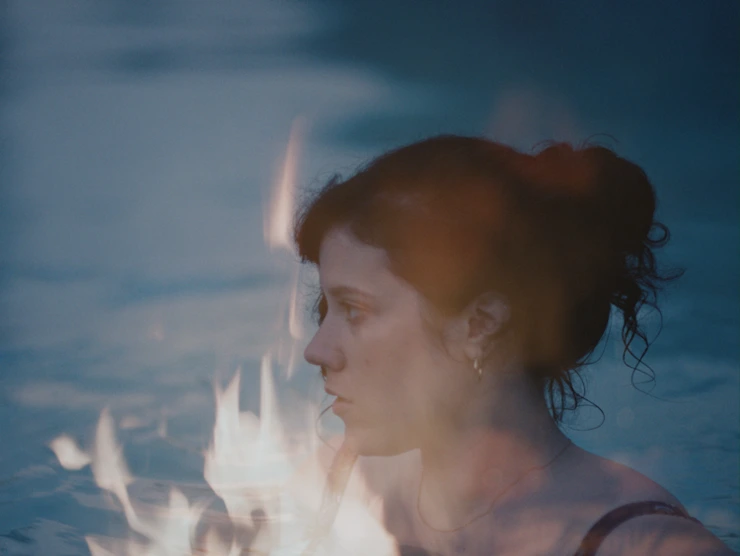
Grief has a home in cinematic representations. With its ability to capture and present close-ups of pained facial expressions, showcase rambling dialogues of heartbreak and agony and metaphorical imagery to trigger the cognitive as well as emotional, filmmaking offers artists and audiences an opportunity to exercise such painful experiences. That is exactly a goal of writer and director Zeshaan Younus in his atmospheric mediating drama I’ve Seen All I Need To See.
The film focuses on Renee Gagner’s Parker, a wannabe actor, who travels to her hometown in LA to discover what happened to her sister (Rosie McDonald), who died in tragic and violent circumstances. While doing so, Parker finds herself staggering and crumbling under the weight of grief and her own struggles. “Told through a non-linear and haunting lens, it looks at the gaps in space and time that are created when we experience immense loss,” the director stated, as shared in Screen Daily.
An immediate note on Younus’s work is that, despite its fairly coherent logline, the film is solidly experimental in its depiction of emotionally driven noir. I’ve Seen All I Need To See is not exactly a cause-and-effect narrative feature; instead, visual composition and an alternative-sounding score scatter around a direct plot to present something more tonally artistic and subjective.
The film has been compared to the work of the Master of Surrealism and Subjective, the dearly missed David Lynch, due to its unconventional presentation of a fragmented narrative and emphasis on a fractured psyche, packaged in stylised visuals. We see Parker and those around her sit in their subjective, interior states for seemingly endless sequences. There are no fast cuts or pans to be found in Younus’s work; his camera squeezes in tight to frame the characters with their furrowed brows, teary eyes, flushed cheeks and trembling lips.
To amplify the aesthetic carrying of the emotional ideas, I’ve Seen All I Need To See’s editing appears minimalist yet immersive with its countless long-takes to allow us to sit with the characters and their emotions. The camera essentially works like an intruding guest shameless in their voyeurism of someone’s confusion and pain, refusing to leave or censor the emotional anchor. To reach a further level of artistic flourishing, Younus’s direction shows fleeting fascinations with objects and scenery, in addition to facial expressions and body movement. Smashed cups, beer bottles and empty glasses are framed in between the characters, lacing the film’s flow with something slightly refined and ornamental in imagery.
All visual composition and presentation is submerged in an absolutely killer soundtrack, coming in boldly as a real highlight of the work, which cries out to all lovers of alternative, underground sounds. The score composition of dreamy yet aggressive shoegaze mixed with hard-hitting, earth-shaking metal amplifies the ambience and atmosphere of highly emotional or active sequences, including kisses with strangers at underground rock clubs or smoking cigarettes after cigarette in the desert at sunset. Not only does the score come in as an enjoyable decorative piece, but it additionally assists thematically in Younus’s vision, representing the seething, boiling emotional landscape Parker conceals under her empty eyes and blank expressions.
Essentially, Younus’s style approach drowns us in the film’s broody, sullen temperament. We latch on wholly to this world and its emotional threading. When it comes to the thematic tapestry, Parker comes to us in a showcase of a dip between the blurred lines of reality and fiction with her auditions, appearing in college acting level monologues of strides for emotional weight. We join her in her quest for answers and in seeking the truth of the matter, coming to feel just as frustrated and hopeless in the growing sense of being totally lost as she is.
Parker’s emotions, physically speaking, are anything but mercurial, remaining at a sulking state with just one deep outburst we latch onto in one ongoing, uncut sequence. This aligns with the rides and dips of life in circumstances such as this. I’ve Seen All I Need To See makes for a splendid cinematic watch for anyone who appreciates the detailed, visual aestheticism of emotional positions, rather than sitting through another systematic, causality narrative film.
★★★★
In UK cinemas May 1st / Renee Gagner, Rosie McDonald, Sidney McCarthy, John R. Smith Jnr/ Dir: Zeshaan Younus / Bulldog Film Distribution / 15
Discover more from
Subscribe to get the latest posts sent to your email.
