
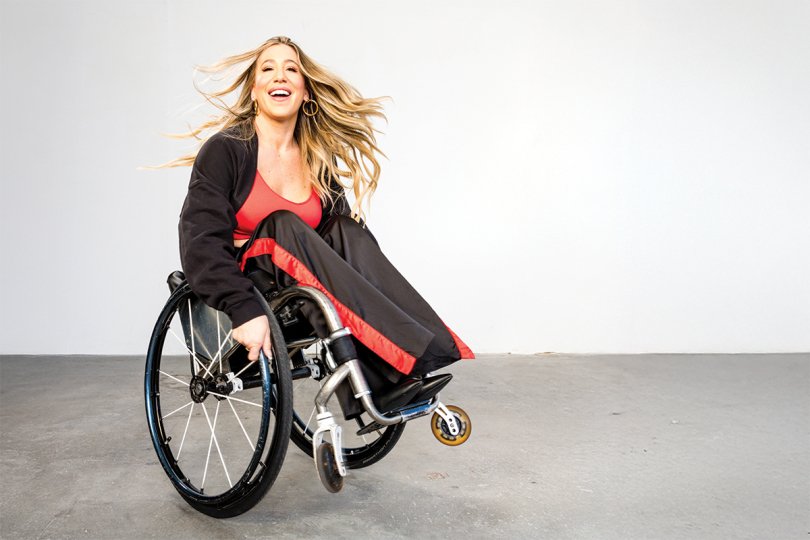
After a paralyzing injury at seventeen years old, Chelsie Hill didn’t just refuse to give up her love of dance—she decided to share it with the world.
Dancing since the age of three, Chelsie Hill grew up knowing she had a passion for being in the spotlight. What she didn’t know was that her story would evolve into a mission to inspire women with disabilities across the world.
At just seventeen years old, Hill suffered a spinal cord injury that left her paralyzed and wheelchair-bound. Suddenly, she questioned what her future would look like—and whether returning to dance would even be possible.
When, in her hospital room, Chelsie’s father showed her a video of a wheelchair dancer, “it sparked this kind of curiosity,” she said. “If I thought I couldn’t do something, my dad would say that even though he wasn’t sure how to get it done, we would figure it out. That mindset has stayed with me for the past 15 years of being disabled.”
After rejoining her high school dance team for a wheelchair performance, Hill realized that she could still dance. “I didn’t feel different. It was a sense of normalcy that I was craving again, especially being the only one in the small town that became paralyzed.”
Having proven that her dream of dancing was still alive, Hill decided that it was time to share her skills and her story with a larger community to prove that disability doesn’t have to mean disheartenment.
Studies have shown that participating in a structured dance routine lasting just six weeks can boost your mental and physical health more than other exercises, helping to regulate emotional well-being, depression, motivation, social cognition, and even memory.
Making a movement
In 2012, Hill appeared on the Sundance Channel’s Push Girls, a series that highlighted the lives of women in wheelchairs. She began to gain a following of women in the disabled community that found inspiration in her story and started using her platform to spread awareness for the disabled community and the possibilities adaptive dance can provide.
“Wheelchair dancers started following me on social media, and I just reached out to them through DMs and asked if they wanted to come to my hometown and dance,” she recalls. “Crazily enough, all six said yes!”
Hill’s new team gave her the connection she was looking for. “Being newly injured, I just felt like these girls got me to my core. Having that at such a critical time of my life when I was figuring out how to wear a skirt in a wheelchair, or how to transfer myself in and out. Or dating! Those connections really just changed my whole outlook on what I could do.”
Hill and her newly minted Rollettes started getting attention from schools and events that were interested in having them perform. As their reach grew, Hill recalls her father asking her what she hoped to accomplish with her team. She said, “Dad, I want a ballroom full of women in wheelchairs dancing.”
In 2018, Hill got to see that dream come true when The Rollettes hosted 115 women from 14 countries that were interested in adaptive dancing and finding likeminded friends. For her part, Hill is as bolstered by her connections as they are by her. “Knowing how incredibly strong the disabled community is keeps me going,” she says. “Being part of a community that wakes up every day in a world that’s not made for us and to still go out there and create a life for [ourselves] is truly amazing.”
Through The Rollettes Foundation, Hill and her team now host a yearly seminar open to all ages, genders, and types of disabilities that offers dance classes, educational panels, and lifestyle seminars.
Now, Hill’s focus is on the foundation’s Boundless Talent Showcase, which allows creatives of all types who are disabled to show off their skills for the chance to win prizes and even connect with talent managers. “Before Boundless Talent, there was nothing like this that gave a platform for people with disabilities to showcase their talent,” she notes. “For example, those in the able-bodied community don’t understand how to score people with disabilities. It’s been incredibly rewarding to create this space and see them compete and thrive.”
The big stage
Since her accident fifteen years ago, Hill has not only founded The Rollettes but has also represented the USA in the ICU World Cheerleading Championships., performed in the opening ceremony at the Paris Paralympics, and told her story on The Ellen DeGeneres Show. She regularly works with people who are newly disabled to help them acclimate and reciprocate the support she received when she was younger.
No matter what she does, visibility is always at the forefront of Hill’s mind. “There are so many different levels to a spinal cord injury or a life with a disability that a lot of people from the outside don’t know,” she says. “What I want people to understand is that every wheelchair user is different, which is why spreading awareness is so important, whether it be through pursuing a passion that you didn’t think you could, or just showing what everyday life is like.”
Ultimately, Hill hopes that welcoming disabled voices is key to creating a better future for everyone, noting that “A lot of people in our community say that the likelihood of becoming disabled at some point in your life is very high, whether it’s from age, injury or illness. Creating an accessible world is not just for our community today, because this is a community anyone can join at any time.”
As a dancer, leader, and now a mother, Hill’s life in the spotlight has been a journey she could hardly have imagined in that hospital bed fifteen years ago. As she continues to advocate for her community and create her art, she proves that a disability doesn’t have to cost you your dreams.
Dancing through life
Dancing is not just for the young. In fact, dancing can be a powerful practice to promote and maintain healthy aging. Here are some of its benefits:
- increased flexibility
- muscular strength and endurance
- improved balance to lower the risk of falls
- increased production of nitric oxide, a molecule that can help reduce the risk of heart disease and high blood pressure
- boosted serotonin for better mental health
Whether you prefer salsa or ballroom, making dance a regular part of your life can help make your golden years a little brighter.
This article was originally published in the May-June 2026 issue of alive magazine (US edition).
