
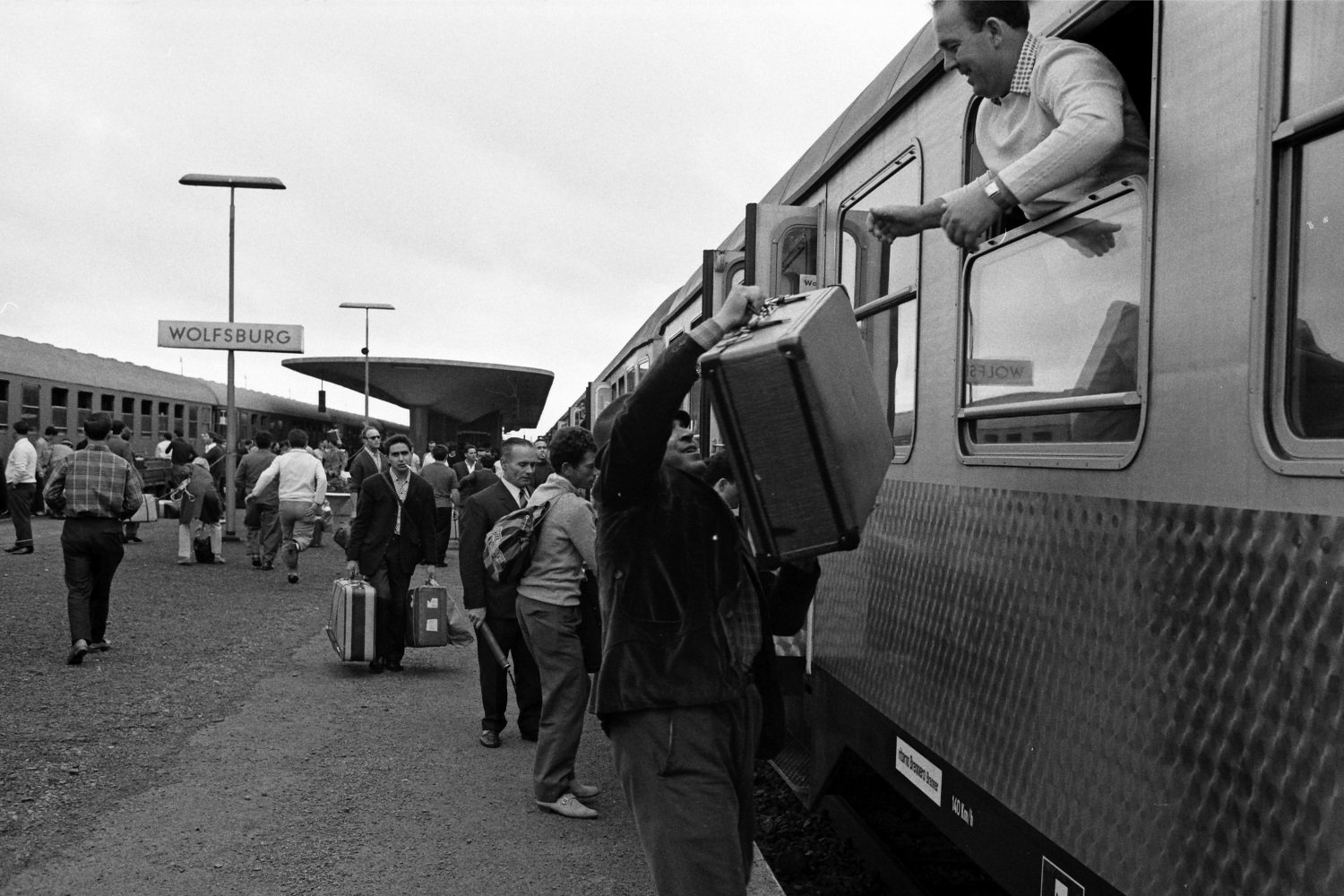
– Fausto Caviglia reconstructs seventy years of Italian emigration to Germany by way of archive material and testimonies, restoring historic dignity
Following the Second World War, Germany found itself in a precarious situation. It was the time of the Wirtschaftswunder – the “economic miracle” – and there was a demand for manpower, but many young Germans had fallen on the battlefield. On 20 December 1955, Germany and Italy signed an agreement regulating the influx of so-called Gastarbeiter – “foreign workers” – into the Federal Republic of Germany. Between 1955 and 1976, roughly 4 million Italians arrived in Germany from the region of Veneto, Friuli-Venezia Giulia, Calabria, Apulia and Sicily, which had the highest unemployment rates of the period. And some of these migrants ended up staying for good.
In 2021, young director and third-generation descendent of Turkish immigrant workers Çağdaş Yüksel explored this topic in his documentary, Gleis 11, named after the famous Platform 11 in Monaco train station where the Gastarbeiter would arrive not just from Italy but from Greece, Spain, Portugal, Turkey, Morocco, Tunisia and Yugoslavia. An Italian Dream by Fausto Caviglia, which is hitting Italian cinemas on 7 May, courtesy of Piano B Distribuzioni, opens with that initial agreement before revealing testimonies and observations charting the development of Italian-German relations, which are still central to the debate on integration.
The initial years were anything but easy. As stressed by German writer Daniel Speck – the author of Volevamo andare lontano – at the beginning of the documentary, in the early days of immigration, America invited people to be a part of the country and its collective dream, “while Germany ordered its guest workers to work hard, keep quiet and subsequently leave. That was the agreement”.
Using photographic and audiovisual archive material – including from the Istituto Luce and the Institut für Zeitgeschichte und Stadtpräsentation in Wolfsburg – and gathering together testimonies from workers of the time and their children and grandchildren, An Italian Dream follows a narrative arc ranging from the Fifties to the present day. A shepherd boy on an Apulian farmstead, Lorenzo Annese, now 89 years of age, was one of the first Italians hired by the Volkswagen factory in Wolfsburg, and he rose to become the first foreign member of a works committee in Germany. “My mother said, ‘write as soon as you get there’, but I didn’t know how to write”. Before working in the factory, Lorenzo shifted cement blocks at a rate of one pfenning per 20 kilos, “and to make a phone call to Italy it cost two marks”. When leaving home, “the important thing was not to look back”, explains Vito Gaetano Nigro, who had no idea he’d end up working in a mine in Bochum, 1,000 metres underground. “It was all very sad; you didn’t laugh anymore, you became a different person”. Francescantonio Garippo, who’s now the mayor of Kästorf-Sandkamp, tells us about the lives of Italian people in Wolfsburg. There was a field with shacks in it, whose rooms measured 4 metres squared, and there were 3 people per room, being monitored by factory guards with Wolfdogs. There was just one doctor for 10,000 Gastarbeiter. Former educational director at the Consulate General of Hanover Antonio Riccò speaks of the “feeling of emotional and social instability which undermined intelligent and constructive integration”.
The situation changed: housing was built for the Gastarbeiter, families units were reunited. The role of women became increasingly important. “They slowly became part of the system, learning the language and joining the workforce”, insists Daniela Cavallo, the chair of the Volkswagen factory board and one of the many daughters and sons of the Gastarbeiter who have gone on to claim significant social positions.
As an historical report on the potential for integration, achieved through unwavering tenacity and optimism, An Italian Dream is an invitation for further reflection on the regressive tendency to make nationalist demands for sovereignty in Europe, with neologisms such as “remigration” – a synonym for deportation – becoming dominant buzzwords in the xenophobic lexicon sweeping the entire western world. A language which speaks volumes about the crisis of the present age: impoverishment, social insecurity and fears over global conflict scenarios.
An Italian Dream was produced by Orisa Produzioni (Italy) in collaboration with Latteplus (Germany).
(Translated from Italian)
