
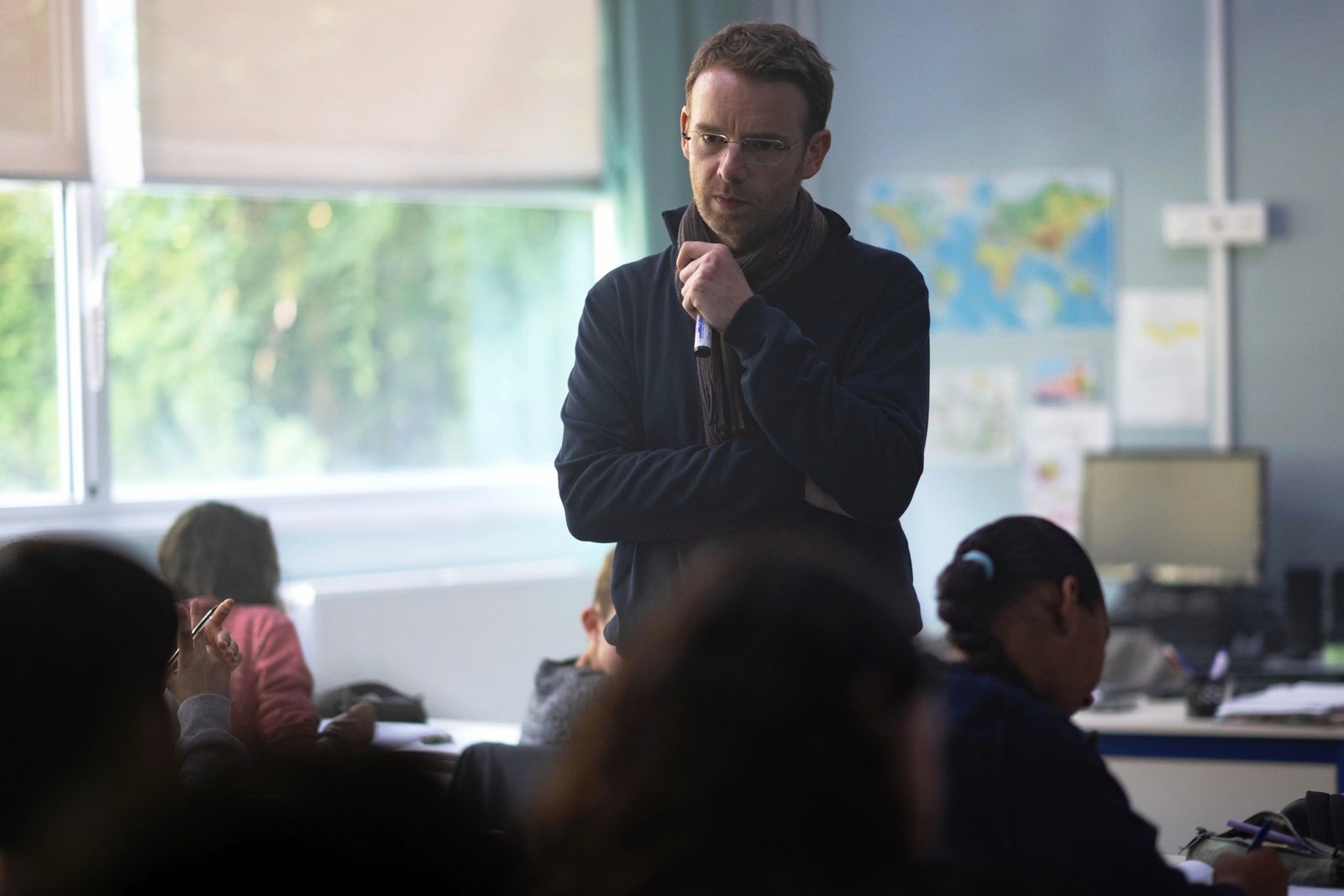
– CANNES 2026: Vincent Garenq’s film is a tense reconstruction of French teacher Samuel Paty’s final days, exploring institutional failure and the human cost of social hysteria
Antoine Reinartz in Forsaken
Premiered in Cannes’ Out of Competition strand and simultaneously coming out nationwide in France, distributed by UGC, Vincent Garenq’s Forsaken is centred on the last 11 days of Samuel Paty (played by Antoine Reinartz), the French teacher killed and beheaded while leaving the middle school where he taught History and Geography on 16 October 2020. What were the primary motives for his murder? What’s the story behind the name that surfaced in newspapers worldwide? A man whose life and beliefs remain unknown to the majority of the people who read the articles surrounding his death?
After showing some of his students the Charlie Hebdo caricatures that led to the famous 2015 terrorist attacks in order to discuss freedom of speech and secularism, Paty inevitably faces tension in the classroom, where there are several Muslim students. One of them, Bashira (extraordinary rising star Emma Boumali), decides to use parts of the truth of the event to invent a story that will cause a chain of misunderstandings and trigger terrible consequences. In fact, when her dad, Nedjim Bouizzoul, insists on spreading the story, the immediate outcry against Paty will cause his abandon (the French title of the film) – his abandonment by everyone around him. Nonetheless, Victoire Lanion (Emmanuelle Bercot), the school’s headteacher, tries to bring peace into the workplace as much as possible, while friction among the rest of the employees rises.
The most interesting aspect of Forsaken is that it is far from being a rhetorical tale and eschews any easy preaching. Instead, it chooses to tell the story for what it is, leaving the ultimate judgements to the audience without steering their emotions in a particular direction. Everything, from its technical aspects to the screenplay, feels detached, at times distant, as if we were watching a fly-on-the-wall documentary. The cold and bluish cinematography by Renaud Chassaing, combined with Nicolas Errera’s music, makes the atmosphere bristle with uneasiness from the very start.
This approach is particularly interesting, as every character in the story is strong in his or her own way. After all, this is a film of actors: with the wrong casting, it would have been a disaster, as its technical rigour does not allow for a lot of experimentation in other aspects. Antoine Reinartz leads a very believable ensemble cast, and the director lingers on each one of them just long enough to let the audience live in their world and feel the internal turmoil, especially when it comes to the youngest ones, Paty’s students.
The truthfulness of the story was assured through the help of Samuel Paty’s sister, Mickaëlle, during the writing process. Stéphane Simon’s book Les derniers jours de Samuel Paty was also a reference for Garenq. Given the extremely delicate topic and the overall careful execution, Forsaken is already stoking some heated debate in its native France and is destined to become a politically controversial title even beyond its borders. Its traditional cinematic approach is likely to please broad audiences and receive a more tepid response from critics. With such a thorny topic, the safest bet was to take this approach – also in order to respect Paty’s emotional legacy – and the result can be considered successful. The film flies by, while keeping the tension and the stakes high.
Forsaken was produced by France’s Outside Films and Les Films du Kiosque, with the help of France 3 Cinéma, UGC France and Umedia (Brussels). Its international sales are in the hands of Studio TF1.
