
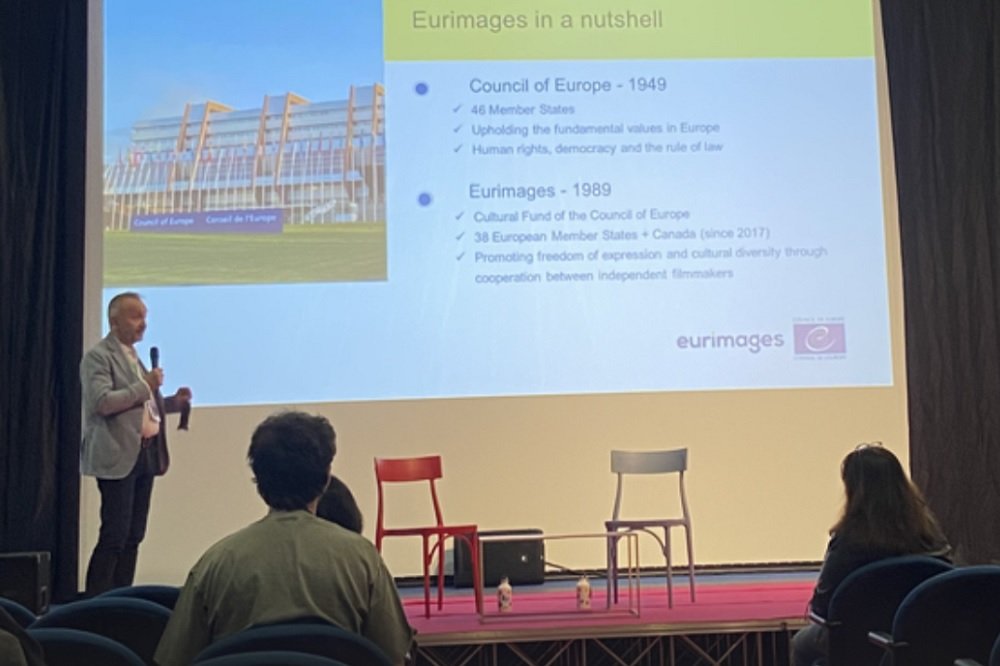
– The Deputy Executive Director of European Council’s fund explained its key elements and its most recent statistics, to the Italian festival’s audience
Enrico Vannucci during the presentation
Within the Industry section of the 44th Bellaria Film Festival, Deputy Executive Director of Eurimages Enrico Vannucci presented the work carried out by the European Council’s cultural fund in a meeting entitled: “Eurimages: an insight into international co-production.” The pan-European organisation founded by various European Council member states in 1989 is now composed of 39 European countries, including Malta (as of February this year), and Canada since 2017.
Eurimages offers four support programmes: Cinematographic Co-Production, Co-Production Promotion, Exhibition and Film Marketing & Audience Development. “The co-production support budget is around 28 million euros, equating to 92% of the total fund (which equates to 32 million euros). These figures, which date from 2024, have also been confirmed, percentage-wise, for 2025, since our budget is slightly higher as a result of an inflation adjustment,” Vannucci revealed at the beginning of the session.
Explaining the various sections, he continued: “The “Exhibition” programme relates to support for cinemas, and it’s limited in terms of its recipient countries. Italy, for example, isn’t one of these countries because, fundamentally, it’s an aid awarded to member states which are unable to access support from the European Commission. As it stands, I’d say the beneficiary countries are primarily Switzerland, Canada, Turkey and Armenia. On the other hand, the Film Marketing and Audience Development fund recently replaced a pre-existing distribution support programme. This required planning and discussions with the wider industry so as to make best use of limited resources. At present, our distribution support is aimed at creating synergies with our co-production programme: one of the criteria for accessing it is to have already received support from Eurimages, in order to facilitate wider circulation of works. There’s still a lot to learn, given that it’s only a recent change.”
In fact, Vannucci revealed that, over time, many projects which have been supported through co-production, even high-quality projects, have only enjoyed limited circulation: majority countries aside, often in minority co-production countries they don’t even benefit from systematic distribution. “And there’s another issue, which isn’t as obvious but it’s fundamental from our perspective: what we’re trying to do is to encourage producers – the beneficiaries of this support – to think about the film’s international circulation above and beyond the countries involved in co-producing it, and, specifically, at a far earlier stage in the process. In other words, we want them to start thinking from the outset about what the film’s trajectory might look like following its completion.”
The presentation also focused on Eurimages’ two fundamental strategies: Gender Equality & Diversity and Sustainable Strategy: “It’s one of the areas of which Eurimages is most proud, because it was one of the first audiovisual industry players to incorporate these kinds of policies. From a European viewpoint, work began back in 2012, pre-dating the #MeToo movement, and in 2017 it resulted in a European Council resolution inviting members states to promote gender equality in the audiovisual sector by way of three concrete criteria, turning Eurimages into a reference point on an international level.” As stressed by the Deputy Executive Director: “In 2024, the data revealed an incredibly significant outcome: support was awarded to more films by women directors than by men. In 2025, the situation reverted. This goes for the number of projects as well as the sums allocated.”
But obviously, it has its limits: “As we’re dealing with a non-binding recommendation, not all member states consider it a political priority. This means that the document is used more as an awareness-raising tool in the industry, as opposed to a fully integrated part of national policies.”
Returning to the topic of co-productions, Vannucci explained: “In terms of the 2024 results, the 2025 numbers were fairly similar: roughly ninety films received support, among which, regrettably, animation was still underrepresented. For transparency, when we say that during this period 41% of projects received support, we’re looking at a five-year average, in this case relating to 2020-2024, and, unfortunately, this trend has fallen in recent years. It’s also dependent on our resources being relatively stable over the given time period.”
“As for first and second works, their importance in our portfolio has grown over time: over a five-year average, they account for roughly half of the works supported. There’s probably also a strengthening effect: there’s no definitive statistical evidence for this, but I get the impression that a rise in first and second works is also a result of national funds realising that international co-productions are a prime space for supporting new directors.”
From an economic viewpoint, support is available for up to 17% of a film’s total budget, and this percentage rises to 25% for documentaries or films directed by women. So there are two kinds of support on offer: soft loans of up to 500,000 euros, and grants of up to 150,000 euros. “Since it’s a cultural fund,” Vannucci continued, “our primary aim is to support creation and cultural co-operation rather than secure financial returns on the loans we’ve awarded. We’re mainly financed by national funds, which means we can focus less on immediate financial returns, not least because contributions from member states are calculated on shifting averages of around ten years, which attenuates short term fluctuations.”
(Translated from Italian)
