
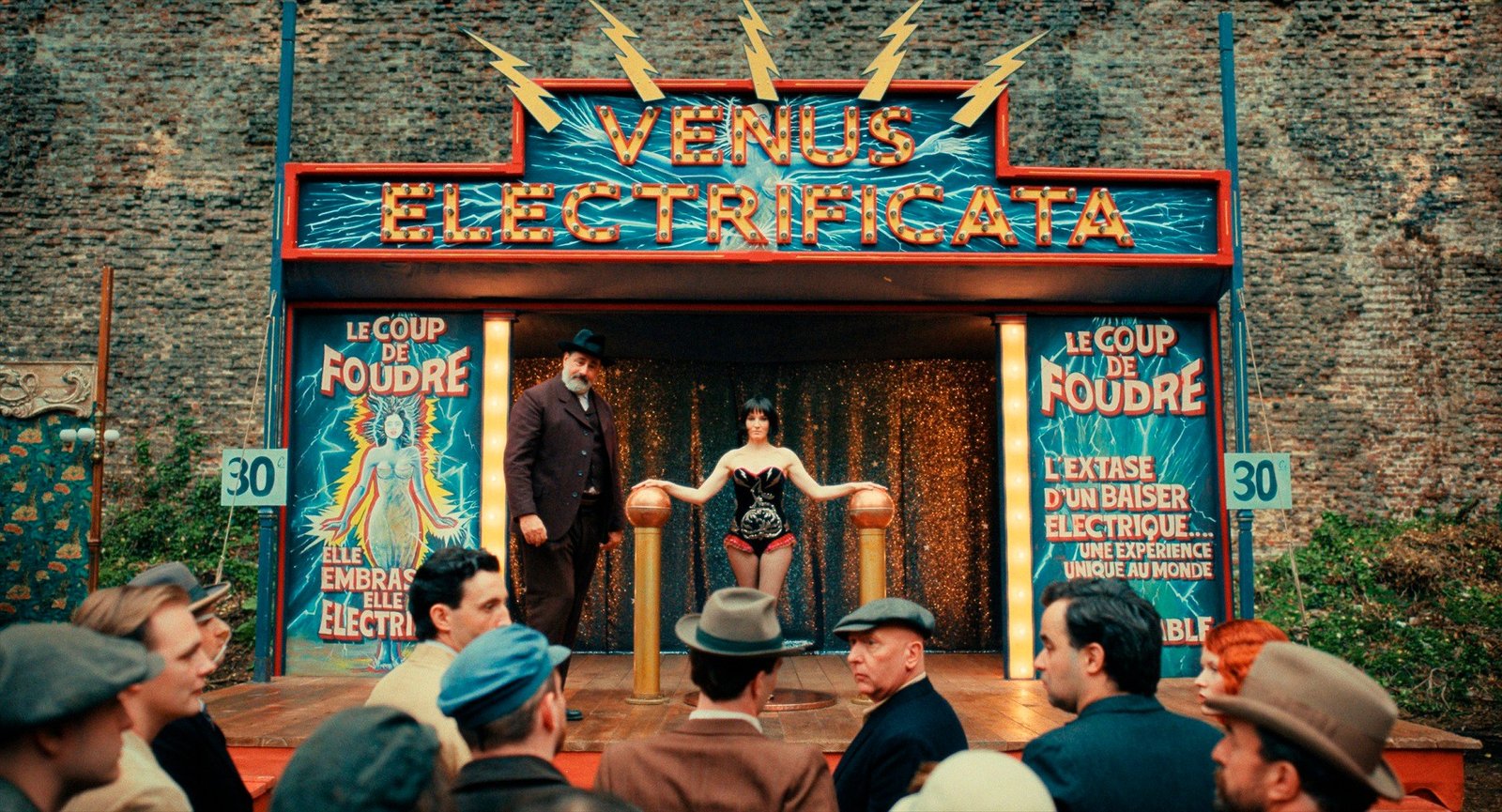
– CANNES 2026: Pierre Salvadori intertwines truth and fiction, art and deception, within the charming setting of a masterfully directed romantic comedy
Gustave Kervern and Anaïs Demoustier in The Electric Kiss
“Since when do people kiss each other just because the weather’s nice?” Fond of lightness, tenderness and irony (sometimes veering into burlesque), and adept at capturing characters struggling with life’s difficulties, Pierre Salvadori delights above all in concealing his many cinematic talents beneath the patina of apparent simplicity, avoiding overpowering beauty like the plague. It’s an approach in the vein of Billy Wilder (to cite just one example), which does not necessarily make him an obvious fit for the major festivals flying the flag of self-declared auteur cinema. But over time, the director has refined his palette to the point of embarking, for the first time (on an idea by Rebecca Zlotowski), on a period film: The Electric Kiss, which opened the 79th Cannes Film Festival under the banner of the sugary artifices of narrative virtuosity.
“See and paint the world for me, bring colour to my night.” We are in Paris, in 1928. Suzanne (Anaïs Demoustier), the star attraction of a fairground act where she delivers electric kisses on stage, agrees — after a misunderstanding and for financial gain — to pose as a medium for Antoine (Pio Marmaï), a guilt-ridden, drunken painter desperate to contact his recently deceased companion, Irène (Vimala Pons). Encouraged by the art dealer Armand (Gilles Lellouche), who sees that the deception is bringing Antoine back to life and work, Suzanne continues the fake séances while uncovering Irène’s secrets through her diaries. But genuine feelings soon begin to surface, greatly complicating matters (“when there were two of us, there were three, but all of a sudden there were two, and I was alone”)…
Fully embracing its blend of artifice — a relentlessly brisk pace and wildly far-fetched twists, almost like unfolding a treasure map — and background social realism (art and money, social class), the film displays constant playful inventiveness in its exploration of duplicity. Developing a screenplay co-written with Benoît Graffin and Benjamin Charbit, the director gradually intertwines two timelines, bringing Irène’s memories back to life and forging a connection between the two women around the film’s central theme: the pursuit of happiness. “A new love does not erase another,” yet “love at first sight is not an idea or a metaphor, but a sensation, a disturbance.” Pierre Salvadori tackles this emotional terrain with remarkable directorial finesse and a keen eye for detail, beneath the seemingly effortless surface of a theatrical comedy that gives its cast plenty to relish and leaves the audience smiling.
The Electric Kiss was produced by Les Films Pelléas and co-produced by France 2 Cinéma, Versus Production, Pio & Co, Tovo Films, the RTBF, Be tv and Orange, and Proximus. Playtime handles international sales.
(Translated from French)
