
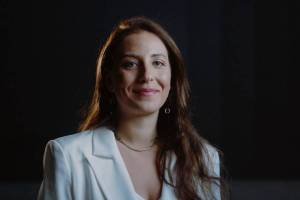
My route into sustainability came through the industry itself – not through activism or academia, but through years working across sales, distribution, festival programming, PR, financing, development, and exhibition. That breadth gave me a particular vantage point: I started seeing the whole system, and I started seeing how much waste – environmental and creative – is baked into the way we operate.
Day-to-day, my work through LPE means I am embedded in productions, advising from before greenlight through to wrap. But as Programme Director, the scope is bigger than any single project. I am interested in how we shift the culture of decision-making at leadership level. The decisions that shape a production’s environmental footprint are made early – in the budget, in the locations, in the supply chain – and they are made by people in senior positions. So that is where I focus.
I am also lucky to have Djamila Grandits as co-director on the programme. She brings deep expertise on social sustainability, and together we offer something I genuinely believe is rare: a programme that holds environmental and social impact together, because they are inseparable.
Q2: Sustainability is becoming a key topic across the audiovisual sector. From your perspective, what are the most urgent challenges and opportunities right now?
The challenge I keep coming back to is the gap between awareness and structural change. The industry knows it has a problem. There are more green toolkits, more pledges, more sustainability coordinators being hired than ever before. But most of those interventions happen at production level – onset, on the ground – and they are treating symptoms rather than causes.
There is also a persistent myth that sustainability costs more. It can – in the short term, in isolation, without the right frameworks. But when you design for it from the start, the economics shift. And we are at a point where incentives are beginning to emerge across Europe to support this – green financing criteria, sustainability requirements attached to public funding, early-stage certification schemes. They are not yet fully realised or consistently applied, but the direction is clear.
The deeper challenge is structural. What we are really talking about is redesigning the industry along more circular economic lines – rethinking how resources flow, how assets are reused, how productions relate to the communities and environments they work in. The conversation is happening. But the infrastructure to actually accelerate that change – the logistics networks, the data systems, the supply chain standards – is still being built. We are asking people to operate differently before the ecosystem fully supports them doing so. That tension is real, and we need to name it honestly.
The opportunity is that we are at a genuinely pivotal moment. The people entering the industry now expect sustainability to be embedded, not bolted on. And there is growing recognition – especially post-pandemic – that the industry’s relationship with place, with travel, with the physical world, needs to be rethought. That creates real openings for people willing to lead.
Q3: Beyond your role as Programme Director, you have also chosen to participate in International Screen Institute programmes yourself. What motivates you to continue engaging with the Institute from different perspectives, and how does this connect to your broader professional goals?
I think the moment you stop learning is the moment you stop being useful to the people you are trying to develop. I genuinely believe that. Participating as a student in the ProPro programme last year was not incidental to my work as a programme director – it was central to it. It reminded me what it feels like to be challenged, to be in a room where your assumptions get tested.
There is also something specific about the Screen Institute’s approach that I find genuinely aligned with how I think about the industry. It is international, it is rigorous, it connects people across sectors and borders. That is rare. And it connects to what I am trying to build more broadly – work that has long-term impact, not just short-term deliverables.
Q4: You took part in the International Screen Institute’s ProPro: The Producers Programme for Women last year. How did that experience shape your approach to your work or your projects?
It was genuinely a game-changer – I do not use that phrase lightly. I came in with a strong production and industry background but without a formal producing framework. What the programme gave me was not just knowledge – it gave me a more coherent way of articulating what I already knew, and a clearer sense of how to position the projects I am developing.
It also deepened my conviction that sustainability has to be built into projects from the ground up – not added later. When you are thinking about a project’s lifecycle from development through distribution, the questions you ask about environmental and social impact have to be part of that same conversation. The programme reinforced that instinct and gave me better tools to act on it.
Q5: Based on your experience, what makes the International Screen Institute’s programmes valuable for film professionals today?
What distinguishes the Institute is that it takes film and TV professionals seriously as thinkers, not just practitioners. A lot of professional development in our industry is skills-based and quite narrow. The Screen Institute works at a different level – it asks bigger questions about the industry, about your role in it, about where you want to take your practice.
For the Sustainability Management Programme specifically, the value is also in the community. Participants come from across the audiovisual sector and beyond – film, television, distribution, exhibition, festivals, financing, and the wider cross-cultural creative sector. That breadth is deliberate. Everyone in this ecosystem has a voice, a role, and an impact. The programme creates space for those people to find each other and build something together. In an industry that can feel quite isolated and transactional, that is genuinely valuable.
Q6: With applications open until May 18, what advice would you give to film professionals who are considering applying to the Sustainability Management Programme at the International Screen Institute?
Apply if you are in a position where your decisions affect other people – whether that is a team of two or a department of twenty. The programme is designed for people who have leverage, even if they do not fully recognise it yet. And wherever you sit in the film, TV, or wider audiovisual ecosystem – find your leverage point and use it.
Do not be put off if you are not coming from a traditional sustainability background. Some of our most engaged participants have come from distribution, from exhibition, from financing, from festival programming, from the cross-cultural creative sector. If you work anywhere in this ecosystem, you have a role to play, and this programme will help you see it more clearly.
And apply now. The May 18 deadline is close, and the cohort size is intentionally small to protect the quality of the experience.
