
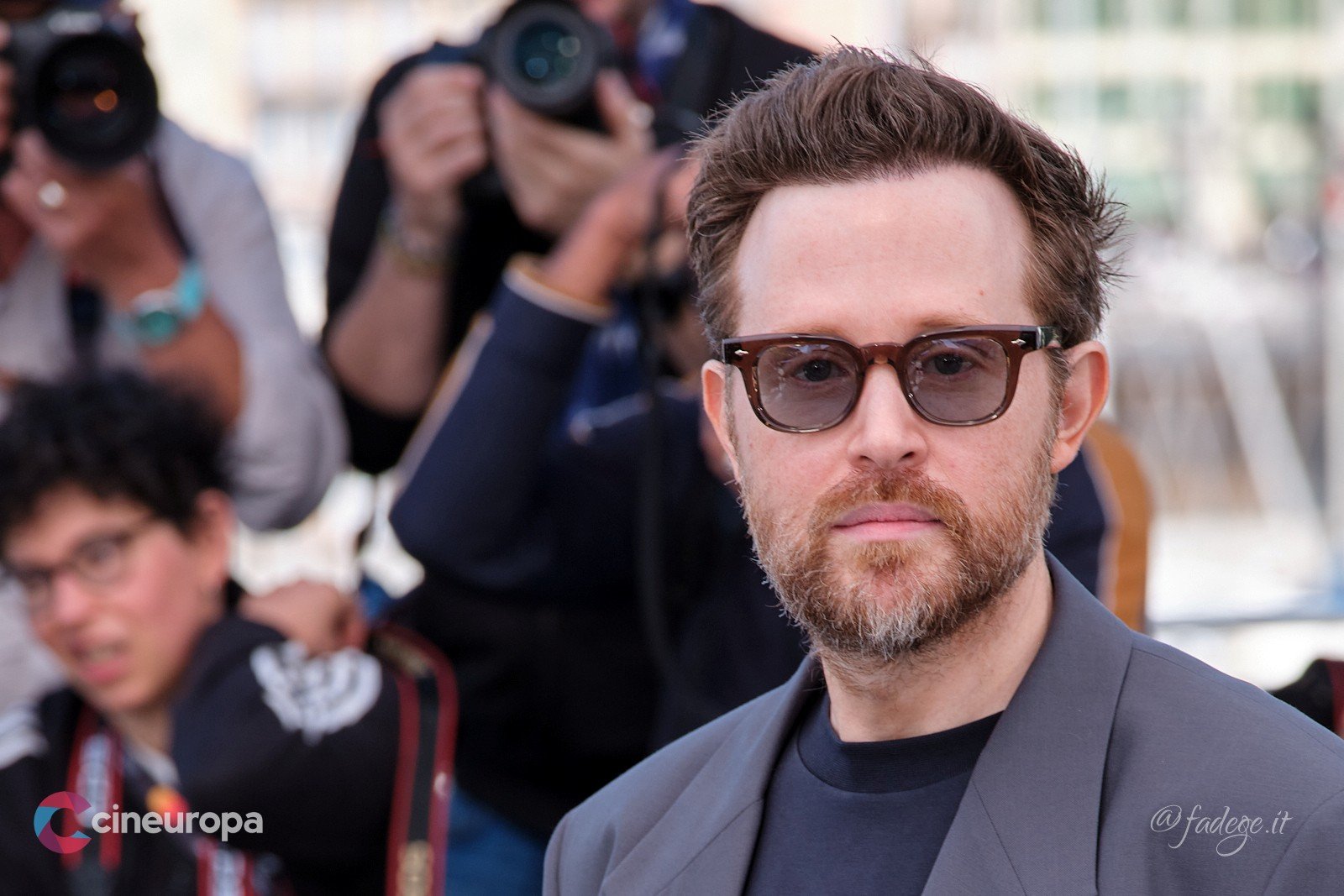
– CANNES 2026: The French filmmaker discusses the origins of his second feature, a moving melodrama starring Hafsia Herzi and the young Nour Salam
(© 2026 Fabrizio de Gennaro for Cineuropa – fadege.it, @fadege.it)
Winner of the New Directors competition at San Sebastián in 2015 with The New Kid, French filmmaker Rudi Rosenberg returns with Words of Love, his second feature, unveiled in the Un Certain Regard section of the 79th Cannes Film Festival.
Cineuropa: Where did the idea for this story, centred on a young girl searching for her father, come from?
Rudi Rosenberg: I’m a big fan of the programme Strip-Tease, and I had seen an episode from 2004 entitled Papa va venir, which follows a single-parent family: a mother who, together with her children, is waiting for the father to arrive and celebrate their daughter passing her driving test. They wait for him throughout the entire episode, and he never comes. It was both funny and deeply moving. I actually managed to track that family down and meet them afterwards. The idea for the film, and for the character of Abigail, initially came from there, and I did a great deal of research into children searching for their parents. But I also wanted to write about family, and mothers in particular, and about their unconditional love for their children. And there was also the idea that, sometimes, we spend our lives chasing after people who are not interested in us, and end up no longer seeing those who are truly there for us and really matter.

Why did you choose to structure the story across two time periods, first during Abigail’s childhood and then during her adolescence?
At first, there was only one time period. But I wanted to explore the almost “borderline” nature of Abigail’s obsession, to really push it as far as possible. Time therefore became one of the key elements in helping us fully understand her obsession. And also because, very often, time feeds obsession, along with the distress that gradually consumes a person.
Why did you choose to set the story in 1995?
For a more technical reason. Nowadays, finding an absent father is much easier — you can do it in three clicks. Back then, it was far more romantic in the narrative sense: you had to investigate, search through the phone directory, go back to the café he used to frequent, and so on. It is ultimately much more interesting than making a film about someone sitting in front of a computer or on the phone.
How did you want to approach the character of the mother?
Originally, the story was more focused on Abigail searching for her father and on her obsession, with a mother who felt somewhat helpless, wanting to protect her while at the same time feeling obliged to help her. Little by little, the audience needed to sense the mother’s guilt in relation to the situation. But with everything Hafsia Herzi brought to the role, the film also became, to some extent, about the relationship between a mother and her daughter.
How did you want to channel the melodramatic dimension inherent in the subject matter?
The subject itself is already deeply moving. These kinds of themes are seen quite often in cinema, so I felt it was important to approach them with great subtlety, because things could very quickly become excessive. It all had to feel truthful, especially when it came to the character of Abigail. I am very fond of documentaries, and I think emotion emerges through a sense of authenticity, not by trying to overplay things. And I also like the idea that, just as in life, humour and tragedy are intertwined.
How did you cast the two actresses playing Abigail at the ages of seven and fourteen?
I first noticed Nour Salam, who plays the older Abigail, during auditions for an advert I was directing. She was 12 at the time and I met with her six or seven times before giving her the role. Afterwards, the challenge was to find a little girl who resembled her. We discovered the younger actress in Sarcelles, where I wanted to film because I think it is a very beautiful place with a highly mixed community. We organised a large casting call there — many local residents also appear in the film — and Ella Bedoucha came along with her parents. We were immediately struck by how much she looked like Nour.
What were your main visual intentions?
I wanted the film to feel very immediate and realistic, but without becoming overly documentary-like. Above all, I wanted fairly natural lighting so that it would feel like real life rather than a stage play. At the same time, there also needed to be a certain visual aesthetic, because the 2000s were a colourful period and I wanted the film to feel warm.
(Translated from French)
