
Ah yes, the team we all expected to lead the majors in scoring nearly 50 games into the 2026 season: the New York Yankees (no?), the Los Angeles Dodgers (really?), the Washington Nationals. Wait, what?
Through 48 games, the Nationals are two games below .500 with a run differential (-22) that suggests they’re lucky to have won as many as they have. Their pitchers and defense have allowed a league-worst 284 runs. Yet, their run prevention struggles are hiding just how well they’re done on the other side of the ball.
Through 48 games, the Nationals have scored an MLB-leading 262 runs. That’s 12 more than the Braves in second, 18 more than the AL-leading Yankees, and 95 more than the last-place San Francisco Giants. If they maintain this pace, their 5.46 runs per game would set a new franchise record, surpassing the World Series-winning 2019 club (5.39) and the dominant 1994 Montreal Expos (5.13).
I don’t mean to say I expect the Nationals to keep this up all year. I doubt anyone does. Even so, what they’ve done to this point is impressive, especially considering preseason expectations. Coming into the year, you could have predicted Washington would score the fewest runs in the league, and nobody would have batted an eye. FanGraphs still projects the Nationals to rank last in runs per game over the rest of the season. Yet, they’ve already piled up so many that even if they score at their projected last-place pace (4.28 runs per game) over their final 114 contests, they would finish the year with 750 runs. That would be the fifth-highest total in franchise history.
The Expos/Nationals franchise is in its 58th season, and this is only the ninth year in which the team has scored at least 262 runs over any 48-game stretch. Those other years were 1987 (.562 winning percentage), 1994 (.649), 1996 (.543), 2012 (.605), 2017 (.599), 2018 (.506), and 2019 (.574). All eight seasons were winning campaigns. And heck, the eventual World Series champions in each of the last three seasons (2023-25) led the majors in scoring through their respective 48th games. Once again, I’m not trying to say Washington will win the World Series. I’m not trying to say Washington will finish with a winning record. But 48 games isn’t nothing, and through 48 games, the Nationals’ offense has been a lot more productive than you probably realized.
I’ll admit that the title of this post is a little tongue-in-cheek. However, the Nationals really have hit well this year. Their .740 OPS ranks fifth in MLB, and their 108 wRC+ is sixth. There’s certainly some good luck in their high run total, but it isn’t just the result of timely hitting or balls finding holes. Their .331 expected wOBA ranks seventh in the majors, while their numbers with runners in scoring position are only in the middle of the pack. The BaseRuns formula at FanGraphs, which estimates the number of runs a team would be expected to score based on their underlying offensive stats, suggests that Washington “deserves” to have scored 5.10 runs per game. That’s less than 5.46, but it’s still excellent. Only the Cubs, Dodgers, and Braves have a higher BaseRuns expectation. Meanwhile, Baseball Prospectus’s DRC+, a metric that considers quality of contact instead of just results, ranks the Nationals as MLB’s sixth-best offense – and that’s without giving them credit for their excellent baserunning.
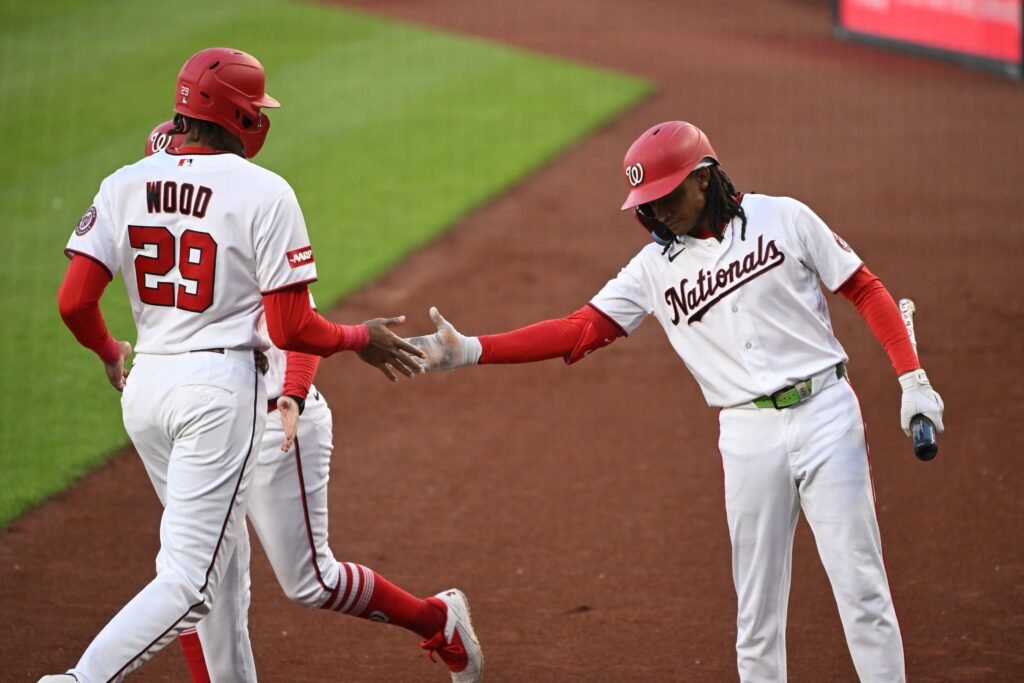
Turning to the individual players, the memory of Juan Soto is powering the Nationals’ lineup in 2026. Shortstop CJ Abrams and outfielder James Wood, both of whom came to Washington in the Soto trade, are tearing the cover off the ball. In fact, they’re both outhitting Soto himself. Wood, the leadoff hitter, is pacing the majors in runs scored, while Abrams, batting cleanup these days, ranks third in RBI. They’re each among the top 20 qualified hitters in OPS and wRC+.
Wood is hitting for a bit more power, and his 17.5% walk rate leads the National League. Abrams puts the ball in play more often, and he’s been flirting with a .300 average for much of the year. The question for Abrams going forward is whether he can avoid another midseason collapse. He started strong in 2024 and ’25 before struggling badly in each season’s second half. As for Wood, the only question is how high he can climb. The numbers are already remarkable, and the way he impacts the baseball suggests his ceiling is even higher. His .393 wOBA ranks 11th among qualified NL batters, but his .425 xwOBA leads the Senior Circuit.
After Wood and Abrams, Daylen Lile is the team’s only other qualified hitter with a wRC+ above league average. That goes to show how much Washington’s two best hitters have done for this offense, but Lile deserves his fair share of credit as well. The left fielder isn’t lighting the world on fire like he was down the stretch last year, but he has continued to be a power threat against right-handed pitching. A deeper team might platoon him more often, but his overall 112 wRC+ is solid, even if a 78 wRC+ against southpaws is dragging that number down.
Speaking of platoons, the Nationals’ best hitter this season – without any playing time minimums – has technically been Joey Wiemer. The righty-batting outfielder began the season by reaching base safely in his first 10 trips to the plate. All in all, he has slashed .300/.410/.529 with a team-best 165 wRC+ in 83 plate appearances. Wiemer’s track record and the underlying numbers made it clear that none of it was sustainable, and the Nationals saw that, optioning him in favor of Dylan Crews earlier today. Regardless, Wiemer is a part of this story, and a pretty important one at that.
So is fellow right-handed batter Curtis Mead, who is finally starting to look like the promising hitter he was in the Phillies’ and Rays’ minor league systems. A .213 isolated power and more walks than strikeouts through 114 plate appearances have resulted in a 133 wRC+. Washington has shielded the infielder from same-handed pitching, but to his credit, his early numbers are equally strong against lefties and righties alike. While the sample is small, Mead is swinging at the right pitches and hitting the ball hard. The Nationals are surely grateful the White Sox designated him for assignment at the beginning of the year.
One last player worth highlighting is Nasim Nuñez. With a .187 batting average and a 54 wRC+, the second baseman has hurt his team’s offense more than he’s helped. Still, he walks enough that he gets on base at a passable rate, and once he reaches base, he might be the most dangerous player in the game. His 20 stolen bases are tied for the MLB lead, while his 3.4 baserunning run value (per FanGraphs) ranks second to only José Ramírez. That accounts for two-thirds of the Nationals’ league-leading 5.1 baserunning runs.
I’ve only touched on six of the 14 players who have stepped to the plate for the Nationals this year, and one of them isn’t even on the active roster anymore. That’s a big reason why this level of success doesn’t seem sustainable. Wood is the closest thing this offense has to a sure bet, and he’s still just a 23-year-old who has never hit this well over a prolonged period of time. The Nationals earned their 262 runs, and they earned the praise I’m giving them. Yet, this praise shouldn’t be confused with confidence. The Nationals have had the most successful offense in baseball over the first eight weeks of the season, but there are a whole lot of weeks left to play.
Stats up-to-date entering play on Tuesday, May 19. Images courtesy of Rafael Suanes, Charles LeClaire, and Patrick Gorski – Imagn Images
