
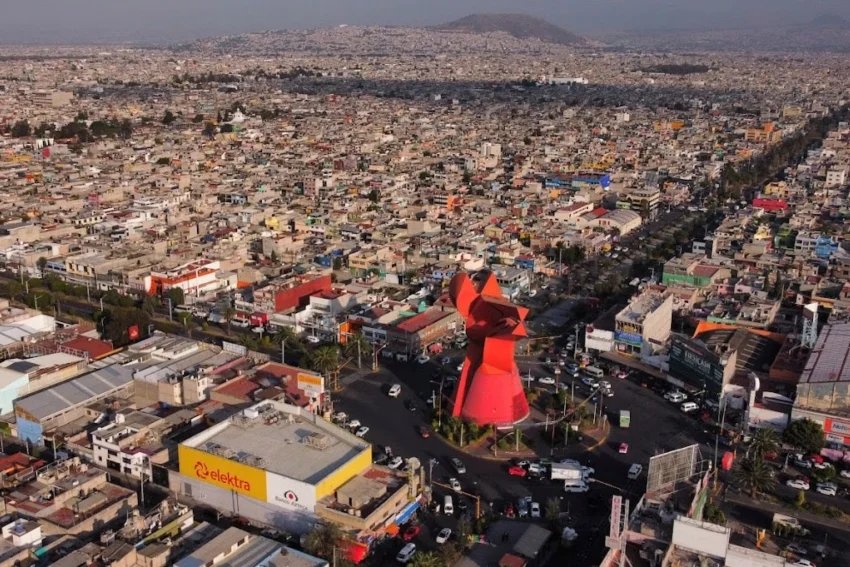
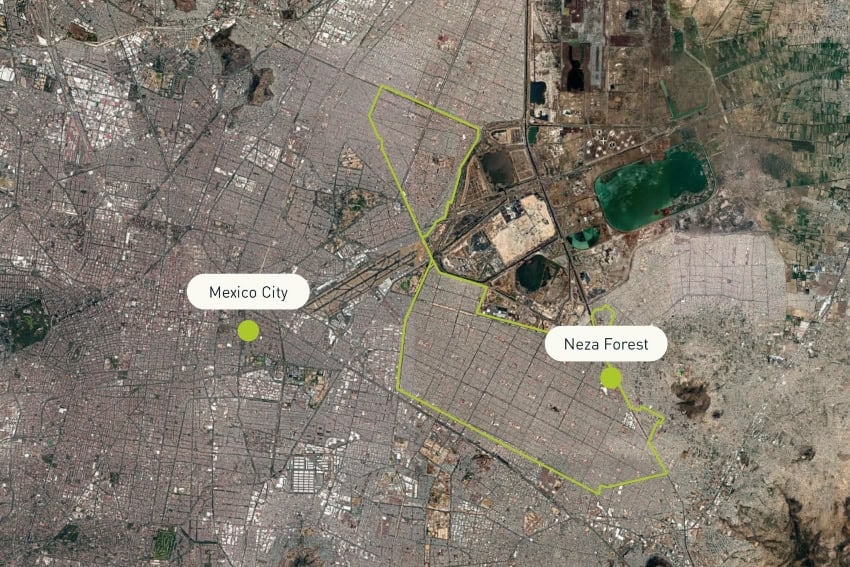
A year ago, a network of reforestation workers embarked on a challenging mission to plant a pocket forest in Nezahualcóyotl, an area located on the periphery of Mexico City.
Andrea Guzmán, the urban planner behind the project, realized during her studies that most city layouts were driven by architectural design rather than by the biology of the environment. When she heard about SUGi, a nonprofit that has fostered the creation of over 263 pocket forests across 62 cities, she decided to propose the creation of an urban forest in Neza. “The truth is, everything happened very quickly. They already had a funder. And within months, we were planning the project,” she said of the process.
Planting Trees in ‘Neza York’
Nezahualcóyotl, also known as “Neza York,” is a densely populated urban settlement located on the former bed of the saline Lake Texcoco. It suffers from the urban heat island effect, in which concrete and asphalt absorb and re-emit the sun’s energy, creating “islands” of intense temperatures, often between 1–7 degrees Fahrenheit higher than surrounding areas. Marginalized communities are especially at risk. Due to environmental injustice, these communities often receive little to no investment in green space, which offers relief through shade and heat absorption. In Nezahualcóyotl, residents have access to just a fraction of the green area considered adequate, far below the roughly 100 square feet per person recommended by the World Health Organization.
But soil conditions in Neza are also part of the problem. “Because of the high level of soil salinity, we first needed to validate that planting an urban forest would work,” said Diego, co-founder of the Chilean reforestation company Simbiótica, who was hired for the project.
Reforesting with the Miyawaki method
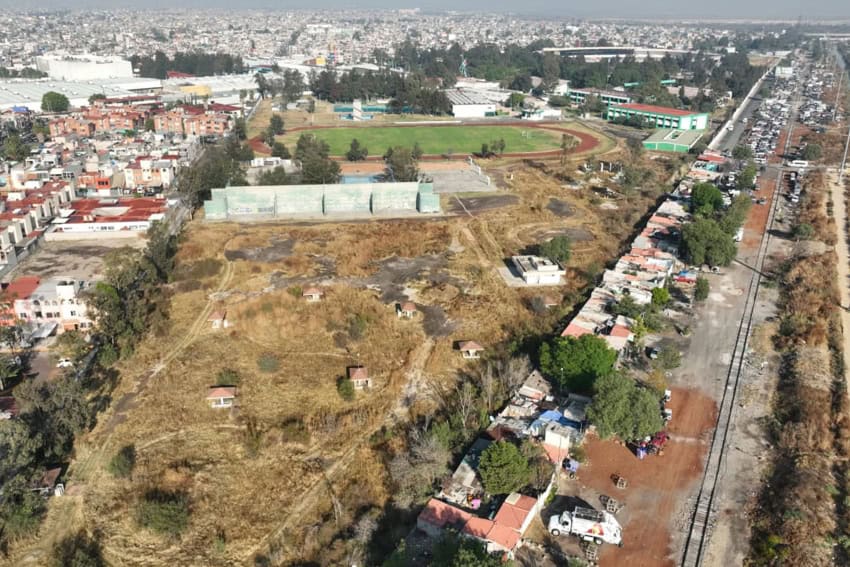
Funded by Steve Madden, under the direction of Andrea and Symbiotika’s team, consisting of Diego, Gabriel and Nicolás, and with the help of over 300 volunteers, the bare soil near the university campus of the Universidad Tecnológica de Nezahualcóyot was transformed into a living ecosystem. The technique used is inspired by the Japanese Miyawaki method, a “high-intensity” reforestation process mimicking forest structures in urban environments. The soil is decompacted, reoxygenated and revived with large amounts of compost. Between three and five different trees and shrubs are planted within roughly 10 square feet. The dense planting encourages vertical growth and an irrigation system supports the plants during their first three years. From the third year onward, the best management becomes no management, as the forest becomes autonomous and self-sustaining.
One year after the painting, the urban forest in Neza thrives, with a plant survival of more than 90% and some trees having reached over 10 feet. The circular green space with multi-layered vegetation holds over 25 native plants that tolerate soil salinity. The project in Neza is considered a success, proving that an urban forest, if designed purposefully, can even grow in saline soil.
What trees bring to Mexico City
“In cities, the marginal value of every new tree is higher than in landscapes that are already heavily vegetated because they provide more ecosystem services,” says Amelia Harvey, an urban planner and data analyst who created a dataset analyzing tree density, marginalization and surface temperatures in Mexico City and the peripheral area to identify the areas most in need of vegetation, such as Nezahualcóyotl and Ecatepec.

Urban forests can reduce noise pollution and capture harmful air particles. They attract biodiversity, enhance soil health, store carbon and allow water to infiltrate, helping to prevent flooding. Surface temperatures within the pocket forest can be significantly lower than in the surrounding area.
Another benefit of green spaces in cities is their contribution to residents’ mental health. A growing body of research shows that people with little or no access to green space tend to have higher levels of depression and anxiety.
“An urban forest is a healthy place that can inspire and surprise you. A place where you can spot insects you have never seen before, different colors … where suddenly a purple flower grows. We need to be part of a world that still holds magic,” explains Andrea about the forest’s impact.
“When everything is so controlled, when you know in how many minutes the Uber will arrive or when your coffee will be ready, nothing surprises you anymore. But the natural world can still surprise us every day.”
Micro-ecosystems, ‘urban acupuncture’ and biodiversity corridors
From a global perspective, the carbon capture of urban forests may be limited, but at the local level, green spaces are a powerful solution. Climate change must be addressed in two ways: through large-scale reforestation and through the creation of biodiversity corridors and vegetation within cities.
“You cannot care for something you don’t know,” says Andrea when we talk about climate change. The urban forest becomes a teacher and reference point for city residents, who are often disconnected from the natural environment.
To help cities counter the negative effects of urbanization and climate change, she suggests “urban acupuncture,” a strategy in which small green spaces are distributed across the city to help it recover and heal. The introduction of biodiversity corridors is also crucial to help reconnect the fragmented wildlife habitats that are a consequence of urbanization. The next urban forest is planned for Iztapalapa.
But installing urban forests is not the only goal.
“We also want to change the perception of green areas,” says Gabriel, co-founder of Simbiótica. A green space with a lawn and a few trees does not hold the ecosystem that existed before urbanization. Andrea is working on projects that will reintroduce bountiful vegetation into existing parks and lawns in Miguel Hidalgo and Cuauhtémoc. She is convinced these micro-ecosystems work. “The response we’ve received from people has been incredible. There’s been an impressive sense of ownership over these forests, a level of participation that exceeds our expectations. People are eager; once you place it in their neighborhood, they want it and take care of it.”
Katy Alivraz is a contributor to Mexico News Daily.
