
– CANNES 2026: Tiago Guedes’s 200-minute adaptation of JM Coetzee’s Jesus trilogy is a striking philosophical journey through the life of David, a unique boy
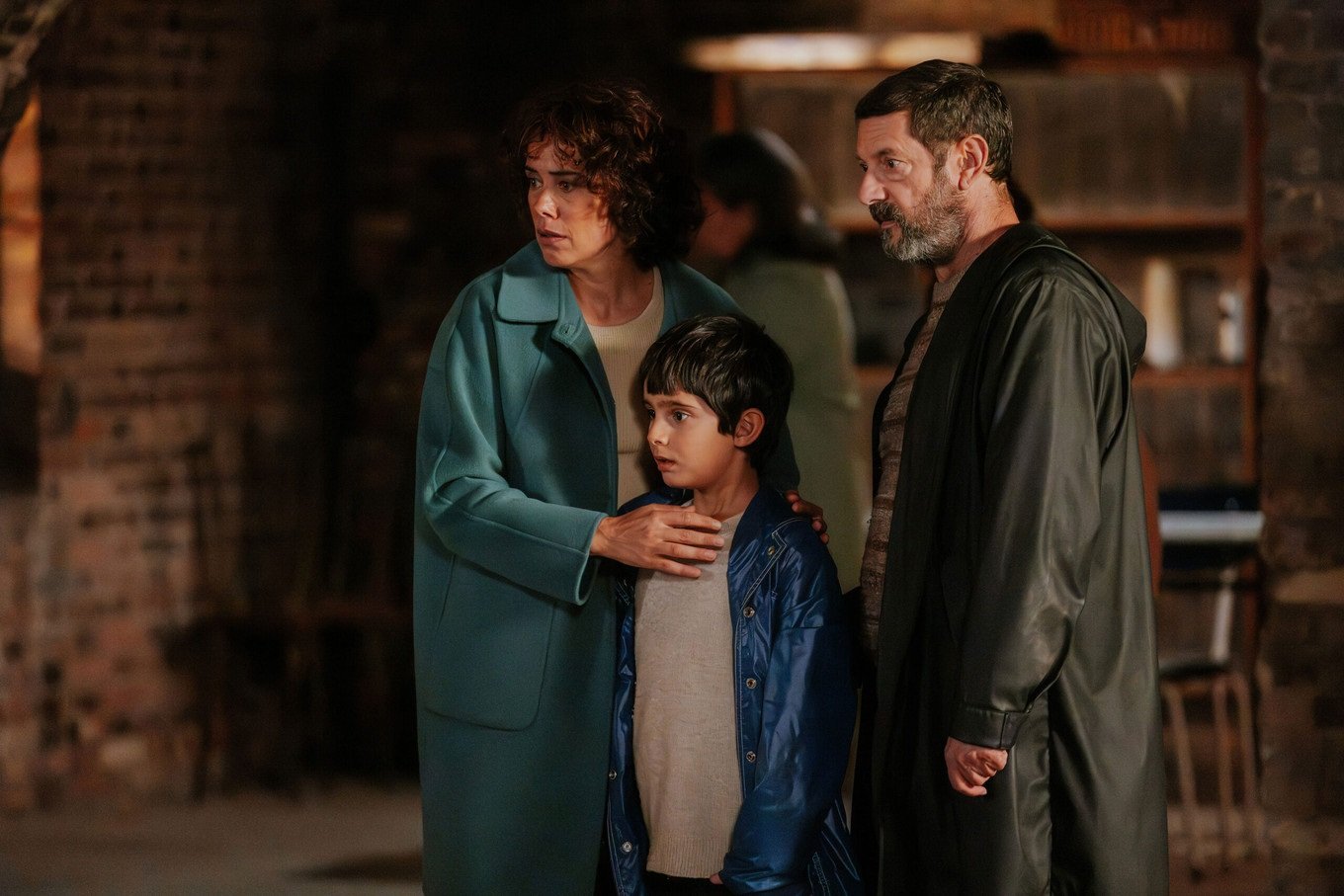
Patricia López Arnaiz, Álex Peláez and Manolo Solo in Aquí
Aquí, directed by Portuguese filmmaker Tiago Guedes, who co-wrote the script with Luís Araújo, is an ambitious adaptation of the Jesus trilogy by Nobel Prize Winner JM Coetzee. The Portuguese director is not new to adapting literary works for the screen, having recently directed Dialogues After the End (2023), based on Cesare Pavese’s Dialogues with Leucò. The plot of the film, which world-premiered in the Cannes Premiere section of the 79th Cannes Film Festival, is relatively simple, yet enigmatic: Simón (Manolo Solo) becomes responsible for David (whose younger version is played by Álex Peláez, before being succeeded by Hugo Encuentra), a child he meets during a mysterious boat voyage towards a new life. For some reason, he convinces himself that he will be able to find the boy’s mother — whom he briefly saw during the crossing — and comes to believe that Inés (Patricia López Arnaiz) is the right woman. Not because he remembers much about the woman he actually saw, but because he feels it within himself. Surprisingly, she accepts the proposal. From there, the unlikely trio embarks on a journey as a family, while David continues to surprise his adoptive parents with his unique way of seeing the world.
Considering that it is an adaptation of three books totalling almost 1,000 pages, the film could hardly be anything other than extremely expansive. It is, in fact, 200 minutes long, which may feel like a significant drawback for many viewers. That said, it should be noted that time passes surprisingly quickly and, once the film finds its rhythm, it flows with relative ease. Nonetheless, it will chiefly appeal to spectators with a certain degree of patience and an appreciation for slow-paced cinematic experiences. The casual cinemagoer will likely struggle to sit through such an enigmatic film without growing restless.
There is never a clear explanation as to where the story is actually set, beyond the fact that people speak Spanish there. The setting of the novel is the fictional town of Novilla, but little is revealed about its background. Nor do we know precisely when the film takes place, although the set and costume design suggest it is unlikely to be set in the contemporary world. This sensation of being suspended in time and place may feel disorientating, but it also frees audiences from the constraints of placing events within a specific social or historical framework. It also serves as an effective narrative device for sustaining engagement throughout the lengthy storyline, as the question that continually arises – especially for viewers unfamiliar with the book trilogy – is: “Will there be a clue that finally makes everything clearer?”
All in all, Aquí is a very interesting film, boasting a strong ensemble cast that also includes Sergi López, Ángela Molina, Fernando Trueba and Lambert Wilson, as well as extremely well-choreographed dance sequences. Both young actors portraying David are extraordinary, conveying both the triviality and the holiness – David is compared to Jesus in the books – of the character they embody. Its philosophical and mystical atmosphere, drawn both from the literary source and the film’s technical craftsmanship – with Bolivian cinematographer Daniela Cajías demonstrating a particularly sharp eye for thoughtful visual composition — makes for a memorable cinematic experience.
Undoubtedly, its greatest obstacle in reaching a wide audience remains its length and its obscurity, which does little to encourage potential viewers. On the other hand, for those seeking a cathartic and moving experience that also features gripping plot twists, Guedes’s film is a perfect fit.
Aquí was produced by Leopardo Filmes (Portugal) and co-produced by RTP Rádio e Televisão de Portugal, Alfama Films (France) and APM (Portugal). International sales are handled by Films Boutique.
