
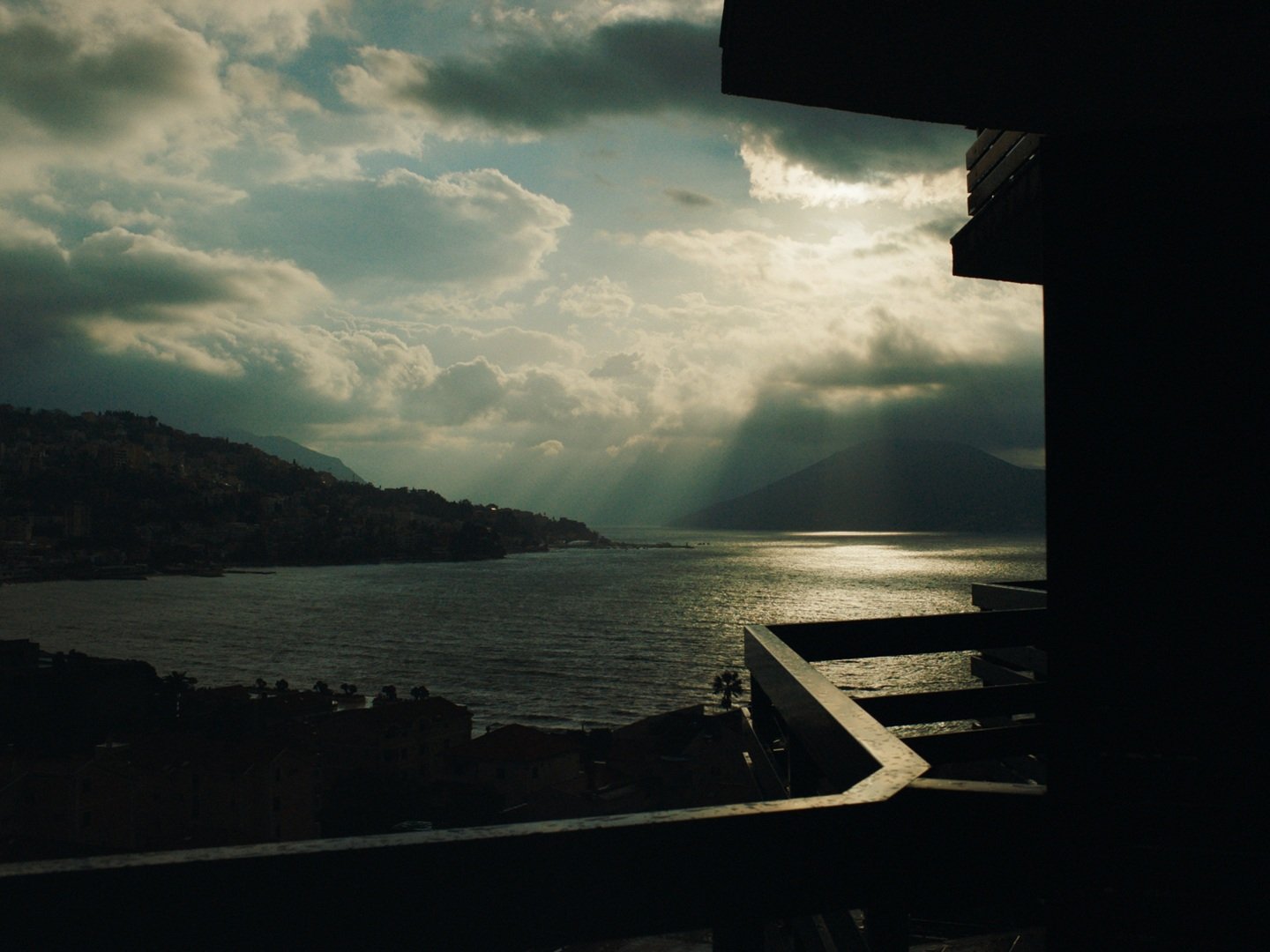
– Serbian cinematographer and director Miloš Jaćimović’s documentary explores the passage of time in a physical therapy resort on the Montenegrin coast
In Igalo, on the Adriatic coast of Montenegro, sits the imposing, modernistic building housing the “Dr Simo Milošević” Institute for Physical Medicine, Rehabilitation and Rheumatology. This is the setting, the topic and main character of Serbian filmmaker Miloš Jaćimović’s first feature-length documentary, Sunset, which has world-premiered in the Serbian Competition Programme of Beldocs, also scooping the Grand Prix in that section.
Even though it was obviously filmed over a longer period during COVID-19, the film is structured as one day at the institute, bookended with a sunrise and a sunset. Jaćimović and editor-producer Vanja Kovačević lead us in with a fade-in, of sorts, as the sun slowly rises and shadows give way to brightness inside the rooms, hallways, restaurant and reception hall of the institute. The staff slowly appear, and soon, so do the patients. The quiet morning turns into the busyness of everyday activities.
We watch scenes of various kinds of physical therapy, from exercises in the swimming pool, in the gym and on the patio outside to the application of medicinal mud and the use of various electronic devices. Technicians and nurses strike up cordial relations with patients. At the reception desk, which serves as a sort of command centre and vantage point for the viewer, which Jaćimović returns to several times throughout the film, employees discuss necessary repairs and guests come to schedule their therapies. In the kitchen, food is being made in large quantities, while in the laundry room, washing machines judder and hum. In the offices, the staff scroll on their phones, chat, joke and smoke.
The institute is the last such establishment in Montenegro that is still owned and run by the state. Hailing from the times of Yugoslavia, it somewhat preserves the communal vibe of a workers’ union resort, even though it is now functioning under strict capitalistic rules. With one exception, that is: patients from the countries of the former Yugoslavia can book their stays at a discount price.
Jaćimović’s film is about time, but not in the historical sense. Rather, it is about the slow passage of daily moments and their repetition. While the institute is the only actual character, the staff and patients are not mere side figures; there is a distinct vibe of the Balkan spirit in their interactions, but it is somewhat muted, more sombre and dignified, compared to what is usually understood from this term.
Best known as the cinematographer on such films as Tilva Roš, The Uncle and My Late Summer, Jaćimović films with a static camera in a 4:3 aspect ratio. The tone of the picture is predominantly warm, enhanced by the sunlight and pleasantly designed interiors, although scenes in tiled premises and a sequence with a storm bring darker, colder images. A couple of underwater shots in the pool or close-ups of soap bubbles in rotating washing machines add a bit of an otherworldly aspect, but the film remains firmly rooted in its place and time. Jan Nemeček’s soft ambient score is sparsely used, at the beginning and end, with a few snippets in the middle interspersed with added strings. It remains a quiet, sober and moderately paced film throughout its 65 minutes of running time.
Sunset is a co-production between Serbia’s Baš Čelik, Montenegro’s Meander Film and Croatia’s Zagreb Film Festival.
