
– CANNES 2026: Guillaume Canet’s suspenseful psychological thriller relies on an eventful plot while digging into the age-old symbiosis between sex and power, rooted in male frustrations
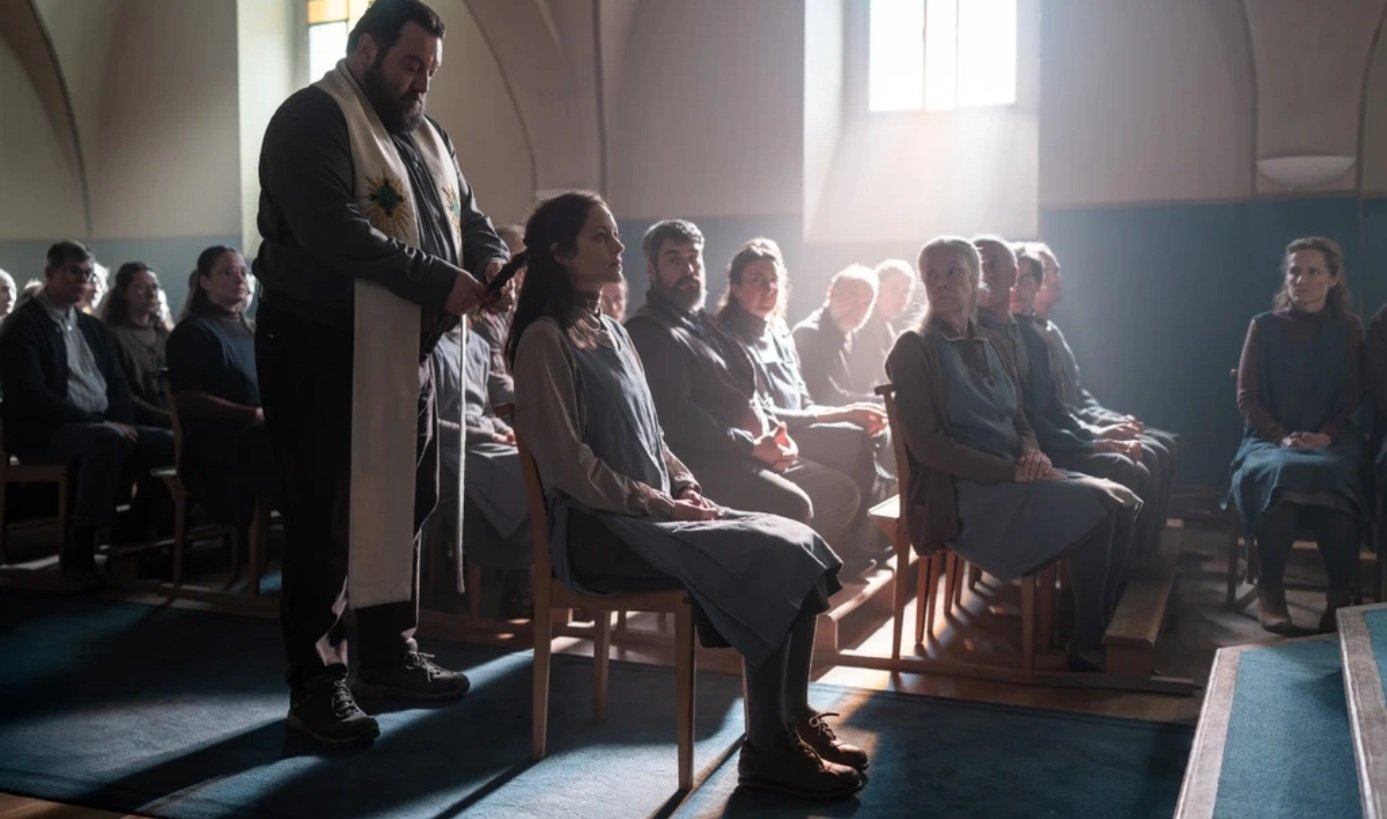
Denis Ménochet and Marion Cotillard in Karma
Settling into territory he apparently feels is his own – nestling somewhere between the crime-thriller mode he explored in Tell No One and Blood Ties, and the theme of troublesome relationships seen in Little White Lies and Little White Lies 2 – in Karma, just shown Out of Competition at the 79th Cannes Film Festival, Guillaume Canet allows himself an expansive plot in which nothing is quite what it initially seems. Meanwhile, the breathless pace propels the characters through a series of obstacles that ultimately lead them to the truth about themselves, without, however, offering the audience anything beyond a comforting resolution of the eternal battle between good and evil.
Karma is a deftly assembled but overlong piece of eye candy, produced with the involvement of Netflix and never rising above the familiar calibre of streaming content. Even for Out of Competition – a section that rarely elicits great expectations – it is difficult to understand what this film is doing at Cannes, unless one starts speculating on theories of French-style favouritism.
The movie opens as a feverish drama about a relationship in crisis, with Marion Cotillard’s Jeanne appearing almost unhinged – fixated on her godson Mateo (Aaron Ramo), forgetting where she left him and failing to return him to his parents, while her partner Daniel (Leonardo Sbaraglia) struggles to reconstruct the identity of a woman he barely seems to know. When Mateo disappears while under her supervision, it inevitably becomes clear that he is, in fact, her son, and her past begins to come to light, layer by layer – as if we were peeling an onion that the film expects us to cry over by default alongside the heroine, entangled in the tragedy of her melodramatic fate. Daniel sets off in pursuit of her dark past, haunted by his own, no-less-troubled one, closing in on the shadow of an isolated sect in the Catalan Pyrenees, controlled by the sinister Marc (Denis Ménochet). Professional ethics prevent this writer from revealing any further details, as those present at the screening were explicitly warned by the publicists not to drop spoilers concerning what is, in any case, an already rather one-dimensional plot — although be warned that, however enigmatic it may sound, it is not worth sticking around for.
Despite Canet’s good intentions, having “had a strong urge to write a great role for Marion”, her character amounts to little more than a simple victim buffeted around by fate and by various men, with very few ways to be played beyond the mournful gaze of a doe being hunted down, supposedly seductive in her own martyrdom. Ménochet is given the role of the resentful antagonist, a frustrated man who seeks revenge and sexual gratification left, right and centre after being denied love – a performance based on shouting and grimacing. In the middle stands Sbaraglia’s Daniel, trying to atone for past sins while clinging to a looming disaster like a drowning man would clutch at a straw. They are all linked through cheap psychology within an otherwise coherent narrative, which holds our attention only insofar as we are curious to see what exactly the €24 million production budget has been spent on, and how the time of otherwise experienced actors has been wasted.
Karma was produced by France’s Iconoclast Films and Canéo Films. Its international sales are handled by Pathé International.
