
It’s not exactly an original observation, but the first three Toy Story films remain one of cinema’s great trilogies. The so-called “Andy Trilogy” charts a natural progression, following Andy as he grows up and gradually leaves the trappings of childhood behind him. More importantly, Toy Story 3 provides an emotional, near-perfect conclusion, bringing closure to both Andy’s story and the toys’ journey. However, with Pixar making the conscious decision to move away from original stories, focusing more on sequels, it was inevitable that the studio would return to the franchise that helped define it. Even so, the existence of Toy Story 5 feels difficult to justify.
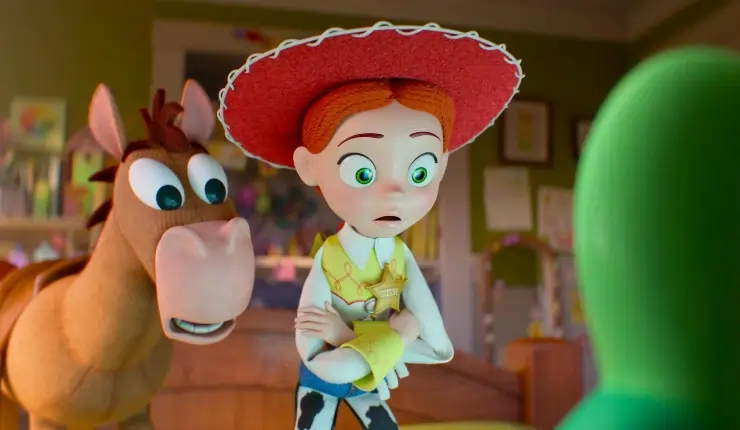
This latest instalment shifts the spotlight away from Woody (Tom Hanks) and Buzz (Tim Allen) and onto Jessie (Joan Cusack). Their sweet-natured owner, Bonnie, is increasingly left out by her peers, all of whom have moved on from toys and are now constantly occupied with their electronic devices. Hoping to help, her parents bought her a LilyPad tablet (Greta Lee) that allows her to socialise online. Unsurprisingly, the arrival of a new electronic companion causes panic amongst Bonnie’s toys – with Jessie accidentally abandoned, and Lilypad consigning the other toys to the garage, it takes the reappearance of an old friend to help save the toys and Bonnie.
This is a film of two distinct halves, both of which have their merits. On one hand, there’s Bonnie’s story, exploring childhood loneliness and the growing role technology plays in children’s lives. On the other hand, there’s a surprisingly thoughtful character study of Jessie. The former is a mixed bag. The idea of toys competing with screens for a child’s attention is a great premise, and the film presents a fairly even-handed argument for both sides – screentime is shown to help with socialising while also transforming children into passive zombies, (an odd stance to take, given that a large portion of the intended audience will inevitably watch this on a similar device), while playing with toys, though childish, encourages creativity. The problem isn’t that the film vilifies screen time; it’s that it seems convinced technology and imaginative play are mutually exclusive.
This is only compounded by the forced conflict that exists between Jessie and Lilypad. In theory, LilyPad is one of the more interesting antagonists of the series. Unlike Stinky Pete or Lotso, she genuinely wants what’s best for Bonnie. The issue is that the film manufactures conflict by preventing its characters from speaking plainly. Jessie immediately views LilyPad as a threat, while LilyPad responds with smug superiority, and neither ever takes the time to understand the other’s perspective. Their goals aren’t fundamentally incompatible, but the film relies on contrived misunderstandings and hostility to generate drama.
Thankfully, the Jessie material is considerably stronger. Cusack has always brought an irrepressible enthusiasm to Jessie, and this film finally gives her the spotlight she deserves. Thankfully, the script largely avoids revisiting the emotional beats of Toy Story 2. Rather than simply rehashing “When She Loved Me” over the course of 90 minutes, it expands upon Jessie’s insecurities and explores her past in a genuinely moving way without ever feeling laboured or maudlin.
An inevitable byproduct of this focus means that Woody and Buzz feel like spare parts. Both characters are given their own subplots (Buzz, in particular, gets some incredibly funny moments), but neither feels particularly essential to the narrative, and it often feels like the writers are struggling to find something for them to do. Similarly, a subplot involving multiple Buzz Lightyears on a mission to find Star Command is so disconnected from the rest of the film that it feels like a last-minute addition to the script.
Perhaps the biggest disappointment, however, is the treatment of the supporting characters. Hamm, Rex, Slinky Dog and the Potato Heads are all reduced to little more than extras. Some of this is understandable given the passing of several key voice actors over the years, but it’s frustrating to see once integral characters pushed to the sidelines, in favour of the blander new toys. When Mr Pricklepants is getting more lines than Hamm, something has gone wrong.
It’s not a bad film by any stretch; there are a fair few inspired moments, and the animation is exceptional, even by Pixar’s standards. The sequence involving the Buzz Lightyear figures venturing through the woods is both beautifully animated and genuinely funny, complete with music lifted directly from Bambi, while the sight of dozens of Buzzes marching across the countryside is one of the film’s most indelible images, recalling Small Soldiers animated by Pixar (and how cool would that be!) The striking new visual style deployed during the play sequences is a neat way of differentiating Bonnie from Andy, and the animation of the humans is up there with the best the studio has done, and infinitely preferable to the “Bean Mouth” look of Elio, Turning Red and Luca. The animation of Bonnie in particular is incredibly evocative and poignant, rendered with an astonishing degree of emotional nuance.
The voice cast is similarly strong. Hanks and Allen slip into their characters as if they’d never been away, Lee brings just the right combination of artificial warmth and barely concealed condescension to LilyPad, while Conan O’Brien brings most of the laughs as a snarky toilet training device. While we’re on the subject of voice actors, though, it’s a little disheartening to see Pixar continuing to just insert recognisable British media personalities in cameos for purely promotional purposes.
Toy Story 5 never does anything as egregious as its predecessor, but it’s still a long way from Pixar at its best. The best thing I can say about it is that it never feels like a cynical cash grab. There is enough here, in its treatment of Jessie, and the touching depiction of Bonnie, to justify its existence. But it suffers from an overstuffed plot, too many characters, and a confused message. It’s also indicative of Pixar’s new direction. The original trilogy built towards a definitive ending. This film simply returns everything to the status quo, leaving the door open for yet another sequel.
★★★
In UK cinemas on June 18th / Tom Hanks, Tim Allen, Joan Cusack, Greta Lee / Dir: Andrew Stanton / Walt Disney Studios / U
Discover more from
Subscribe to get the latest posts sent to your email.
