
BUCHAREST: Second-time Palme d’or winner Cristian Mungiu is calling for structural changes in Romanian film industry, which would primarily consist in reclaiming over 130 m EUR from gambling levies, and in building a viable distribution network.
Only a few days after winning his second Palme d’or at the Cannes Film Festival 2026 with Fjord, Mungiu spoke publicly about what he considers “the ten critical issues” of domestic film industry. Number one is the sub-financing of the Film Fund, which is usually not backed by the State, but by different sources related to exploitation and use of audiovisual content, of which some are not respecting the law.
The gambling levies were approved by a law adopted in 2020, but not a penny has gone to the Film Fund so far. “It should suffice that the Ministry of Finance and the Ministry of Culture issue a lawful order” and ask for this money to be paid, says Mungiu.
Collecting the TV advertising tax is also inefficient. The mechanism exists, but the real amounts do not fully reach the Film Fund.
Mungiu is also highlighting the absence of contributions from digital advertising and online platforms, such as Meta, Google or TikTok, as well as the lack of regulation for VOD. Romania also failed to update copyright legislation, so that creators would be fairly remunerated for their works broadcast on the internet and on streaming platforms.
Almost 20 years ago, right after his first Palme d’or, Mungiu announced a caravan with 4 Months, 3 Weeks and 2 Days throughout Romania as the number of cinemas was decreasing. “Sadly, that caravan became the norm”, says Mungiu now, calling for a more profound distribution network.
“Presently, there are 50-55 towns with multiplexes or individual cinemas, meaning that most of the towns don’t have any possibility for a public screening”, Mungiu added.
There are 318 towns in Romania, of which 103 are municipalities.
Mungiu’s other concern is the lack of a premiere cinema in Bucharest, as Sala Palatului, opened in 1960 to host the congresses of the Romanian Communist Party, and the only one cinema hall with over 1,000 seats in Romania, is very expensive (20,000 EUR for a premiere). Mungiu is suggesting that Sala Palatului should be transferred from the Autonomous Regie “Administration of State Patrimony and Protocol” (RAPPS) to the Ministry of Culture or the Romanian Film Centre (CNC).
Building a “cultiplex”, a multiplex for cultural events, would also be ideal, suggests Mungiu.
Other critical issues are the under-financing of the National Film Archives, and the lack of support for distribution and cinematographic services.
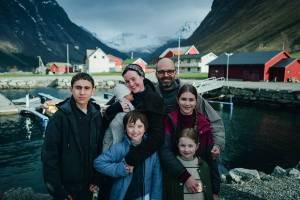
The national theatrical release of Fjord is not yet settled, as it depends on finding a proper cinema hall, the filming schedule of Sebastian Stan and Renate Reinsve, and the American release of the film, but an avant-premiere in 90 Romanian cinemas from 52 towns was announced for 13 June 2026 at 7 pm. The screening is a partnership between Mungiu’s Voodoo Films and Forum Film, one of the biggest distributors in Romania.
Neon Films will release Fjord in the United States.
Fjord (Romania, France, Norway, Sweden, Denmark, Finland) was produced by Mobra Films, and coproduced by Why Not Productions, Eye Eye Pictures, Garagefilm International, Filmgate Films, Snowglobe, and Aamu Film Company. 4 Months, 3 Weeks and 2 Days was produced by Mobra Films.
