
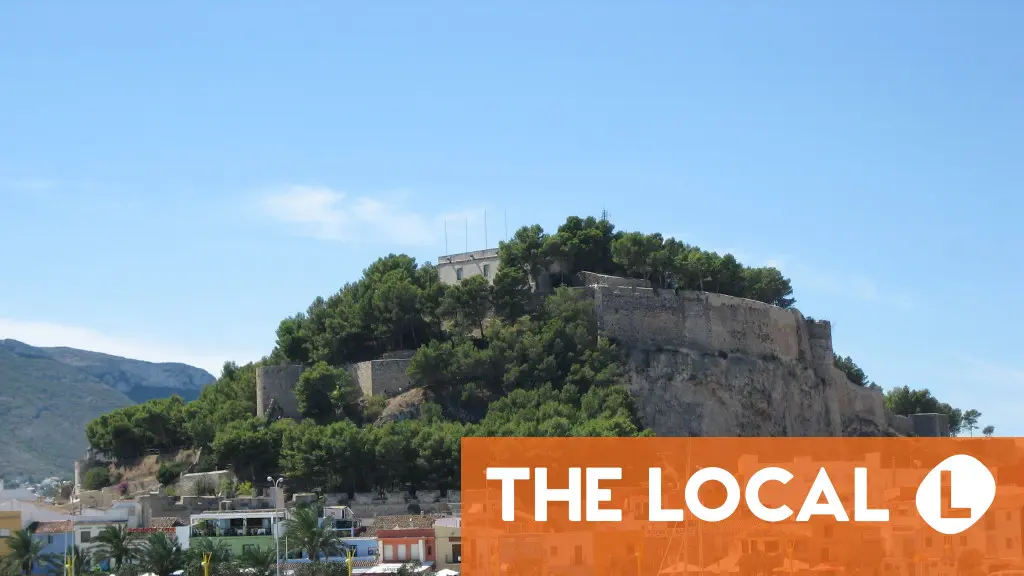
The Alicante town of Dénia, one of the Spanish municipalities with the highest rate of foreign residents, has announced that it will ban tourist apartments in certain neighbourhoods by 2029.
Dénia Town Council has approved a new ordinance regulating tourist rental properties, effectively banning tourist accommodation in certain neighbourhoods and reducing the overall current number of holiday lets from 639 down to 344.
The 295 existing tourist licenses will begin expiring in 2029 and the city council has said it will not renew them.
Local councillor Maria Josep Ripoll explained that the plan is designed to protect residential neighbourhoods and help to them maintain their local way of life. It also seeks to keep long-term rental prices down in these areas.
READ ALSO: Valencia rolls out Spain’s ‘most restrictive’ holiday let limits
It will mean that neighbourhoods such as Les Roques, Saladar and Patricio Ferrándiz, as well as Paris, Arxiduc Carles and Valga’m Déu squares and streets in the historic centre like Loreto, Major, Pare Pere and Sant Josep will be completely free of tourist housing in the future.
“In these neighbourhoods, which have never been tourist destinations, the traditional way of life will be preserved,” Ripoll said.
Holiday lets will however still be permitted in the areas of Marqués de Campo, Colón and La Mar streets, as well as the Cervantes and Raset esplanades and the port. Nevertheless, the council have noted that the limit in these areas has been reached and that no new tourist licences will be granted in these parts of Dénia.
READ ALSO: How Madrid plans to split city in two to regulate holiday lets
In Baix de la Mar, half of the neighbourhood will still allow tourist rentals, while the other half will ban them completely by 2029.
Meanwhile, in the urban centre around Raset beach and Avenida Miquel Hernández up to Camí del Llavador holiday rentals will still be allowed and an additional 217 tourists licences may be granted there.
This is due to the fact that these areas are no longer just residential and have more second-home owners and more tourist accommodation than local housing.
Dénia is one of Spain’s most multicultural towns, very popular with Europeans who come to buy holiday homes or those that make it their permanent base.
More than 16,000 registered residents are foreigners, which is 33 percent of the population. In total there are 107 different nationalities living in the area.
Many towns and cities across Spain have taken steps to ban or reduce tourist apartments over the last few years.
Last month, Valencia ruled that only two percent of homes in each neighbourhood could be used as tourist apartments.
READ ALSO: Valencia rolls out Spain’s ‘most restrictive’ holiday let limits
In 2025, Madrid also introduced new tourist apartment regulations and in 2024 said that it wouldn’t grant new licences in certain areas.
Barcelona so far has gone to the greatest lengths, vowing to abolish all tourist apartments in the city by 2028. Whether this will still happen or not remains to be seen.
READ ALSO: Can Barcelona really ban all Airbnbs?
