
More Canadians now say economic growth should be a bigger priority in Canada’s energy policy than protecting the environment, a new Angus Reid Institute report suggests.
The pollster released a report Monday indicating 61 per cent of Canadians now see economic growth as the biggest priority in energy policy. The question offered two options on the top priority shaping federal energy policy: economic growth or environmental protection.
That’s a shift in public opinion since seven years ago, when the same question had 55 per cent of Canadians saying the environment should be the top priority in energy policy.
Shachi Kurl, Angus Reid Institute president, said climate change was a top issue for voters in both the 2019 and 2021 elections, but opinion research shows the sense of urgency surrounding it has been declining in recent years.
“So you combine that with a level of urgency, or call it something else, around the (President Donald) Trump factor and that notion of ‘elbows up’ and that significant concern over if we can’t get our resources to market through the United States we’d have to look at other ways to make money — it all comes into play,” Kurl said.
Alex Walker, energy analytics program manager with Environmental Defence, said it’s easy to understand why Canadians are ranking the economy as a higher priority, given the cost of living challenges and broader economic uncertainty brought on by American tariffs and the war in Iran.
Walker argued, however, that while higher oil prices and increased Canadian exports can look good on a government’s balance sheet, they don’t necessarily ease broader economic challenges.
“If the oil prices stay this high for the next 12 months, the industry is on track to make $90 billion in profits, which is significantly more than it would have made without the war,” Walker said.
“So that could look like economic growth, but if you ask, you know, who’s earning that money, who’s getting to take home that money? It’s most likely not going to be everyday Canadians like us.”

Get breaking National news
Get breaking Canada news delivered to your inbox as it happens so you won’t miss a trending story.
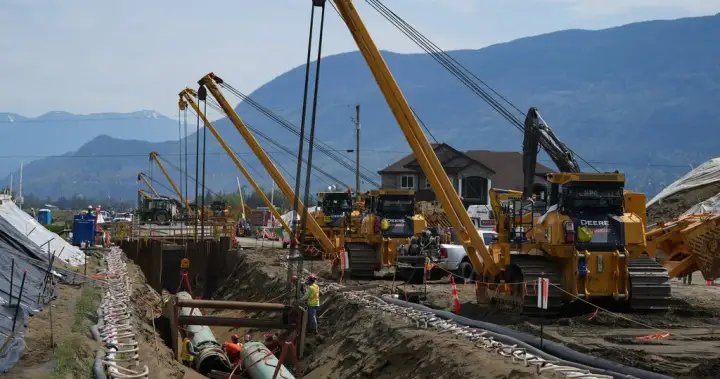
The poll suggests almost two thirds of British Columbians now support the recently approved $4-billion expansion of Enbridge’s Westcoast natural gas pipeline, with 17 per cent opposing the project. The remaining 22 per cent of respondents said they were not sure.

The pollster found 55 per cent support the project nationally, with 17 per cent opposed and 28 per cent not sure.
In an interview with The Canadian Press on May 1, Prime Minister Mark Carney said a new pipeline is “more probable than possible.” He also said Canada needs to increase its energy production and exports in a way that addresses emissions, pointing to carbon capture and storage technology.
Carney met with Alberta Premier Danielle Smith last week to talk about progress on a deal between the two levels of government to advance a proposal to build a new oil pipeline to the Pacific coast through B.C.
Smith said after the meeting she was more confident the deal will be completed, while noting there are still some issues to iron out. Those issues include the timeline for Alberta’s adoption of a $130 per tonne industrial carbon price.
Thomas Green, a David Suzuki Foundation spokesperson, said he worries an Alberta pipeline project will come with major government subsidies since there is no private proponent behind it yet.
“This kind of pipeline takes five to 10 years or more to build. By the time it’s built, the Strait of Hormuz, the war in Iran, all that will be settled,” Green said.
“Meanwhile, the world will have learned from that. We’ll have surged towards electrification, batteries, and there won’t be a market for that product. So I think it’s going to be a big white elephant.”
Angus Reid collected polling data going back to 2012 on the Northern Gateway pipeline to show opposition to pipeline development has been waning in B.C. The 2012 poll recorded 57 per cent opposition to the Northern Gateway project, which dropped to 32 per cent opposition in 2025.
A potential Alberta-backed pipeline enjoyed 56 per cent support in B.C., with 33 per cent opposed, according to an October 2025 Angus Reid poll.
Kurl said this represents a significant shift as natural gas has long been more palatable for British Columbians. She said while more people are showing support for oil pipelines, there are still high levels of resistance in B.C. compared to other provinces.
“The big question is, where do First Nations come in? Where does the routing come in? Where do the proponents come in and can they land the plane, so to speak, on the right runway?” she said.
“That’s the outstanding questions, but these are numbers that 10, 15 years ago, I’m not sure we would have expected.”
More respondents told Angus Reid this time that the government is taking the right amount of action to get new pipelines built, with 31 per cent agreeing the level of action was “about right” compared to 23 per cent seven years ago.
The number of people saying the government is doing too much declined from 27 per cent in 2019 to 21 per cent in this poll.
About half the population maintains the government is doing too little, with 50 per cent of respondents holding that view in 2019 compared to 48 per cent in 2026.
The Angus Reid Institute says the online poll was conducted between April 24 and 28 with 2,360 Canadian adults drawn from the Angus Reid Forum, the agency’s poll respondent pool.
The Canadian Research Insights Council, an industry organization that promotes polling standards, says online surveys cannot be assigned a margin of error because they do not randomly sample the population.
© 2026 The Canadian Press
