
Successful countries make public transit a national priority. The world’s great capital cities–Paris, Berlin, Rome, London, Moscow, Tokyo, Beijing—all have excellent urban transportation systems. Canada’s are embarrassingly poor. Canada is the only G7 country lacking national public transit policy or legislation.
Urban sprawl, car-centric planning, scarce infrastructure funding, and fragmented governance are some of the reasons that public transport is so bad in Canada. Another main cause is the myth that private sector competition alone can provide efficient and affordable transport—a myth enshrined 60 years ago in Canada’s national transportation act and perpetuated by government actions ever since.
The result is a playing field where private companies compete for transport infrastructure funds from multiple government sources and there is little coordinated planning, oversight or accountability.
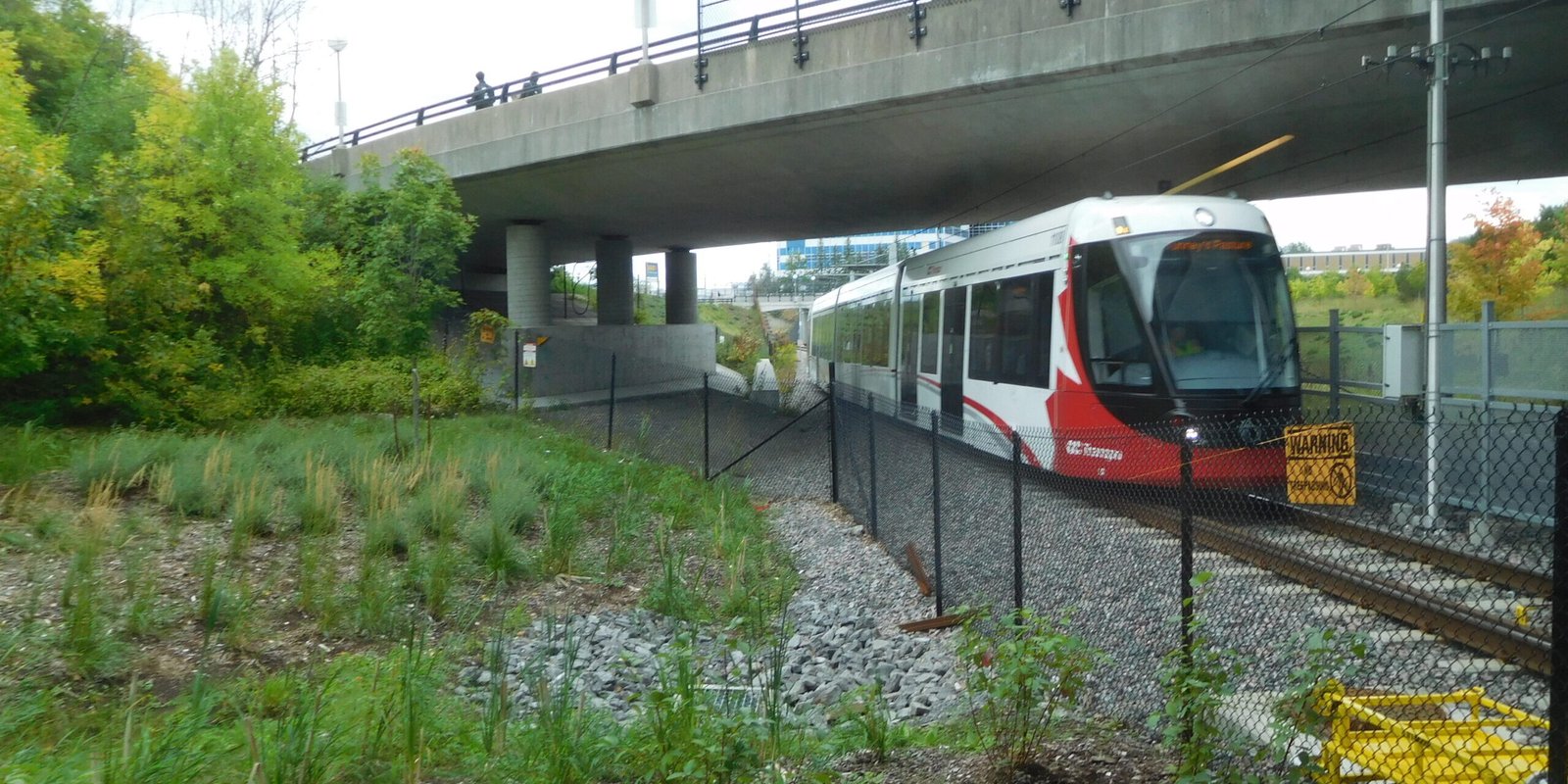
Ottawa’s six-year-old light rail line, Confederation Line 1, is a real-world example of what you get when you assume that private sector competition will magically produce world-class public transit. Line 1 was co-funded by Infrastructure Canada, the Province of Ontario and the City of Ottawa to the tune of just over $2 billion. The 30-year contract for design, construction, operation and maintenance is held by Rideau Transit Group, led by Madrid-based ACS Group, which purchased train cars from Paris-based Alstom.
Line 1 is now a dysfunctional embarrassment, with frequent breakdowns and overall poor service. Train cars and tracks do not align, a problem aggravated by poor design. Four sharp bends exist near the Line 1 crossing of the Rideau River. Even at slow speeds, train car wheel bearings and axles experience rapid wear. Cars are repeatedly taken out of service for repairs.
An existing rail bridge could have provided a direct route across the river but was rejected in favour of a new bridge and the four sharp curves. Line 1 is now being expanded to the east and west without addressing this core problem. Maintenance costs will escalate, unreliability will persist, and commuters will continue to shun public transit, despite having to battle gridlock on highways and bridges.
There are other serious public transit deficiencies in Canada’s capital city. Ottawa’s north-south rail Line 2 reopened last year after delays and a five-year closure. Its southern portion, extended across the Greenbelt into farm fields south of the city, is virtually riderless. A new spur to the airport is also mostly unused, because travelling from downtown requires two transfers.
No rapid transit exists across the Ottawa River connecting Ontario to Quebec. Use of an existing rail bridge–just past the northern terminus of Line 2, where it meets Line 1–was rejected by the mayors of Ottawa and Gatineau, who felt it would bring too many Quebec riders to the system. A Gatineau-Ottawa “tramway” project seems to be going nowhere, with the earliest possible opening date in the mid-2030s.
Hundreds of Gatineau buses head daily across the Ottawa River. A handful of Ottawa buses go the other way. The two systems use incompatible smart cards.
The latest transport infrastructure project in the Canada’s capital is a new Ottawa River crossing for vehicular traffic, downstream from the five existing bridges. This project is well along in the planning stages, although no impact assessment has been launched. Its main rationale appears to be rerouting truck traffic away from downtown areas.
The federal government now seems fixated on high-speed rail from Toronto through Ottawa and Montreal to Quebec City. Better public transit would benefit far more Canadians.
An updated transport policy with a clear goal of improving public transit is long overdue. The policy could enshrine the value of world-class public transit to our country and provide the means to achieve it, including coordinated planning, oversight and funding mechanisms. An initiative such as this would be a real “project of national interest.”
