
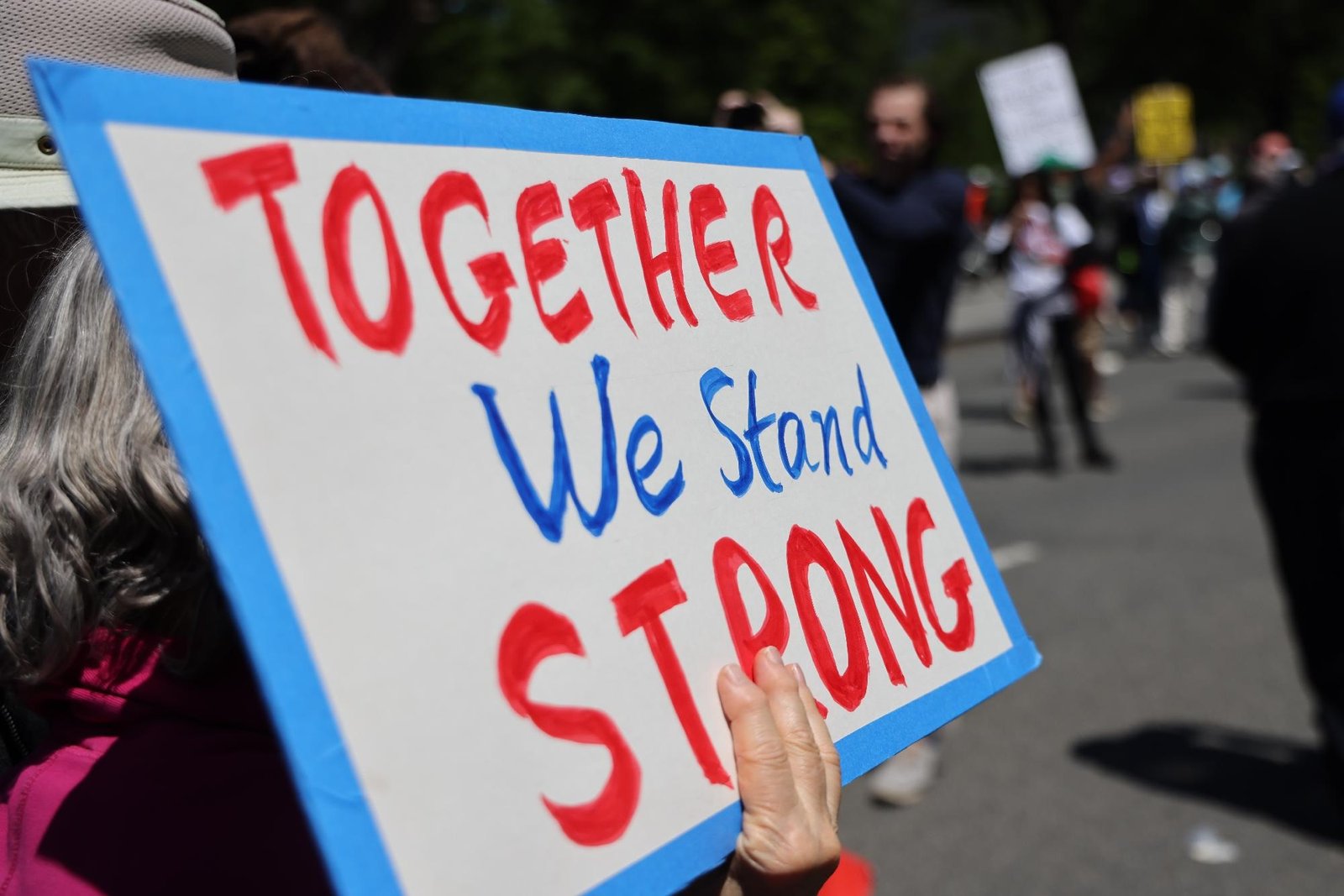
History often has a cruel sense of humour, but not always. Sometimes the joke, or as Deutscher called it, the irony of history, is a happy surprise. Certainly if the attempt by the anti-Trump activist group Indivisible ( the energetic gang that already brought us three impressive No Kings rallies) succeeds in reviving the tactic of the general strike in their May Day Strong organizing and helps bring down the worst president in US history and his wannabe stormtroopers, it would be welcome surprise. The call from Indivisible has been widely endorsed by unions, civil liberties groups, anti war organizations and other elements of civil society. Right wing commentators are alarmed and fall back on red baiting and conspiracy theories. (If you would like to time travel to the era of Joe McCarthy and anti-red witch hunts, just tune in to commentary yesterday and today on FoxNews!) It has also been criticized by some observers on the left as an attempt to co-opt and tame the rising tide of opposition.
On May Day 2026, workers and their allies responded to the call from Indivisible by organizing over 3,000 events across America. From Alaska and Hawaii to Maine and Florida, the streets were full of demonstrators. (Crowd size estimates for May 1 remain contested and under-reported as this column is written, but previous No Kings rallies saw millions of Americans march.)
“Since Inauguration Day, corporate billionaires and the Project 2025 agenda have driven attacks on our rights and freedoms, including by targeting workers based on how we look, the language we speak, or the work we do, and undermining our First Amendment rights and our freedom of association,” New York City Central Labor Council, AFL-CIO President Brendan Griffith said in a statement to Al Jazeera.
In Philadelphia, Sen. Bernie Sanders joined the “Workers over Billionaires” rally hosted by the city’s AFL-CIO chapter.
“Never before in our history have so few had so much wealth while so many Americans are struggling,” he told thousands of supporters in front of Philadelphia’s City Hall. “Never before have so few had so much political power.”
“Trump has poor and working-class people forgetting who our enemies are,” an organizer with the Party for Socialism and Liberation said to the large crowd gathered in New York City’s Union Square.
“Our enemies are not international students that organize on their campus. Our enemies are not undocumented workers that contribute to their communities, that pay taxes and can’t get services. Our enemies are not workers that work for corporations.No – this racist, sexist, anti-worker, homophobic, xenophobic, transphobic system is our enemy,” the organizer said as the crowd cheered in response.
The Indivisible kids did not invent the general strike. It is, in fact, a time honoured tradition in the workers movement- a tactic that recognizes that the ruling class cannot function and continue to control the lives of workers if we simply refuse to keep the wheels of the economy turning.
General strikes have featured in worker struggles around the world for centuries now, and have often played a key role in energizing revolutions and radical reforms from Africa to India to Russia, Canada, the US and India.
Canada has a long and rich history of general strikes, including the Winnipeg General Strike of 1919 and the 1918 general strike in Vancouver responding to the state murder of union organizer Ginger Goodwin and a 1976 nationwide work stoppage to protest wage control legislation.
One source that identifies with the anarchist tradition spells out a little of the history and a lot of the intent of the classic general strike:
“Over the years, general strikes have been called for a wide range of purposes: to halt wars, to topple dictatorships, to demand shorter working hours, to win union recognition, to defend labor and political rights, and to build a new society. General strikes have been held on every continent except Antarctica.
While there have been withdrawals of workers’ labor for as long as there have been exploiters, the first recorded advocacy for a general strike seems to have been in January 1832, when William Benbow published his pamphlet, Grand National Holiday and Congress of the Productive Classes. The very title speaks to the emancipatory vision and power implicit in the general strike–a grand holiday from exploitation, coupled with the constructive work of deciding how society might better be organized.”
In contrast, a mild statement from Indivisible captures what the organizers of this year’s May Day in America had in mind:
“Workers, students, and families will be calling out of work, walking out of school, and refusing to shop as part of the nationwide day of economic disruption. There are many ways you can help make a difference on May Day.”
Notice that the call does not use the powerful term “general strike,” instead invoking the more anodyne cliche “make a difference.” However, this is the closest the current American crisis has come to a widespread mass call for a general strike. The organizers this year may hope to present their tactic as less radical and extreme than a true general strike, and in fact this terminological reticence has prompted some observers on the left to criticize the Indivisible sponsored event as being purposefully too mild mannered to accomplish much.
Citing the union support for May Day Strong, Tom Hall, writing on the World Socialist Web Site, wrote:
“For well over a century, the American union bureaucracy was overwhelmingly hostile to May Day and largely ignored it, instead observing Labor Day as a nationalist and non-political alternative in the fall. This flowed from the bureaucracy’s explicit support for capitalism and its intense anticommunism and “America First” nationalism.If they are now partly changing their tune, it is because they want to get in front of the growing movement to the left, dilute the radicalization and divert it into harmless channels.”
Nevertheless, even the most skeptical observer will acknowledge that organizing a nationwide work stoppage to demand an end to the Trump regime’s war on working people is a positive development. Much, of course, will depend upon how widely the call is answered and how sophisticated the follow up organizing is. Thanks to the hard work of many organizers, May Day marchers this year had the intoxicating experience of popular power and solidarity. Right wing alarmists are right to be nervous. Once we get a taste of real popular power, we are reluctant to go back to the status quo ante. While the May 1 events in the US may not have been the revolution as “festival of the oppressed” celebrated by Lenin and later Germaine Greer, it may well have been a rehearsal and warm up for rebellions yet to come. We live in hope.
