
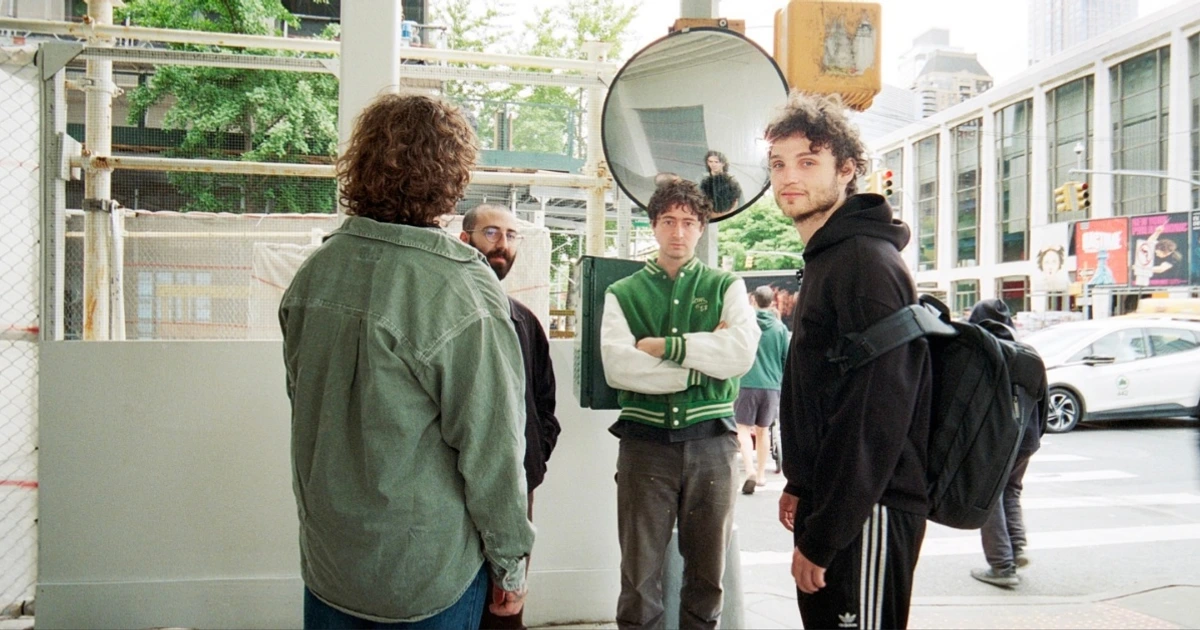
Over the last few years, I have loved a lot of music. But the moments where a sound or set excites me, where the high of experiencing true originality hits — they’re few and far between. With YHWH Nailgun, NYC’s avant-garde quartet — that buzz has yet to wear off, time warped by their idiosyncratic identity, a fusion of industrial sounds, electronics, and visceral poetry.
I wrote this over a year ago, in the wake of YHWH’s debut album, 45 Pounds. There was a charged excitement around them, and what they were doing — live and in the studio — which reminded me of my teenage years going to DIY spaces like ABC No Rio and witnessing powerviolence shows for the first time: terrified, confused, enamoured. Today, as we approach the release of YHWH’s quasi-controversial sophomore effort, Magazine — their 11-minute full-length — my initial review of YHWH rings just as true as it did then, if not more so. In the last month, the band have performed the LP in its brief but muscular entirety a few times, sending some audience members up in arms. On r/indieheads, these frustrated few cling to each other desperately, debating over what constitutes a full-length. One user says an 11-minute album sounds like “a Hard Times headline.” Another replies, “Punk-rock magician doesn’t give a fuck if this is your card.” The argument over what constitutes an album or not, I don’t have time for. However, all intended joking aside, “punk-rock magicians who don’t give a fuck about your card” might be the best and most accurate description of YHWH I’ve seen.
Read more: 26 of the most exciting rising artists to watch in 2026
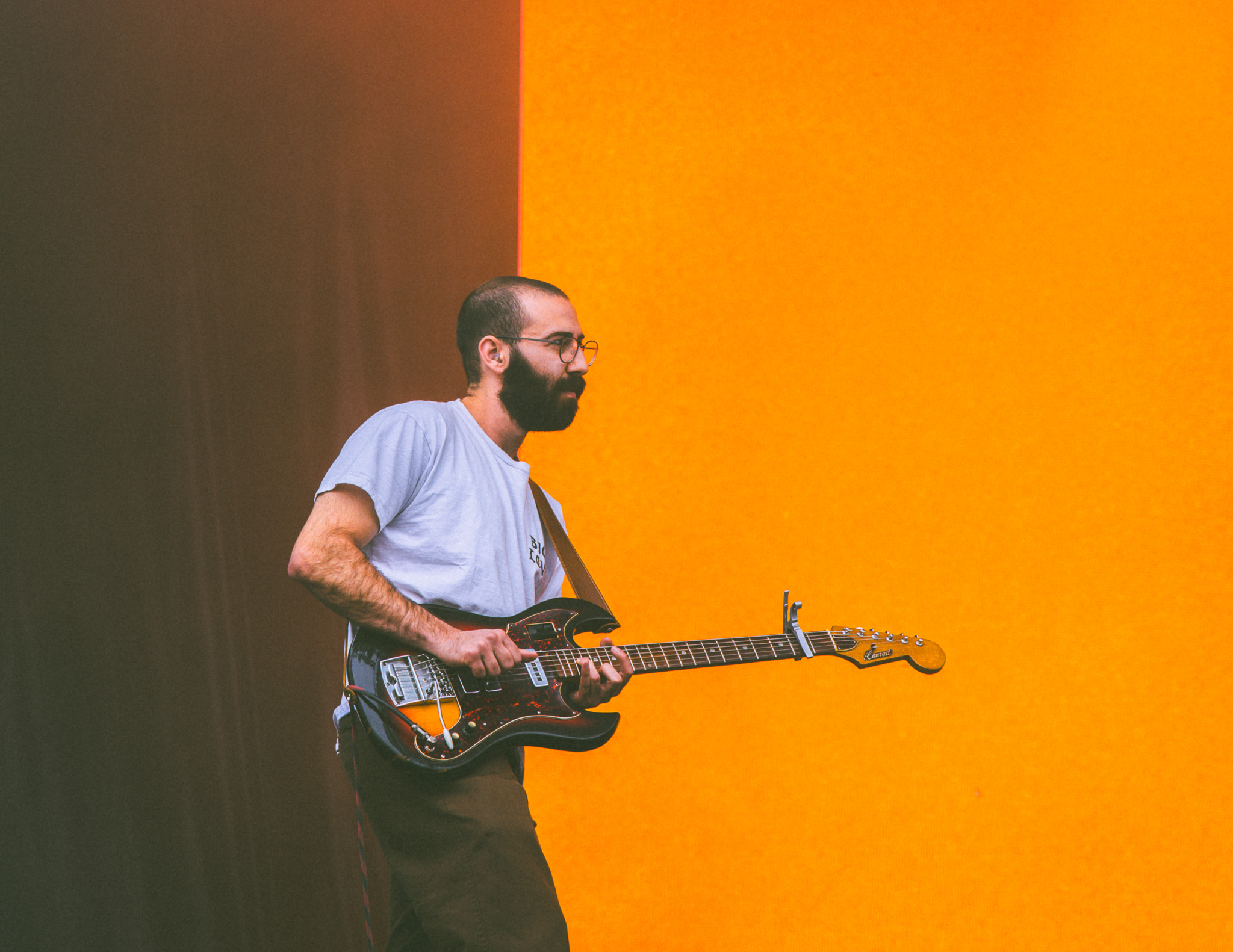
In May, the band and I sat in a circle on the floor of their green room at Kilby Block Party, and dug into their evolving creative process and the new album. It’s a left turn from the lauded 45 Pounds in its length and lack of rototoms, offering a new flavor of their signature ferocity. You may have drawn a card, but the magician has moved on — he’s now pulling an 11-minute album out of a tophat. On Magazine, we see Saguiv Rosenstock — guitarist and producer — take up more space, bringing guitar closer to the foreground. Zack Borzone’s vocals are clearer, the message he carries is more base, leaning into religious narrative — the devil, serpents, blood, God — which he presents in a profoundly stark manner that recalls the American Songbook, if it were brutally stripped to the bone.
YHWH are not a band that try hard. But they are a band that work incredibly hard. They are also deeply heady and philosophical in their process, and have found, like jazz musicians, a bizarre way of being both incredibly intentional and extemporaneously experimental. There’s industry lore around what the sophomore record does, or means for a band. But what drives YHWH is self-knowledge and trust, and that’s made evident. They are grounded in knowing what pulls them, where their interest lies, and the sentiment they want to share — both individually and as a unit. This is crystallized with Magazine, as they tread the roads they want to tread, leaving a map far behind. They arrive at a place full of paradox, with a sound that’s looser and roomier, though timing is tighter and the message is more direct.
In conversation, we touch on the many puzzle pieces that make up Magazine, and YHWH as a whole, which includes their new writing process, amputation, and what they’re listening to: an appropriately eclectic combination of noise, alternative metal, anarcho-punk folk, and transcendental poetry-meets-“Southern nightmare jazz.”
How would you describe the sonic difference between Magazine and 45Pounds?
ZACK BORZONE: It’s scarier. One of the things we put a lot of focus on was making songs, cool songs. That’s why we switched from five to 10 minutes because you can’t really make something that feels more than a fraction of a song in less than a minute.
SAGUIV ROSENSTOCK: It’s a little more guitar-forward, riffs. More restraint.
SAM PICKARD: On my end — we incidentally wound up having a lot of very drum-forward songs on earlier stuff — on this one, I wanted to pull back the density of the songs a little bit, and let a lot of it be built up by the other instruments.
ROSENSTOCK: We’re trying to remove things that seem like they are “what YHWH is” and see what we’re left with, to find out what the band really is. Like removing the rototoms, making songs shorter, changing it from drum-forward to guitar-forward, keeping what is the essence of the band.
And what is the essence of the band?
ROSENSTOCK: I don’t really know. It’s impossible to articulate. I think if you could say what it is… Sorry to give you vague answers.
No, I agree with you, or what I think you’re saying. I feel like if you can answer that question easily, you’re at risk of being easily pigeonholed.
JACK TOBIAS: Not even intentionally. We’re just trying to show a different side. If we were to just do the same thing, we would be labeled as the rototom band or something. But those are just tools. They’re not the actual thing that we make.
PICKARD: When the materials become the center of it, then you are getting caught up in the outer forms of the music, instead of whatever the essential thing is that might be hard to put your finger on, but you know when you see it. We’ll write a song and be like, “Yeah, that’s right. That’s correct for us.”
Was there a lot that got left on the cutting-room floor for this one?
BORZONE: Yeah. There were a few songs early on, but at a certain point, I think it clicked, and we were like, “Now we know,” for some reason. We got rid of all the dregs that were left over from 45 Pounds. We had still been doing 45-style stuff up to a certain point.
TOBIAS: We actually wrote a decent amount of songs until we realized and scrapped them.
PICKARD: We did this weird thing where we’d come up with a song, record it, and then next practice, we wouldn’t touch it again. We would just write something else the next time, not touch that, write something else, not touch that. So then after a couple months or whatever, you go back and you listen to all this stuff you’d recorded. It’s weird. You just forget what you were doing the previous weeks. But there will be this unconscious through line, sound-wise, stuff that courses through the whole thing — and then, you kind of deduce, “Oh, that’s what we’re doing.” You’re like, “I guess this just appears every time we get in the same room.”
What was the process like, literally, around this? Because I know you guys went to a farm for 45 Pounds.
ROSENSTOCK: I went to Studio G for like two days with Hayden [Ticehurst] because it’s so short that we thought we could make it in two days.
BORZONE: A few months later, I tracked vocals separately. It was kind of odd. Typically, I do track vocals separately from the band, but I’ve never not been present for the recording. This is just how it worked out, but it was a step that was good for me, individually, because it forced me to reconcile — fully get to a place of satisfaction without any real validation. For the whole album, it was more pressure than we’ve ever had on anything. So it was really a crazy little period of time I was writing the songs, and then we recorded them together.
It’s kind of like that exquisite corpse game where you fold the paper and someone draws a head, and you pass to the next person who does the torso, and another does the legs. But you can’t see what the previous person drew. You unfold, and it’s this weird creature.
ROSENSTOCK: It was unusual. With 45 Pounds, by the time we were in the studio recording the band, most of the lyrics were already there, so there was more of an idea of what it was. With this, we didn’t know what it was going to be like until a few months later.
You said you conceptualized this while you were making 45 Pounds. Would you say it’s all in reaction to or inspired by what you were doing previously?
ROSENSTOCK: Maybe in the way that you want to keep trying new stuff, but not that much of, “Oh, we did that, so now we’re going to do the opposite.”
BORZONE: I wouldn’t say reactionary. To me, it seemed like a very natural part of our course. It was a fun thing to accept, that this would be the next step for us, because it felt hilarious to me at first. It’s also funny that some people are going to be mad. But it’s not because of that at all that we do it — it’s just a part of finding the right thing and following that. 45 Pounds was power, condensed into small spaces. So, it made a lot of sense to go even further with that because it felt like our little zone, but also, time moves on, and we responded to ourselves — making the songs a little airier and slowing them down in certain cases, and making it more song-heavy and less force and punch. It’s really been interesting playing live, too, because we play the records side by side, and you can really feel the difference of the vibes. It’s a nice way to digest it.
But you also said there was a lot of pressure around this one.
PICKARD: Well, I think there always is, no matter what, in different forms. Sometimes I feel like there’s this silly myth that people have of this momentary inspiration, and you’re making this music in a perfect vacuum, and you’re this singular thing, like rising above the world, making this music. But no matter what, you’re situated within shit, you know what I mean? There was a form of pressure when we started the band, and no one listened to it, too. There’s different forms of pressure — I don’t know if pressure is the right word. There’s different circumstances that push you in different directions as you’re working on something, no matter what. And you just can’t escape that. The cool thing is to be able to work with it and transform it. Sometimes that feels like blocking out certain things, and sometimes it’s things like Zack doing vocals separately — in my mind, I was like, “Let’s just roll with it. It’s an experiment. Let’s see what happens.”
TOBIAS: It’s not that big of a deal.
PICKARD: But it’s a type of pressure. We have to manage these circumstances that we don’t usually, and it’s like, “OK, how does that inform us?” It’s a different experience.
When you are making an album, do you try not to listen to other music? A lot of artists I speak to do that.
TOBIAS: No. I feel like our lives are exactly the same when we’re writing. We go to the practice space, we play, record it, and then we just do what we always do.
PICKARD: I always feel like being too precious about the process… I basically try not to think about the record when we’re not doing it.
BORZONE: Let it be what it is. It’s not far away. The thing that you’re trying to reach is there already. It’s just finding the grammar of it. You’re just trying to relax and interact.
TOBIAS: Probably some people feel like listening to music obscures the thing that’s already there.
Or maybe there’s a fear of being derivative.
TOBIAS: We don’t fear that. It’s also the four of us with different perspectives, interacting in the room. So if I’m listening to reggae and have this dub flair to what I’m doing, it will interact and be very different than what they’re doing with each other, and will create this new thing.
What are you listening to?
TOBIAS: I’ve been listening to the Grouper record.
BORZONE: I’m listening to this guy, Johnny Coley, from Alabama, who just died last year. But his band was these kids, who own a record label called Sweet Wreath. He’s so cool but has this French poet kind of swag, off the cuff, and he makes everything sound like he’s coming up with it on the spot. It’s really funny, has a lot of personality, and he’s got a bunch of records that I’m really excited about.
PICKARD: We’re listening on tour. It’s really good. Jack also put me onto Amps for Christ. When I was younger, I loved Man is the Bastard and Bastard Noise, and it’s the same guy. It’s this really fried freak folk sort of stuff, and he has this album called The People at Large that I’ve been listening to three times a day. I’m fixated on it right now. It took me back to listening to Man is the Bastard, too. I love heavy bands where people have other projects that aren’t heavy. Like, I love the Neurosis guy’s side project. It contextualizes the heavy stuff.
Reminds me of Agriculture.
TOBIAS: Zack and I have this project, Peace Thru Strength, and we did a show with them at Baby’s All Right. It was so fun watching them because I hadn’t really seen them before… I’ve listened to that music a little bit, and we’ve hung out with them, but that set… I was like, “Oh, my God.” Also, Richard, with the long hair — a shredder.
ROSENSTOCK: I was listening to the new Gun Outfit album. It’s awesome.
PICKARD: That’s also the Man is the Bastard guy. He plays in their band sometimes, though it’s not his project.
What was the hardest part about making Magazine?
BORZONE: For me, it was writing.
TOBIAS: It just felt different recording it separately from each other. But we’re going to take experiences from each record and see what feels good for the future.
ROSENSTOCK: The more psychological aspect of making the short songs… When you’re too deep in it, maybe it feels right, but also it might feel right just because you’re too deep in it. I’m like, “Wait, is this a song? Are we being lazy or something?” I don’t feel that we are, but I personally had to check myself on that as we wrote music. “Is this enough?” Because you don’t want to do more than you need, but you also don’t want to do less. There’s a right amount.
PICKARD: Restraint is a lot harder than just having your dick out.
BORZONE: We all use restraint in different ways.
ROSENSTOCK: We talked about playing loose and swagged out a little more. Where 45 Pounds is an assault and in your face, this is laid back and a little drunken.
TOBIAS: The playing is drunk. The album’s still concise. I think every song gets the idea across.
PICKARD: I have a really far from reference, but I just read this book about this guy who is a detective, and he winds up going to this cult where the premise is that it’s this quasi-Christian cult, but they view amputating parts of your body as aestheticism and getting closer to God. Ever since I read that book, I keep thinking about that with music. It’s called Last Days by Brian Evenson. In the book, they’re bad and scary. But it’s just the idea of… I felt like I chopped off body parts recording this album. Even getting rid of the rototoms and it not being just full-blown, maxed-out drumming on every song. On a lot of it, I’m really trying to do way less. I can only speak for myself, but that’s definitely the feeling — almost handicapping yourself in a way, compared to our previous music.
Lastly, can you speak to the album title?
BORZONE: It’s a diptych. On one hand, it’s like a gun magazine, and then on the other hand, it’s images and media. Then there are these branches that evolve above them, trying to put those things together — like images of war. We’re like a pop band now, you know? So it’s kind of like, we were in a magazine last year. To me, the record takes that year and squishes it down into one little space with the songwriting, and also, we worked on all the new music at that time, too. But the song is the one that explains it. I think the song “Magazine” on the record holds all of what the title of the album is.
