
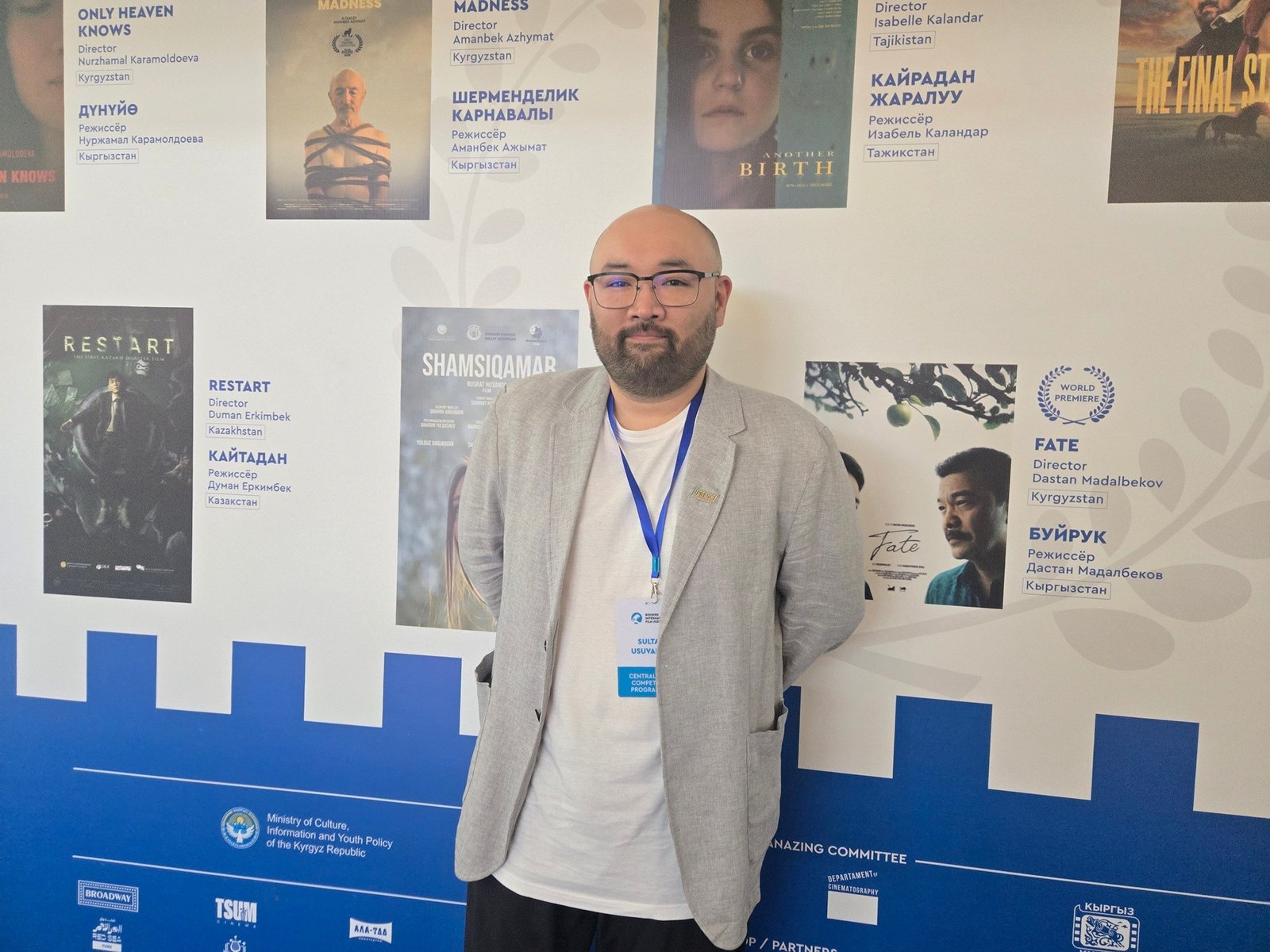
– The festival programmer explains more about his background and the criteria that guided him in selecting films for the regional competition
Now unspooling its fourth edition, the Bishkek International Film Festival is establishing itself as the leading film event in Central Asia, with an increasingly ambitious programme and a competitive section dedicated to the region’s cinema.
The festival takes place in Bishkek, the capital of Kyrgyzstan, and this year doubles down on its core mission: to discover new talent, promote innovative art forms and build a shared cinematic identity among Central Asian countries. We met Sultan Usuvaliev, programmer of the Central Asia Competition and a key figure at the festival since its very beginning.
Cineuropa: Could you introduce yourself and tell us about your background?
Sultan Usuvaliev: I started working with the festival from its very first edition, spending three years as a coordinator of the retrospective programme. Since the beginning of this year, I have taken on the role of programmer for the Central Asia Competition.
You have now reached the fourth edition of the gathering. How has the festival evolved over the years?
I remember the beginning well. My first retrospective programme was dedicated to films based on the works of Chingiz Aitmatov, our great writer. The screenings were held in a tiny room with 28 seats and a small screen at the beautiful Manas Cinema Theatre. Today, the scale of the festival is completely different. The first two editions were still very modest, but the third saw an enormous leap: international experts, guests, jury members, far more films and the launch of the Kyrgyz Box section, dedicated to Kyrgyz mainstream cinema. This year, the Central Asia Competition features nine films, compared to the three in the initial retrospective. The festival has become more precise in its choices, and more careful in selecting jurors and invited guests. The entire structure is designed to support new talent from a region that is still underrepresented on the world stage.
What were your guiding criteria in selecting the Central Asia Competition movies?
We wanted to discover new films, new forms of artistic expression and new talents. If you look at the programme, you will find eight directorial debuts in fiction cinema out of nine films. The ninth, Kharabujur by Kazakh director Kinjibay Dishumbayev, is the work of an established filmmaker, but it is his world premiere, which fully justifies the selection. We have no age restrictions, but we look for new voices and innovative forms – something that goes beyond the traditional. For me, it is also essential to strike a balance between auteur cinema and quality mainstream content. A striking example is the film by Duman Yerkenbiek, a debut feature that grossed over $2.5 million in Kazakhstan: an opening with those numbers is something extraordinary, and we see it as an important signal.
What is your dream for the future?
I want Central Asian cinema to speak with one voice. We are different countries, with different languages, cultural codes and industry rules, but I believe we should come together and present ourselves to the world as a single region. I have seen what happens at international film markets, such as the Marché du Film in Cannes: Kazakhstan, Kyrgyzstan and Uzbekistan all have separate stands. I have heard talk of the idea of a single “Central Asia Cinema” stand, as many African countries do, or the South-East Asian bloc. That would be an important step. But first and foremost, it is a matter of mindset: we need to think of ourselves as one creative hub.
Young Central Asian filmmakers seem to be heavily influenced by European and US cinema. How do you interpret this phenomenon?
It is something I observe with great interest. In Kyrgyz mainstream cinema, there is an extremely strong bond with the local audience: films in the Kyrgyz language and local stories [really connect with audiences], and there are impressive production numbers – this year, around 90 mainstream movies will be released; last year, it was already around 80. But part of the new generation is looking elsewhere: at European, US and Japanese cinema. It is not a case of angling for international audiences; it’s genuine intellectual curiosity. There are directors like Adilhan Mirzhakov, from Kazakhstan, who adapts theoretical books on contemporary horror, and Bigzad Piermatov, from Kyrgyzstan, who, in his only two films, quotes and plays with references from world film culture. These filmmakers are expanding their creative playground, and that is a sign of great cultural maturity for our region.
The festival also has a pitch and development programme. Are there already any films that have come out of those labs?
Yes, there is already a concrete and beautiful example. Heaven Knows by Nurdzamal Karmoldova is a project that went through the CAF Pitch programme, and today, it is having its national premiere in the competition. Seeing a film grow from the labs all the way to the festival screen is exactly the goal we set for ourselves.
