
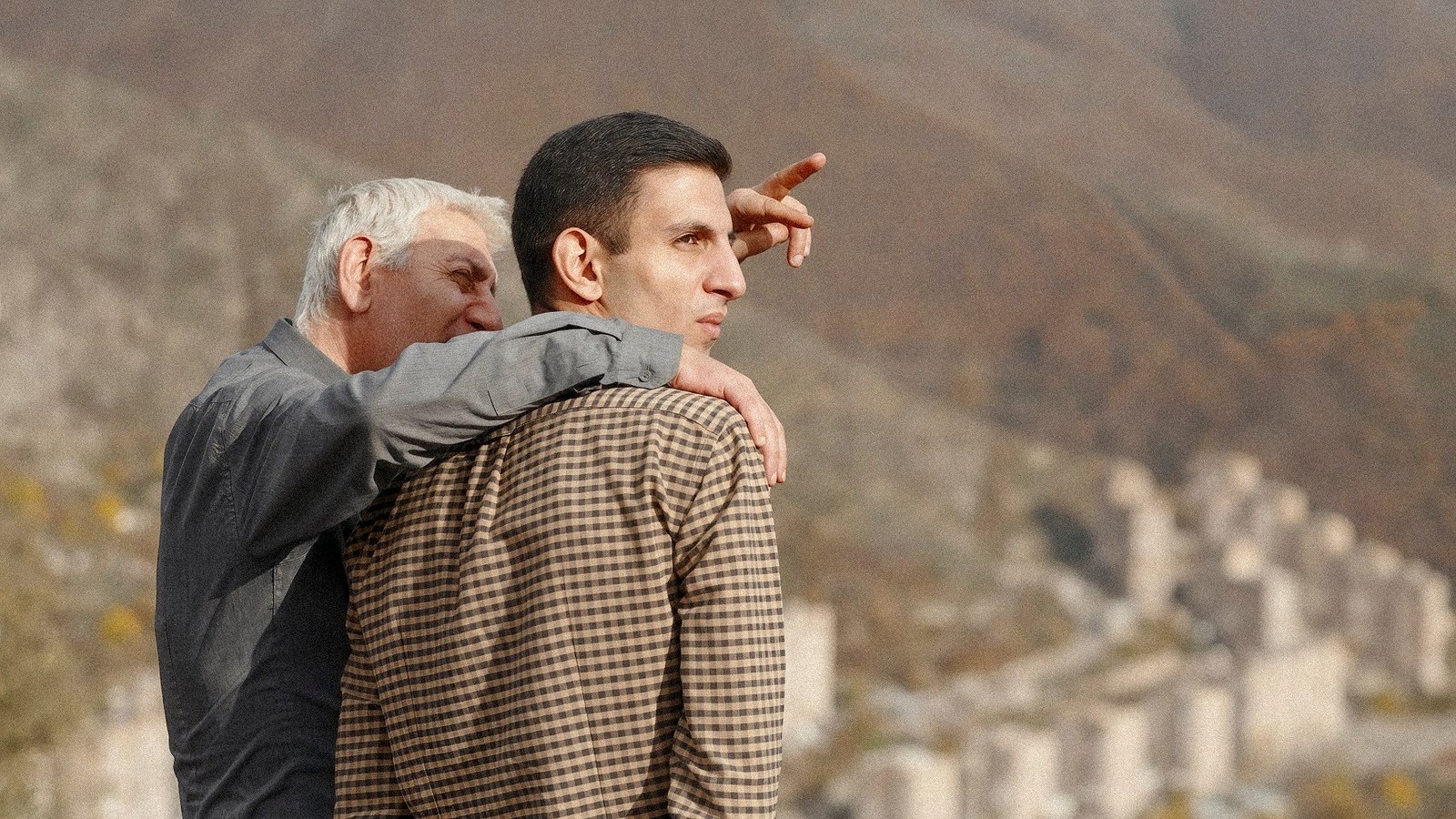
– Marco De Stefanis’ second documentary feature tells the story of a political and family legacy over the course of twelve years of Armenian history
Shant and Shahen Harutyunyan in The Winning Generation
“Son, now you will see with your own eyes what it means to distinguish yourself in war. Don’t dishonour your ancestors”. These words taken from The Odyssey which open The Winning Generation introduce the central theme of Marco De Stefanis’ second documentary feature: legacy. A political, moral and family legacy which spans three generations of the Harutyunyan family and which the director follows over the space of twelve years, interweaving a private story with Armenia’s recent history.
Presented in the international competition in Bologna’s Biografilm following its premiere in Movies That Matter and a stint in the Krakow Festival, the Italian director’s new film accompanies Shahen Harutyunyan from adolescence through to his entry into Armenia’s political arena. When his father, Shant, a long-term opponent of the political regime and a political prisoner, is incarcerated, he passes the baton to his fourteen-year-old son. It marks the beginning of a journey which will see Shahen becoming one of the emerging faces of the new Armenian opposition.
However, The Winning Generation is more than a film about politics; it’s a film about the transmission of values. The struggle for independence and for national sovereignty is explained as a kind of family inheritance. In fact, before Shant, it was Shahen’s grandfather – an exile in the US and an activist for the Armenian cause – who turned political engagement into a kind of existential mission. “My grandfather left me two things: his name and a megaphone”, the protagonist explains, summarising the sense of continuity which the film endlessly conveys.
Despite working with a character who’s naturally inclined towards militant rhetoric, De Stefanis avoids creating a hero. His camera focuses on the everyday reality of activism: gatherings, demonstrations, strategic discussions, social media campaigns… Alongside buzzwords around freedom and national dignity, questions of a more personal nature emerge: how heavily does the family legacy weigh on Shahen’s choices? Is his a genuine vocation or a destiny he’s inherited? And what price is he paying for dedicating his youth to a political cause?
The film allows these questions to emerge without forcing any answers. The relationship between the father and son is, in fact, the emotive beating heart of this work. Between discussions on national history and geopolitical analyses, room is found for simple, almost domestic gestures which convey the loving nature of their bond: a piece of advice, a worry, a “put a jumper on, it’s cold”, which suddenly lend new perspective to the weight of their patriotic rhetoric.
De Stefanis’ approach is predominantly observational. Rather than offering an exhaustive reading of the political situation in Armenia, the director homes in on the way in which it’s experienced by a generation who have grown up amidst conflicts, insecurity and the redefinition of identity. In this sense, the lengthy filming process becomes the film’s main narrative tool: we watch Shahen as he matures, turning teenage anger into a political project.
The film screened in Biografilm just a few days after the parliamentary elections in Armenia on 7 June, which saw Nikol Pashinyan’s party reappointed to government, while Shahen Harutyunyan’s group failed to reach the necessary threshold to gain a seat in parliament. It’s a coincidence which adds another interesting perspective to the film, because over and above the election result, what’s interesting here is the persistence of the act of resisting. “Fighting for an independent Armenia is like try to move a building by blowing on it”, a KGB agent told Shahen’s grandfather in prison. Our young protagonist is still trying today, and it’s this determination which lends the documentary its truest meaning.
The Winning Generation was produced by Dutch firm Bind in co-production with Turin’s EiE Film.
(Translated from Italian)
